What is Best Ball Fantasy Football? A Beginner’s Guide

The fantasy football landscape is constantly changing. What started as a game played between a handful of nerds has evolved into a multi-billion-dollar industry. New ways to play are popping up all the time, providing even more outlets for fantasy addicts to scratch their itch.

These days, some of the biggest yearly prize pools are available in best ball contests. Underdog has a contest this season with a massive $15M prize pool, with $2M slated for first place. Not to be outdone, DraftKings has a contest with a $20M prize pool, with first place taking home $3M. We’re talking about life-changing money for playing a game.

With so much money at stake, it’s understandable if you’re looking to get in on the action for the first time. Let’s dive into all the basics you need to know for the best ball format.

Underdog
Play $5, Get $50 in Bonus Entries!
Must be 18+ (19+ in AL, NE; 19+ in CO for some games; 21+ in AZ, MA, and VA) and present in a state where Underdog Fantasy operates. Terms a...See More
LABSNEWS
Promo Code

What Is Best Ball?

Best ball essentially takes the best part of fantasy football – the draft – and makes it the only thing that matters. There is no in-season management. You don’t have to worry about waivers, trades, or even setting a lineup. You simply draft your team and let things play out.

Each week, your lineup is automatically constructed to give you the highest-scoring possible combination. For example, if you have three quarterbacks on your roster, whichever one scores the most fantasy points automatically becomes your starter. The same happens for every position on your roster across each week of the season.

In the big contests, you start by participating in a 12-team draft. You go through a fantasy “regular season,” and the two teams with the top point total in each league advance to the “playoffs.” The regular season typically lasts through the first 14 weeks, with the playoffs taking place in Weeks 15, 16, and 17.

Once you make it to the playoffs, the whole process starts over. In Week 15, all advancing groups are placed into new leagues. Then it becomes a one-week contest. If you have the highest-scoring team in Week 15, you advance to Week 16. If you can do it again in Week 16, you advance to the Week 17 finals.

The teams that make it all the way to the end have the chance at the big money. The final week essentially becomes a large DFS contest, and the higher you finish on the leaderboard, the more winnings you ultimately secure.
Approaching the Draft

Since there is no in-season management, it goes without saying that nailing the draft is paramount. It’s the only opportunity you’ll have to build your roster, and it needs to last you for the full season.

The good news is that the rosters are a bit deeper than the traditional fantasy league. You’ll get to make 18 selections on Underdog, while you get 20 on DraftKings. You also don’t need to worry about a defense or kicker, so you’ll have all of those selections to allocate to quarterbacks, running backs, wide receivers, and tight ends.

The starting lineup on both Underdog and DraftKings is identical. Each week, you’ll be required to field one quarterback, two running backs, three wide receivers, one flex, and one tight end. That leaves you with eight starters, and you’ll have 10 reserves on Underdog and 12 on DraftKings.

How you choose to allocate each roster spot is up to you. You’ll obviously want to have multiple options at each position, including quarterback and tight end. Even if you have a stud at one of the “onesie” positions, you’ll want a backup to cover the bye week at a bare minimum. The standard roster breakdown for most players looks something like this:

  • Quarterbacks: 2-3
  • Running Backs: 4-8
  • Wide Receivers: 5-10
  • Tight Ends: 2-3

Typically, the positions that you target early in the draft are the positions that you’re going to be “lightest” on. For example, if you draft three running backs in the first four or five rounds, you probably don’t want to waste your later picks on the position. You’re going to need those guys to stay healthy and be productive if you’re going to make a deep run, so you’re better off using your later picks on the other positions.

The same goes for quarterback and tight end. If you end up with someone like Josh Allen or Trey McBride, you may only want to draft two players at those positions. If you don’t land a stud quarterback or tight end, you can approach the position with volume and hope that three (or possibly even four) options can combine to give you a solid score each week. As the saying goes, there’s more than one way to skin a cat, which is partly what makes this format so enjoyable.

Updated on 5/25/26

DraftKings Pick6
Play $5, Get $50 Instantly in Bonus Picks!
Gambling Problem? Call 1-800-GAMBLER. Help is available for problem gambling. Call (888) 789-7777 or visit ccpg.org (CT). 18+ (19+ AL/NE, 21+ AZ/MA/VA). Valid only where Pick6 operates, see dkng.co/pick6states. Void in NY, ONT, and where prohibited. Eligibility restrictions apply. 1 per new DraftKings customer. First $5+ paid Pick Set to receive max. $50 issued as non-withdrawable Bonus Picks that expire in 14 days (336 hours). Ends 6/19/26 at 11:59 PM ET. Terms: pick6.draftkings.com/promos. Sponsored by DraftKings. Sponsored by DK.

Best Ball Scoring

As mentioned above, your starting lineup is automatically constructed each week from the players that are on your roster. However, you should still know how your lineup is being selected.

There is plenty of overlap in the scoring settings between DraftKings and Underdog. Both sites award four points for a passing touchdown and six points for a rushing/receiving touchdown. They also award 0.04 points per passing yard and 0.1 points per rushing/receiving yard. Players are also dinged -1.0 points for an interception. Those are pretty standard across most fantasy leagues. 

However, there are also a few key differences between the two sites. Underdog uses 0.5-PPR scoring, while DraftKings is full PPR. That gives a clear edge to players who catch passes.

DraftKings also awards three-point bonuses for players who eclipse 300 passing yards or 100 rushing/receiving yards. It’s an identical scoring system to what DraftKings offers for their DFS contests, so if you’ve played those, you should already be familiar with it.

Finally, Underdog is a bit harsher towards fumbles. DraftKings only docks ball-carriers -1.0 points for a fumble, but Underdog is at -2.0.

Other Best Ball Concepts to Know

We’ll have more in-depth articles about these concepts coming soon, but these are just a few things to keep in mind if you’re just getting started.

Bye Weeks

Bye weeks are absolutely massive in best-ball formats. You simply cannot afford to take a zero in your lineup at any point in the season. That means that if your starting quarterback has a Week 9 bye, you cannot draft just one backup with a Week 9 bye.

It’s a bit harder to navigate at the positions where you’re drafting a lot of players. You will almost certainly have some bye overlap between your running backs and receivers, but trying to mitigate when your best players are on the bench can be a good tiebreaker. For example, if you’re debating between two running backs early in the draft, if one shares a bye week with a running back you already drafted, it can push you in the direction of the other player.

Stacking

Stacking has become basically mandatory in best ball, and it can be accomplished in multiple ways.

The most straightforward process is simply matching your quarterbacks with multiple pass-catchers. Ideally, you’ll be able to grab a top receiving option for each of your quarterbacks, as well as a potential “differentiator.”

Remember, if you make it to the final week of the season, you’ll be going up against hundreds of teams in a DFS-style contest. If you’ve ridden a stack of Patrick Mahomes and Rashee Rice to that point, you can bet that there will be lots of other teams with the same stack that you’re competing against. But if you also grabbed Tyquan Thornton with one of your last picks? He could be the difference-maker if he pops off in the finals. Even if Thornton doesn’t give you consistent production during the regular season, he would be worth his weight in gold if he delivers when it matters most.

Another concept that has gained popularity in recent years is game stacking. Specifically, you’re looking to target teams that are facing each other in Week 17. Theoretically, if you can land both sides of a game that turns into a shootout, that would propel you up the leaderboard in the championship round.

Building a Portfolio

Just like in DFS, you’re not limited to just one entry in these contests. You can enter up to 150 lineups on both DraftKings and Underdog, so keeping track of your player “exposures” is important.

If you’re only going to have a few entries in these contests, you can simply draft whoever you think are the best players. But if you’re going to look to get closer to the full 150 entries, you’ll want to try to get a little bit of everyone. Specifically, you’re going to want to make sure that you have all your bases covered with the players going in the earlier rounds.

If you are going to “plant a flag” on a player, it’s best to do so with a later round selection. For example, if you think that a receiver typically going in the 14th round is going to finish as a top-15 option at the position, loading up on him is totally advisable. I still wouldn’t go “all-in” on someone, but having a late-round selection in something like 50% of your lineups is doable.

Ultimately, it comes down to risk tolerance. The more you diversify your portfolio, the more likely you are to advance at least a few teams to the playoff rounds.

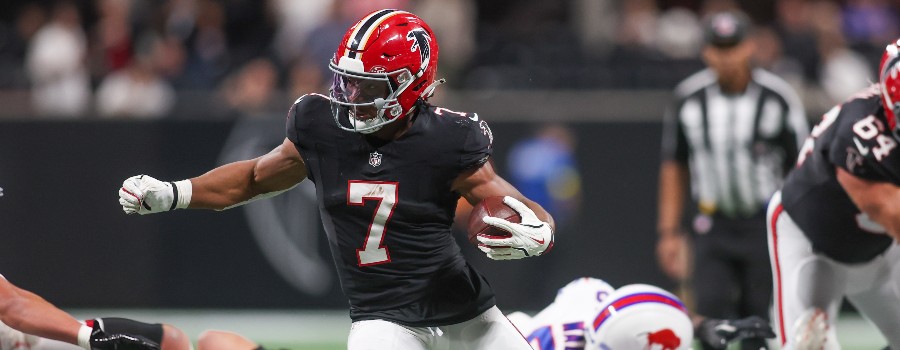
Pictured: Bijan Robinson
Photo Credit: Imagn

The fantasy football landscape is constantly changing. What started as a game played between a handful of nerds has evolved into a multi-billion-dollar industry. New ways to play are popping up all the time, providing even more outlets for fantasy addicts to scratch their itch.

These days, some of the biggest yearly prize pools are available in best ball contests. Underdog has a contest this season with a massive $15M prize pool, with $2M slated for first place. Not to be outdone, DraftKings has a contest with a $20M prize pool, with first place taking home $3M. We’re talking about life-changing money for playing a game.

With so much money at stake, it’s understandable if you’re looking to get in on the action for the first time. Let’s dive into all the basics you need to know for the best ball format.

Underdog
Play $5, Get $50 in Bonus Entries!
Must be 18+ (19+ in AL, NE; 19+ in CO for some games; 21+ in AZ, MA, and VA) and present in a state where Underdog Fantasy operates. Terms a...See More
LABSNEWS
Promo Code

What Is Best Ball?

Best ball essentially takes the best part of fantasy football – the draft – and makes it the only thing that matters. There is no in-season management. You don’t have to worry about waivers, trades, or even setting a lineup. You simply draft your team and let things play out.

Each week, your lineup is automatically constructed to give you the highest-scoring possible combination. For example, if you have three quarterbacks on your roster, whichever one scores the most fantasy points automatically becomes your starter. The same happens for every position on your roster across each week of the season.

In the big contests, you start by participating in a 12-team draft. You go through a fantasy “regular season,” and the two teams with the top point total in each league advance to the “playoffs.” The regular season typically lasts through the first 14 weeks, with the playoffs taking place in Weeks 15, 16, and 17.

Once you make it to the playoffs, the whole process starts over. In Week 15, all advancing groups are placed into new leagues. Then it becomes a one-week contest. If you have the highest-scoring team in Week 15, you advance to Week 16. If you can do it again in Week 16, you advance to the Week 17 finals.

The teams that make it all the way to the end have the chance at the big money. The final week essentially becomes a large DFS contest, and the higher you finish on the leaderboard, the more winnings you ultimately secure.

Approaching the Draft

Since there is no in-season management, it goes without saying that nailing the draft is paramount. It’s the only opportunity you’ll have to build your roster, and it needs to last you for the full season.

The good news is that the rosters are a bit deeper than the traditional fantasy league. You’ll get to make 18 selections on Underdog, while you get 20 on DraftKings. You also don’t need to worry about a defense or kicker, so you’ll have all of those selections to allocate to quarterbacks, running backs, wide receivers, and tight ends.

The starting lineup on both Underdog and DraftKings is identical. Each week, you’ll be required to field one quarterback, two running backs, three wide receivers, one flex, and one tight end. That leaves you with eight starters, and you’ll have 10 reserves on Underdog and 12 on DraftKings.

How you choose to allocate each roster spot is up to you. You’ll obviously want to have multiple options at each position, including quarterback and tight end. Even if you have a stud at one of the “onesie” positions, you’ll want a backup to cover the bye week at a bare minimum. The standard roster breakdown for most players looks something like this:

  • Quarterbacks: 2-3
  • Running Backs: 4-8
  • Wide Receivers: 5-10
  • Tight Ends: 2-3

Typically, the positions that you target early in the draft are the positions that you’re going to be “lightest” on. For example, if you draft three running backs in the first four or five rounds, you probably don’t want to waste your later picks on the position. You’re going to need those guys to stay healthy and be productive if you’re going to make a deep run, so you’re better off using your later picks on the other positions.

The same goes for quarterback and tight end. If you end up with someone like Josh Allen or Trey McBride, you may only want to draft two players at those positions. If you don’t land a stud quarterback or tight end, you can approach the position with volume and hope that three (or possibly even four) options can combine to give you a solid score each week. As the saying goes, there’s more than one way to skin a cat, which is partly what makes this format so enjoyable.

Updated on 5/25/26

DraftKings Pick6
Play $5, Get $50 Instantly in Bonus Picks!
Gambling Problem? Call 1-800-GAMBLER. Help is available for problem gambling. Call (888) 789-7777 or visit ccpg.org (CT). 18+ (19+ AL/NE, 21+ AZ/MA/VA). Valid only where Pick6 operates, see dkng.co/pick6states. Void in NY, ONT, and where prohibited. Eligibility restrictions apply. 1 per new DraftKings customer. First $5+ paid Pick Set to receive max. $50 issued as non-withdrawable Bonus Picks that expire in 14 days (336 hours). Ends 6/19/26 at 11:59 PM ET. Terms: pick6.draftkings.com/promos. Sponsored by DraftKings. Sponsored by DK.

Best Ball Scoring

As mentioned above, your starting lineup is automatically constructed each week from the players that are on your roster. However, you should still know how your lineup is being selected.

There is plenty of overlap in the scoring settings between DraftKings and Underdog. Both sites award four points for a passing touchdown and six points for a rushing/receiving touchdown. They also award 0.04 points per passing yard and 0.1 points per rushing/receiving yard. Players are also dinged -1.0 points for an interception. Those are pretty standard across most fantasy leagues. 

However, there are also a few key differences between the two sites. Underdog uses 0.5-PPR scoring, while DraftKings is full PPR. That gives a clear edge to players who catch passes.

DraftKings also awards three-point bonuses for players who eclipse 300 passing yards or 100 rushing/receiving yards. It’s an identical scoring system to what DraftKings offers for their DFS contests, so if you’ve played those, you should already be familiar with it.

Finally, Underdog is a bit harsher towards fumbles. DraftKings only docks ball-carriers -1.0 points for a fumble, but Underdog is at -2.0.

Other Best Ball Concepts to Know

We’ll have more in-depth articles about these concepts coming soon, but these are just a few things to keep in mind if you’re just getting started.

Bye Weeks

Bye weeks are absolutely massive in best-ball formats. You simply cannot afford to take a zero in your lineup at any point in the season. That means that if your starting quarterback has a Week 9 bye, you cannot draft just one backup with a Week 9 bye.

It’s a bit harder to navigate at the positions where you’re drafting a lot of players. You will almost certainly have some bye overlap between your running backs and receivers, but trying to mitigate when your best players are on the bench can be a good tiebreaker. For example, if you’re debating between two running backs early in the draft, if one shares a bye week with a running back you already drafted, it can push you in the direction of the other player.

Stacking

Stacking has become basically mandatory in best ball, and it can be accomplished in multiple ways.

The most straightforward process is simply matching your quarterbacks with multiple pass-catchers. Ideally, you’ll be able to grab a top receiving option for each of your quarterbacks, as well as a potential “differentiator.”

Remember, if you make it to the final week of the season, you’ll be going up against hundreds of teams in a DFS-style contest. If you’ve ridden a stack of Patrick Mahomes and Rashee Rice to that point, you can bet that there will be lots of other teams with the same stack that you’re competing against. But if you also grabbed Tyquan Thornton with one of your last picks? He could be the difference-maker if he pops off in the finals. Even if Thornton doesn’t give you consistent production during the regular season, he would be worth his weight in gold if he delivers when it matters most.

Another concept that has gained popularity in recent years is game stacking. Specifically, you’re looking to target teams that are facing each other in Week 17. Theoretically, if you can land both sides of a game that turns into a shootout, that would propel you up the leaderboard in the championship round.

Building a Portfolio

Just like in DFS, you’re not limited to just one entry in these contests. You can enter up to 150 lineups on both DraftKings and Underdog, so keeping track of your player “exposures” is important.

If you’re only going to have a few entries in these contests, you can simply draft whoever you think are the best players. But if you’re going to look to get closer to the full 150 entries, you’ll want to try to get a little bit of everyone. Specifically, you’re going to want to make sure that you have all your bases covered with the players going in the earlier rounds.

If you are going to “plant a flag” on a player, it’s best to do so with a later round selection. For example, if you think that a receiver typically going in the 14th round is going to finish as a top-15 option at the position, loading up on him is totally advisable. I still wouldn’t go “all-in” on someone, but having a late-round selection in something like 50% of your lineups is doable.

Ultimately, it comes down to risk tolerance. The more you diversify your portfolio, the more likely you are to advance at least a few teams to the playoff rounds.

Pictured: Bijan Robinson
Photo Credit: Imagn