Fantasy football continues to grow on a yearly basis. ESPN reported an increase of more than 1 million fantasy football players last season for the fourth consecutive year.
The way that people play fantasy football is also changing. Daily Fantasy Sports gave people the opportunity to win life-changing money, but only over the course of a single week.

Best Ball is the marriage between traditional fantasy football and DFS. Your lineup lasts over the course of a full season, but you still have the potential to take home seven-figure prize pools. It has removed the in-season management aspect of fantasy. There are no waivers, trades, or setting lineups; you simply draft your team and hope for the best.
With Best Ball becoming increasingly popular, two major companies have emerged as the leading sites to play on: Underdog and DraftKings. And while the goal remains the same on both sites – draft a lineup that can win first place – there are some key differences between the two.
Let’s dive into everything you need to know about DraftKings vs. Underdog Best Ball.
Be sure to check out all the updates we made for the 2026-2027 NFL season to our Season-Long, Best Ball, and Survivor tools.
Roster Construction & Scoring Settings
To start, make sure to check out my Best Ball primer if you’re looking for all the basics. Essentially, each team starts in a 12-team league with a 14-week regular season, and the top two teams in each league advance to the playoffs.
The first big difference between DraftKings and Underdog starts with the draft. DraftKings features 20 rounds, while Underdog is merely 18. The starting lineup requirements for the major tournaments are identical on both sites – one QB, two RBs, three WRs, one TE, and one Flex – so you’ll have two additional bench spots to work with on DraftKings.
That results in more roster flexibility. You can allocate those spots to whatever positions you choose. Rosters that might only take two quarterbacks or tight ends on Underdog can add a third player at those positions, or you could choose to add additional dart throws at running back and receiver. It results in a deeper player pool overall, with 24 additional players being selected in each draft.
The two sites also feature some key scoring differences. DraftKings Best Ball contests are scored in exactly the same way as their DFS contests. That means that it is full PPR scoring, with three-point bonuses for 100+ rushing or receiving yards and 300+ passing yards. Underdog only gives out 0.5 points per reception with no yardage bonuses. As a result, players with more pass-catching upside are more valuable on DraftKings.
Finally, fumbles are more heavily penalized on Underdog. A lost fumble will net you -2.0 points on Underdog, but it will cost just -1.0 on DraftKings. Fumble luck is nearly impossible to predict, but players who have historically put the ball on the turf more frequently can be slightly dinged on Underdog.
ADP
The slightly different scoring settings and user pools will result in slightly different ADPs across both sites. Fortunately, this is where our Best Ball tool can come in handy. Not only does it include our experts’ rankings for the format, but it also features ADP for both Underdog and DraftKings.
You can use that information to take advantage of certain discrepancies if you’re playing on both sites. For example, Josh Allen is the top quarterback on both sites, but he’s coming off with an ADP of 33.4 on Underdog. His ADP checks in at 26.09 on DraftKings, so he’s going to cost you more there. With that in mind, getting exposure to the Bills’ QB on Underdog makes more sense than doing so on DK.
You can use the tool to find a bunch of players at different costs and create a game plan for how best to attack them.

User Base & Contest Type
This may not seem like a huge difference, but it’s something to definitely keep in mind. Underdog burst onto the scene and quickly gained popularity for their Best Ball formats. People signed up on that site almost exclusively for their Best Ball tournaments, so the player base there is typically well-versed in the format.
That isn’t always the case on DraftKings. There are still plenty of really sharp drafters on that site, but DraftKings is a massive company with lots of different products. There could be some DFS players or sports bettors who dip their toes in the Best Ball waters that aren’t quite sure what they’re signing up for. With that in mind, I would lean towards DraftKings as my platform of choice if I were only going to play on one site.
There are also some differences in the contest types. Both sites feature one marquee tournament that costs $25 to enter and allows up to 150 entries: Best Ball Mania (Underdog) and the Best Ball Millionaire (DraftKings). However, the DraftKings tournament is slightly larger. It has a $20M total prize pool, while Underdog is at $15M.
The way those figures are paid out is also a bit different. On DraftKings, all of the money is allocated to the players who make it all the way to Week 17. On Underdog, there is some money handed out to the best regular-season teams along the way. The highest-scoring team will take home $100,000, while the top 1,000 teams overall will get something for their troubles.
Because DraftKings isn’t giving out regular-season prizes, they have significantly larger payouts at the end. The top three teams in Week 17 will all get seven figures, while every team that advances earns at least $1,250.
Finally, it’s worth looking at some of the smaller contests on both sites. DraftKings features more single-entry and three-entry max tournaments, which are better suited for those who aren’t looking to fire 150 teams. DraftKings also features a $3, 20-entry tournament called the Play-Action, which is another great option for those who don’t want to spend an entire summer drafting. You can get the maximum number of teams for just $60 total and not have to worry about going up against a 150-entry whale.
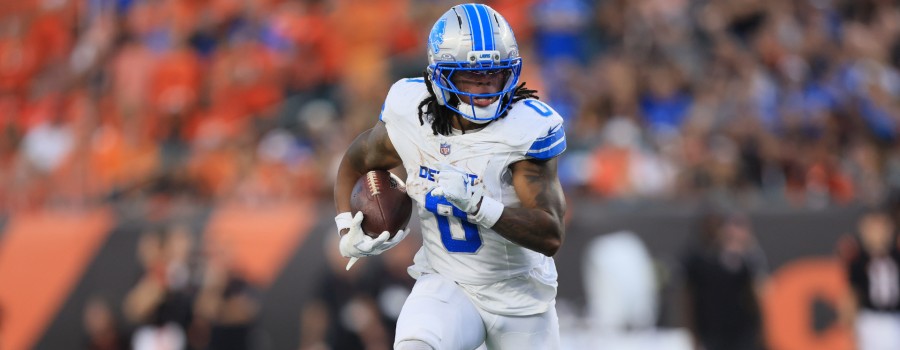
Pictured: Jahmyr Gibbs
Photo Credit: Imagn
YOU MAY ALSO LIKE
 Christmas Day NFL DFS Top Model Picks and Value Plays on DraftKings and FanDuel
 NFL DFS Showdown Picks Breakdown for Broncos vs. Chiefs – Christmas Day (12/25)
 NFL DFS Showdown Picks Breakdown for Bears vs. 49ers Sunday Night Football (12/28)
 Week 18 NFL DFS TE Breakdown: Top Cash Game and Tournament Picks