Before we dive into my QB Tiers, here is a quick reminder on how league format can change QB strategy.
2QB / Superflex Leagues
This is where the biggest QB value spike occurs. With every team needing at least two starting QBs and only 32 available at any time, scarcity drives QBs up the board fast. It’s common to see multiple QBs come off the board in Round 1. If you wait too long, you might be left without 2–3 Week 1 starters, which is not ideal. In these formats, it’s critical to have 2–3 starting QBs at any given time.
4-Point vs. 6-Point Passing TDs
Dual-threat QBs are borderline cheat codes in 4-point leagues, thanks to their rushing stats providing higher weekly floors and ceilings. But if your league uses 6-point passing TDs, it slightly boosts pocket passers like Tua Tagovailoa or Dak Prescott, while dual-threats like Jalen Hurts or Kyler Murray take a small hit. Our customizable scoring tools allow you to tweak projections for this setting, but I’ll be sticking with the standard 4-point format for these tiers.

Best Ball Formats
Best Ball leagues usually have you draft 2–3 QBs, but since only the top weekly score counts, most drafts treat QB value similarly to 1-QB leagues. The biggest difference? You can’t stream, so long-term outlook and stacking are more relevant to best-ball formats. It’s ideal to pair your QB with 1–3 of his pass catchers to maximize your team’s ceiling. So if you’ve already drafted Nico Collins or Puka Nacua, that may influence whether you grab C.J. Stroud or Matthew Stafford later in the draft if either QB is sitting there right around when they typically go.
Season-Long H2H, 12-Team, 1-QB Leagues
This is the most common format and the one that gives you the most flexibility at QB. It’s also the format where you can most reasonably “punt” the position. Why? Because the waiver wire is your friend. Most leagues will have 10+ starting QBs available at any given time. That means if you miss out on a top-tier guy, you can play matchups, stream the position early on, and still end up with a long-term QB1.
I’ve done this countless times. You start out streaming, then stumble into a breakout like Bo Nix (who was widely available to start last season) and ride him to a top-10 finish. The worst-case scenario is that you stream all year, which still usually lands you around a QB15 outcome. But more often than not, you’ll end up with someone startable for the rest of the season. This flexibility is what makes punting QB viable.
Bottom Line
There’s no one-size-fits-all QB strategy. You can win your league by drafting a QB in Round 3, Round 9, or after Round 12. It all depends on your format, draft flow, and how well you navigate value.
Another wrinkle when it comes to Best Ball specifically is that every week, it takes your top score at QB. So if you have 2–3 QBs and all 2–3 have top-10 scores, it’s only going to use the top score. In a perfect world, every week you will have a ceiling game from at least one of your QBs and won’t mind if the other 1–2 have a dud or are on bye. It doesn’t always work out that way because of variance.
The QB position specifically is not only the highest-scoring position but also has a ton of variance week to week. It’s also the position where we see the widest range of outcomes. Some QBs specialize in offering a high weekly floor at the expense of spiked weeks, and vice versa. That’s why I created a Best Ball Points Added (BBPA) metric, where I try to estimate how many “Best Ball Points Added” a QB offers every week.
With 32 starting QBs providing stats every week, the metric isn’t based on simply being above the league average. Instead, it awards how many points above roughly QB12 a player scores for that week. That’s sort of the sweet spot when it comes to Best Ball, as you benefit more from a QB providing “spiked” weeks as opposed to just churning out average scores. But having a QB consistently churn out high-floor scores can help if paired with a volatile QB who has a wide range of weekly outcomes, providing a safety net if that QB has a dud. You can also pair up two volatile QBs and simply hope they have fewer spiked weeks at the same time and can alternate in a way that maximizes both. There is no way to really know when each QB will have his spiked weeks, so treat this as much more art than science.
I have my main BBPA stat, which is the cumulative score of BBPA, but I think the best way to assess how much value a QB could provide is looking at it per game (BBPA/G), since QBs who suffered unfortunate injury luck can have their overall score hurt. A perfect example would be Brock Purdy, who finished 12th in overall BBPA but 2nd in BBPA/G. That doesn’t mean I think he would have been the QB2 overall had he simply been healthy for all 17 games, as he surely would have regressed closer to his expected average the more games he played. But it’s a good way to see which QBs the market might be overlooking, like Purdy.

I also have columns that show the percentage of time a QB posted a top-5, top-12, or top-24 week. This is the best way to see which QBs were providing true spiked weeks (top-5 scores), which were providing a solid floor (top 24), and what I consider to be the “sweet spot” of ceiling/floor value, which is top-12 scores and the foundation of BBPA.
A few caveats, though. This isn’t just raw data being dumped in your lap. I did take the liberty of carefully manipulating it how I see fit, where it’s not simply based on raw top-5, top-12, or top-24 scores that week. While it might seem “fair” to do it that way, you are introducing a ton of variance that really doesn’t help us out much. A QB’s actual weekly rank depends on a ton of things outside of his control, including how many teams were on bye that week, the strength of the defenses that week, weather, and how other QBs performed that week. I try to filter out all the noise and assign top-5, top-12, and top-24 score “grades” based on how that QB performed that week. In the end, it’s designed to all even out, but in a way that better assesses how that specific QB played, which should be our ultimate goal.
Plus, I removed weeks where the QB left the game early due to injury or came in later in the game because the starter went down. Those types of games can really pollute the data and how we analyze it, so I tried to only include scores for QBs when they played “most” of the game. I also omitted Week 18 because it’s such a volatile/tricky week and one that most sites, especially best-ball sites, do not use. So it makes sense to simply not include those scores.
So you can see how I carefully cleaned up the data in a way where the sole purpose is for us to better assess what I’m trying to achieve without needing a ton of caveats. I tried to remove the caveats altogether.
As always, I’m basing my commentary around a 12-team, 0.5 PPR, 4-point passing TD league that starts QB/RB/RB/WR/WR/WR/Flex/K/DEF.
I’m well aware no two leagues are exactly the same, and your format may have wrinkles that change the value of certain positions. 0 points for a reception? Derrick Henry becomes more valuable. Full PPR? Derrick Henry becomes less valuable. 6 points for a passing TD? Dak Prescott gets a boost, while Malik Willis takes a hit. Only start 2 WR? Getting multiple WRs early becomes less urgent. 10-team league? Onesie positions like QB/TE become a bit less valuable because the waiver wire is even deeper. 14+ teams? QB/TE become more valuable because the waiver wire gets thinner. Start 2QB? Well, QB becomes WAY more valuable.
Without further ado, here are my BBPA scores from 2025, and now, onto the tiers.
Tier 1
- Josh Allen
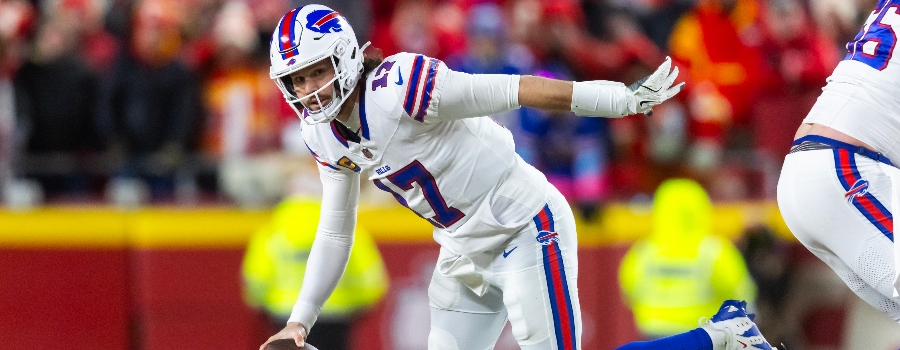
Allen deserves to have Tier 1 all to himself, as he has proven time and time again to be one of the most durable and consistent players in all of fantasy. He has finished top 3 at his position for 6 straight seasons, which is remarkable considering how much he uses his legs and exposes himself to big hits. But he has mastered the ability to avoid injury thanks to technique, size, and sheer grit. There’s almost nothing left to say about him that everyone doesn’t already know, but entering his age-30 season, I’m expecting him to continue to maybe be closer to the tail end of his peak. There’s no reason to expect him to slow down anytime soon.
You can view all of my updated Best Ball and Season-Long Fantasy Football Rankings here.
Adding DJ Moore to the mix should only help boost the offense overall. The only real question is: should you take him as the 1st QB overall? I think you absolutely can, and should, in spots in best-ball formats, especially if he falls past his 33.5 ADP overall and you are in position to grab him. The only real knock with him is that he’s trickier to “stack,” considering he tends to spread it around and scores 10+ TDs with his legs (which lowers the TD upside of his pass catchers). James Cook is in direct competition with those short-yardage scores, making him sort of anti-correlated with Allen, but the good news is you can usually get Moore, Shakir, and Kincaid fairly cheap to pair with him. You can also take late-round gambles on Palmer, Coleman, or Bell types.
Either way, taking a near lock to finish in the top 3 at the position is usually worth elite draft capital, so being able to get him in the 30–35 range is absolutely warranted.
Tier 2
YOU MAY ALSO LIKE