There is no shortage of ways to play fantasy football. Traditional redraft leagues remain the gold standard, but other formats have popped up to challenge them in recent years. We’re certainly no strangers to daily fantasy football here at Fantasy Labs, and this year, we’re diving more into the Best Ball streets as well. Our new Best Ball tool combines our expert rankings, ADP, and a stacking feature, which helps you increase the correlation in your lineups.
If you’ve played in redraft leagues in the past but are looking to try out Best Ball for the first time, fear not. In this article, we’re going to look at some of the key differences between the two formulas and how to apply them to your drafts.
Be sure to check out all the updates we made for the 2026-2027 NFL season to our Season-Long, Best Ball, and Survivor tools.
Draft for the “Best Case” Scenario
In traditional fantasy football, you cannot win your league during the draft. Sure, having a great draft definitely helps, but you have plenty of tools at your disposal to improve your roster throughout the year. If your top running back gets hurt, you can look to the waiver wire or trade market to try to replace his production.
You have no such luxury in Best Ball. The draft is legitimately the only way to add players to your roster. If your top pick goes down in that format, you’re basically SOL.
With that in mind, you need to look at each team you draft in terms of its “best case” outlook. You’re going to need your top players to stay healthy and productive in order to have a chance, so it’s not worth thinking about scenarios where any of those players go down.
That makes something like “handcuffing” your top picks a big no-no. For example, if you select Bijan Robinson with your first pick, you would not want to put Brian Robinson Jr. on the same roster. If Bijan gets hurt, your chances of competing with every team in the format are basically non-existent, so it doesn’t matter what type of production the backup gives you in his stead.
Instead, you’ll want to use your bench spots on backups for players that aren’t on your roster. Go back to that same example. If you have Brian Robinson Jr. on a team where you drafted Jahmyr Gibbs, now you have two players who can potentially propel you up the standings.
This type of thinking can also be applied to positional construction. In Best Ball leagues, you want your rosters to be fragile. When things go wrong, it doesn’t matter how wrong they go; finishing dead last is no worse than finishing fourth.
You’re going to need to be “thin” at certain positions in a Best Ball draft, and where you allocate your early selections will likely dictate that. For example, if you spend three of your first five picks on running backs, you probably shouldn’t allocate much more than that to the position. Again, we’re banking on those players to be healthy and productive, so “wasting” bench picks on running backs doesn’t make a ton of sense with that roster construction. You’re better off adding additional firepower at wide receiver, quarterback, and tight end. Ultimately, you should be investing “quality” at some positions and “quantity” at others, and with a little bit of luck, that will give you the best chance of putting together a top-tier lineup.
Updated on 8/17/26

Chase Ceiling
We’ve all been there. You have a WR4 type on your redraft roster that pops for 20+ fantasy points on your bench. You move him into the starting lineup the following week, and he proceeds to lay an egg. Once you move him back to the bench, he pops off for another big game. Nothing can be more infuriating than rostering a few of those players in redrafts.
But in Best Ball ? Those players are worth their weight in gold. Their spike weeks can propel you to high finishes in the standings, while their dud weeks can be mitigated by the other players on your roster. Ultimately, you’re getting all of the “boom” without all of the “bust.”
That makes chasing “spike week” players extremely appealing. For wide receivers, those are players who thrive in terms of air yards and average depth of target (aDOT). For running backs, it’s guys who have the potential to score multiple touchdowns or catch a bunch of passes.
If you can add a few of those types of players in the middle rounds and pair them with your studs, it can be a good recipe for a contending roster. That’s obviously easier said than done, but you should ultimately be fine with accepting “risk” in the middle rounds.

Prioritize Late-Season Production
In redraft leagues, we pay a lot of attention to who is “winning” certain training camp battles. We’re looking for guys who could be flying under the radar that have the chance to pop early in the year. If those guys hit – congratulations, you have someone who can potentially help lead you to a championship. If they bust, you can simply move on to a different player through waivers.
In Best Ball leagues, the calculus is completely different. Getting off to a good start is nice, but there are no records. You don’t have to worry about starting the year 1-5 or 2-6 and making the playoffs; points in Week 10 count just as heavily as points in Week 1 or 2.
If anything, you want your lineups to be getting stronger as the year progresses. The vast majority of the money in Best Ball leagues is determined by how your team plays in Week 17. If you’re fortunate enough to make it that far, it essentially becomes a one-week GPP-style contest.
That means that guys who might have starting jobs to start the year aren’t nearly as valuable as those who might pop throughout the season. The easiest way to gain value in that manner is by targeting rookies. It might take them a few weeks to earn their spot on the field, but they can be legitimate contributors by the end of the season. Think Luther Burden from last year. He was basically a non-factor for the first two-thirds of the year, but he absolutely erupted in the Best Ball playoffs. That included a WR1 finish in the crucial Week 17, and he ultimately landed in the winning lineup in the Best Ball Mania contest on Underdog.

Stack or Die
Stacking is not something that is generally talked about in redraft fantasy football. It can certainly be done, but it’s not something that most fantasy players actively seek out during their drafts.
That could not be more different in Best Ball leagues. Almost every lineup in each 12-team league will feature multiple stacks. That includes individual stacks and more aggressive game stacks. With Week 17 being so crucial in Best Ball Leagues, it’s not unusual to see drafters craft their entire strategy around getting upside and correlation in the penultimate week of the NFL regular season.

Portfolio Management
This is something that you may think about with your redraft leagues if you’re playing in a bunch of them. You might not want to triple up on the same early round picks if you’re playing in a handful of leagues.
However, the volume gets cranked up to 11 with Best Ball. You can have up to 150 teams in most contests on DraftKings and Underdog, which gives you the possibility for seemingly endless combinations of lineups. The biggest Best Ball players will legitimately compete in more than 1,000 drafts.
That type of volume warrants specific attention towards player exposure. If you’re going to play in more than 10-15 Best Ball contests, you’ll want to at least give some thought towards portfolio management.
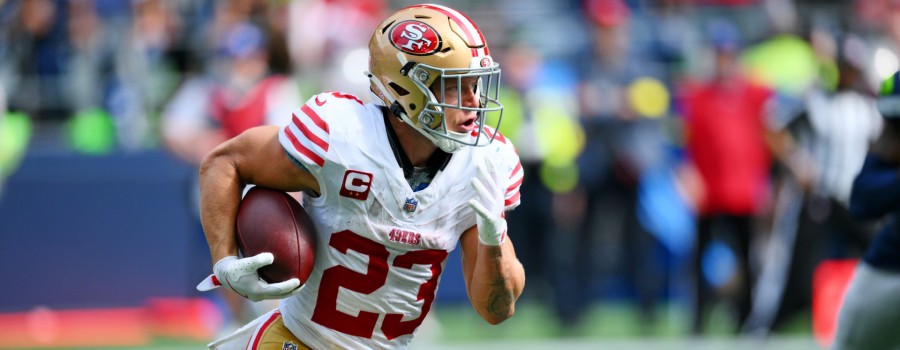
Pictured: Christian McCaffrey
Photo Credit: Imagn