Best Ball has become one of the most popular ways to play fantasy football. It takes the best part of the format – the draft – and removes all the pesky in-season aspects. You don’t have to worry about trades, the waiver wire, or even setting a lineup; you simply draft your team and hope for the best. Add in some massive prize pools, and it’s easy to see why Best Ball has become so beloved.
This year, we’re diving headfirst into more Best Ball content here at Fantasy Labs. We have a new Best Ball tool, which includes our expert rankings for the format. It also includes a stacking feature, which highlights the top options at each position for all 32 teams. It also features each team’s playoff schedule, so building correlation into your lineups is much easier.
In this article, we’re going to talk about another important factor: portfolio management. Each of the big Best Ball contests allows up to 150 entries, similar to a big DFS tournament. Just like you wouldn’t want to build 150 tournament lineups with the same players, you don’t want to stack a big Best Ball portfolio the same way. If you’re too condensed around the same players, all it takes is one early bust or injury to derail your season.
Let’s dive into everything you need to know when it comes to portfolio management for Best Ball.
Be sure to check out all the updates we made for the 2026-2027 NFL season to our Season-Long, Best Ball, and Survivor tools.
Early-Round Player Diversification
For starters, it’s worth stating that “portfolio management” only really applies when you’re actually building a portfolio. If you’re only drafting a handful of teams – say, 10 or fewer – you don’t really need to worry about it. I still wouldn’t load up all of your limited entries with 100% exposure to the same players, but it’s worth being aggressive.
However, if you’re going to be attacking these formats with volume, you need to think about risk management. The same way you wouldn’t put all your chips in one basket in the stock market, you need to do the same for Best Ball.
This is particularly important in the early rounds. These are the players that can make or break a fantasy season. If you focused last year on the early-round pass-catchers and avoided guys like Bijan Robinson, Jamhyr Gibbs, and Christian McCaffrey, you probably didn’t have a great season.
Ultimately, your draft spot is going to play a big factor in your first-round selection. If you’re lucky enough to land a top-two pick, you should almost always be taking one of Robinson or Gibbs. That’s basically the only situation where you’re going to be able to land one of those players, so you should take advantage where you can.
The next three picks should be the “big three” receivers: Puka Nacua, Ja’Marr Chase, and Jaxon Smith-Njigba. After that, the rest of the first round will likely be comprised primarily of Jonathan Taylor, McCaffrey, Amon-Ra St. Brown, CeeDee Lamb, Justin Jefferson, James Cook, and Ashton Jeanty. Assuming that you have a roughly even spread of draft position, you should be able to get a solid mix of all 12 of those players.
After that, it’s important to focus more on ADP than on rankings. That’s not to say that you can’t have stances. If you think that a WR coming off the board in round three has a chance to be the WR1 this season, that’s someone that you want to be overweight on. However, you don’t necessarily need to “reach” for that player. You should feel comfortable drafting him when he slips, but if you take him earlier than expected, it’s going to put you in a subpar position compared to your opponents.
Think about it this way. If you reach for that third-round receiver in the second round, even if he goes off this season, once you make the playoffs, you’re still going to have to compete against teams that drafted him in the third round. Some may have even gotten him in the fourth. That gives those teams extra draft capital against your lineup.
Remember, the goal is ultimately to win the entire contest. That means you’re going to need to beat teams that can have the same players as you in the playoffs. Being “right” about your selections is important, but so is ensuring your lineups are constructed to give you an edge in those matchups.

Late-Round Player Diversification
In the early rounds, you’re going to want to spread your ownership across every player available. It’s not possible to do that perfectly – you would need thousands of lineups to achieve that dream – but you can at least get some exposure to everyone. Even if you don’t like a running back going in round four or five, you’re still going to want at least a couple of shares if you’re building 150 lineups.
However, once you get into the middle or late rounds, this is where you can be a bit more aggressive. The “risk vs. reward” aspect of being overweight on certain sleepers is much more favorable. If you have 35-40% ownership of a Round 14 wide receiver, it’s not going to kill you if he busts. But if he goes off? That can propel a bunch of teams to the postseason.
Another way to gain some potential value is to target players you think can “rise” during the offseason. Maybe it’s a veteran wide receiver who is looking for a change of scenery. Maybe it’s a rookie who is competing for a starting spot. If you’re able to land those players before their ADP starts to climb, it will give you a massive advantage over the lineups that are forced to draft those players at an earlier price tag closer to the start of the season.
Combined Ownership
This is really how I like to think about ownership in Best Ball formats. Ownership for a single player is a good start, but combined ownership is much more important.
For example, let’s say that you get the No. 1 overall pick in 15 of 150 drafts, and you take Robinson every single time. That gives you 10% exposure to Robinson overall. Who you pair with Robinson with your second pick is just as important. If you always take the same two or three players when you land Robinson, you’re not nearly as diversified as you might think.
Outside of stacks, the easiest way to ensure you’re getting unique combos when drafting is by taking players after their typical ADP. Those combinations are going to be harder to come by in general, so you should take advantage when you have the chance.
Using a spreadsheet or Best Ball portfolio tool can help tremendously with player exposure. Each time you draft a player in the first round, see who you have already paired that player with. Try to get as many unique combos of duos, trios, and quartets as you can to start drafts. If you’re able to do that across 150 lineups – and can pair the right combos with the right stacks and sleepers – that’s a great formula for a high finish. That does require some luck, but no one ever took home seven figures without getting a bit lucky.
Updated on 9/17/26

Stack Distribution
Speaking of stacks, this is another area where you’re going to want to think about diversification. A good Best Ball portfolio is going to have exposure to most (if not all) of the starting quarterbacks, and you’re going to want to be attacking them in different ways.
Some stacks will come at a premium. A stack like Chase and Joe Burrow is going to cost you two early-round picks. Of course, that is a stack that you’re going to want to target. Those players are capable of going absolutely nuclear, so no exposure to the Bengals’ top duo could leave you drawing dead.
However, you’ll also want other lineups where those two aren’t tied to each other. You’ll want some standalone Chase lineups, and you’ll want some Bengals’ stacks that don’t include Chase. If he gets injured, stacks of Burrow with guys like Tee Higgins, Chase Brown, Mike Gesicki, and even Andre Iosivas could pay huge dividends.
Strategy Variety
This goes hand-in-hand with the combined ownership section. If you’re always using the same strategy in drafts, you’re going to end up with similar lineup constructions across the majority of your lineups. You should be implementing different types of roster constructions with each of your early-round picks.
Let’s go back to the hypothetical 15 Robinson lineups. Perhaps you go RB-RB in five of them, and you take a third RB in two of those. Perhaps in another five, you go with the “hero RB” strategy, which means spending your next six or seven picks on pass-catchers and possibly a quarterback. Maybe you sprinkle in a couple of early TE builds and an early QB build. By going with different strategies, you shouldn’t have a ton of “blind spots” in your portfolio.
You can also consider shifting the times when you draft. Getting all 150 lineups in the early summer leaves you vulnerable to training camp and preseason injuries. You should get some solid ADP values in those drafts, but you’re also going to have some lineups that are drawing dead. You also might miss out completely on guys who were off the radar in June but have emerged as legit sleepers.
Conversely, if you draft all of your lineups late, you’re going to miss out on the smash values from the summer. For example, if a starting RB goes down with a season-ending injury, that team’s backup RB is going to shoot up the draft board. You’re going to have to compete against teams that were able to secure that player at a heavily discounted price tag, which is going to put you behind the eight ball.
Ultimately, a good mix of both seems like the perfect recipe. You should get some solid ADP values by default, but you’ll also be able to get some exposure to the late risers in the process.
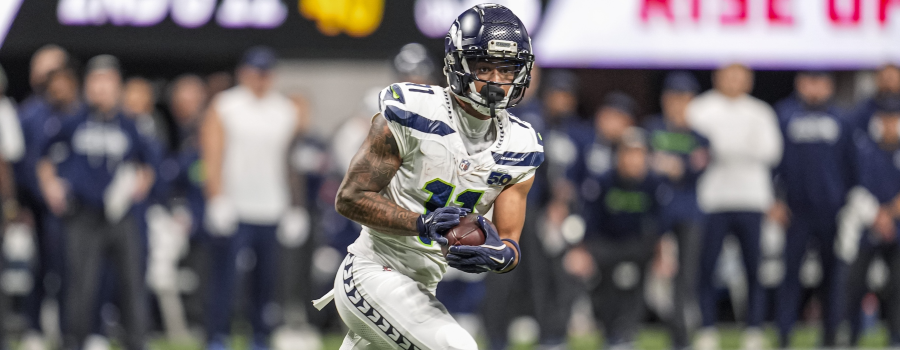
Pictured: Jaxon Smith-Njigba
Photo Credit: Imagn
YOU MAY ALSO LIKE
 Week 1 NFL DFS Cheat Sheet: Top Picks, Stacks, Values, Leverage Plays, Player Props, More
 NFL DFS DraftKings Showdown: Lineup Optimizer Rules and Favorite Angle in Vikings-Eagles
 NFL DFS Week 3 DraftKings Main Slate Look Ahead: Early Values in Our Projections
 Daily Fantasy Football Week 1 NFL DFS Stacks and Picks on DraftKings and FanDuel