If you’ve played Best Ball even casually for any length of time, you’ve been there. You’ve got the perfect stack set up, taking a team’s top two pass catchers, and all you need is the quarterback. Maybe it’s Round 1 Ja’Marr Chase followed by Tee Higgins in Round 3, and all you need is Joe Burrow when the draft comes back to you.
Your pick rolls around near the 4/5 turn, and it’s decision time. Do you take Burrow with your first pick or grab another high-upside option and wait on Burrow? You opt for the former, assuming that nobody without Higgins or Chase would take Burrow ahead of ADP – and yet someone does.
It’s the most frustrating thing to happen in Best Ball, as all of your best-laid plans are dashed by somebody just drafting on vibes. Fortunately, we have a solution for you.
Be sure to check out all the updates we made for the 2026-2027 NFL season to our Season-Long, Best Ball, and Survivor tools.
Introducing the Stacks Tool From FantasyLabs
Of course, we can’t actually guarantee that you will never get sniped in Best Ball. The vast majority of Best Ball drafters are casual fans at best, clicking players they’ve heard of based on vibes. Frustrating as that may be, if everyone was using best-in-class Best Ball tools, there wouldn’t be much of an edge for those of us putting in the work.
However, by giving you a one-stop shop with the rankings and ADPs of every team’s top players, the Best Ball Stacks tool allows you to plan ahead and drastically limit your chances of getting beat to the last piece of your stack. Here’s what it looks like:
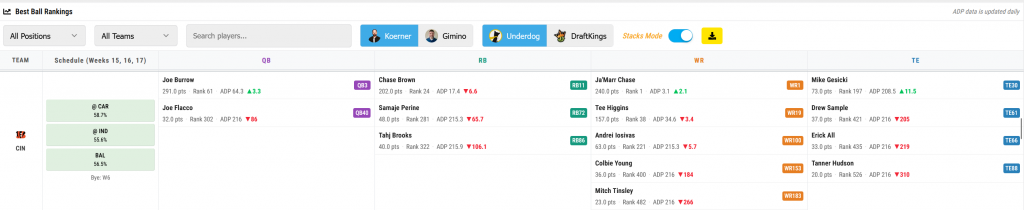
Using the Bengals example from above, if you have the third overall pick and land Chase – Sean Koerner‘s #1 overall player on Underdog – you can start to plan from there. You probably can’t wait until your late 4th-round pick to draft Higgins, so you need to reach a bit for him, or you can make sure you grab Burrow in the fifth while waiting for Mike Gesicki. Before we get too far though, let’s take a step back and examine why stacking is so important in the first place.
Why Stack?
“Stacking” is a familiar concept to NFL DFS players, and the same general logic extends to Best Ball. Essentially, every passing point scored by a QB necessarily means one of his teammates is also scoring, and vice versa with wide receivers. Since Best Ball (and DFS) prize pools are generally so top-heavy, we should be maximizing our odds of a top. 1% outcome, rather than trying to raise our floor.
By pairing a wide receiver and QB (or tight end, or pass-catching running back), we can broaden our range of outcomes. Yes, a bad game from Joe Burrow hurts a lot more when your top two receivers are Chase and Higgins – but you weren’t winning anything significant with a bad game from your QB anyway. On the flip side, if Burrow throws five touchdowns in Week 17, there’s a very high chance that one or both of Higgins and Chase also appear in the winning lineup.
By constructing teams this way, you limit the number of things you need to get right, betting on just one offense in its entirety rather than multiple separate players. To use a sports betting analogy, it’s like hitting a straight bet instead of a two- or three-leg parlay.
Of course, unlike in DFS, we can have multiple stacks on our Best Ball rosters. That introduces another wrinkle to the equation, as we can attempt to stack games in the fantasy playoffs or just have two or three separate team stacks that each have a shot of paying off.
For more on the overall concept of stacking (both team and game), check out the in-depth piece from Matt LaMarca on the subject.

Using the FantasyLabs Stack Tool For Game Stacks
For full disclosure, I’m of the belief that the Week 17 (or fantasy playoff in general) game stacking concept is probably a bit overblown. Of course, Team A lighting up the scoreboard also forces Team B to be aggressive, so there’s clearly a strong correlation between opposing teams’ scoring.
The problem comes when trying to predict what those teams will look like six months in advance. It’s a long season, and what we view as premium offenses or attackable defenses will almost certainly be drastically different by December. Plus, we have to worry about weather and team motivation, both factors that are hard to predict, especially with the expanded NFL schedule meaning many teams now throw in the towel two weeks early and not just for the final game.
With that said, my approach isn’t to avoid stacking games in the fantasy playoffs. Instead, I’m not so much worried about which game I think is the likeliest to be a tournament winner, but which stacks fit together well from an ADP standpoint. It’s generally a bad idea to draft multiple quarterbacks early, for example, so trying to stack the Ravens-Bengals Week 17 game might not work out. Sure, you’re in for a big Week 17 score, but you’ll have a tough time making the playoffs with two QBs taken in the first five rounds.
Instead, I might target something like Bears-Lions, even though Week 17 in Chicago isn’t the ideal offensive environment. You could get Amon-Ra St. Brown in the mid-first round, Rome Odunze, Luther Burden, and Caleb Williams in the 4th/5th/6th, and then come back and snag Jared Goff as your QB2 late. These teams have different bye weeks, so you’ve given yourself a high weekly floor at QB, with plenty of upside for a championship-round shootout.

Using the Stacks Tool For Player Evaluation
Of course, the biggest edge in Best Ball is simply being right on which players you draft. We get deep in the weeds with advanced concepts like stacking, scheduling, and “ADP CLV” (drafting players early in the summer who end up having their ADP rise), but none of that matters if the players you draft don’t score points.
Given the remarkable accuracy from our rankers Koerner and Chris Gimino over the years, the best strategy is probably to load up on players they are high on. However, that’s typically difficult to do while still executing stacks, since you might have to reach on one or more players in order to correlate them together.
That is, until now. My favorite and by far the simplest feature of the stacks tool is the ability to see at a glance which teams Koerner and Gimino are broadly high on relative to their ADP at either DraftKings or Underdog. For example, here’s how Sean has the 49ers ranked relative to their DraftKings ADPs:

Going overweight on the 49ers in DraftKings contests is probably a very good idea, even if you can’t get the exact players you want. Here’s Gimino’s rankings of the aforementioned Bears on Underdog:

If you’re playing on both sites, another benefit is deciding where to get exposure to different players/teams. Koerner is much less enthusiastic about the 49ers relative to ADP on Underdog, so it would make sense to focus your DraftKings lineups on them while targeting other teams in Underdog contests.
Stay tuned all summer as we continue to adjust our rankings for all of the latest news, since all of our Best Ball and Season-Long Fantasy tools will adapt to the changes in player rankings and ADP. Good luck, and happy drafting!
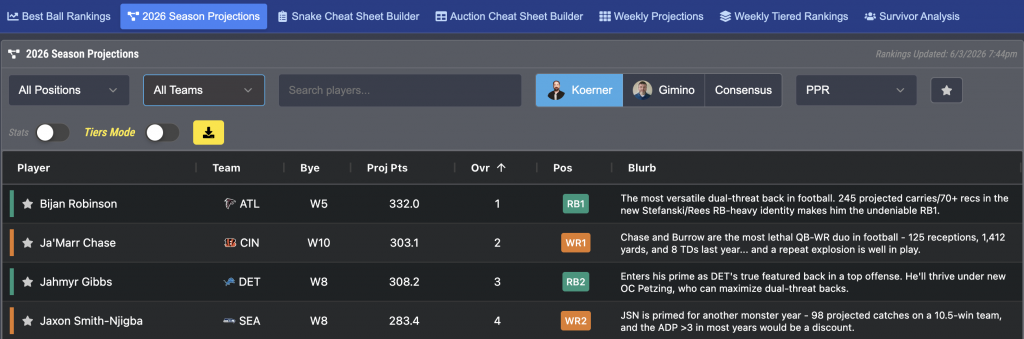
New Season-Long Feature: Don’t forget to check out our season-long rankings, complete with 250+ blurbs, full stat projections, and our “Tiers Mode” that you can toggle on and off.
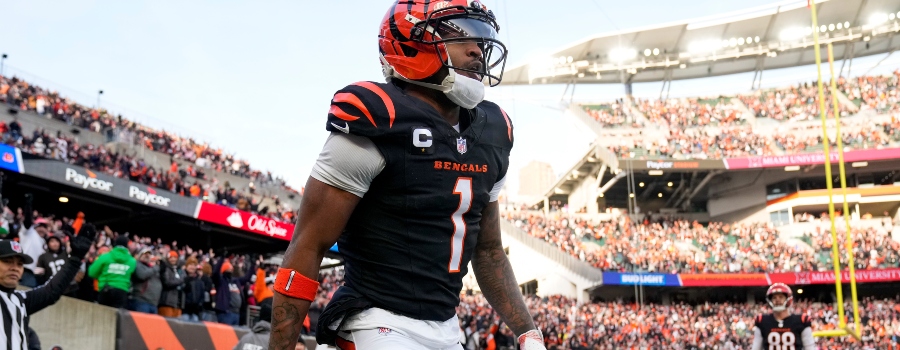
Pictured: Ja’Marr Chase
Photo Credit: Imagn