Why Stacking is an Important Best Ball Concept

This season at FantasyLabs, we’re taking a much deeper look into Best Ball contests. Between Underdog and DraftKings, there are millions of dollars up for grabs. That’s potential life-changing money, and someone out there is going to win it.

Of course, it’s not going to be easy. You’ll need to beat hundreds of thousands of other competitors to take home the top prize.

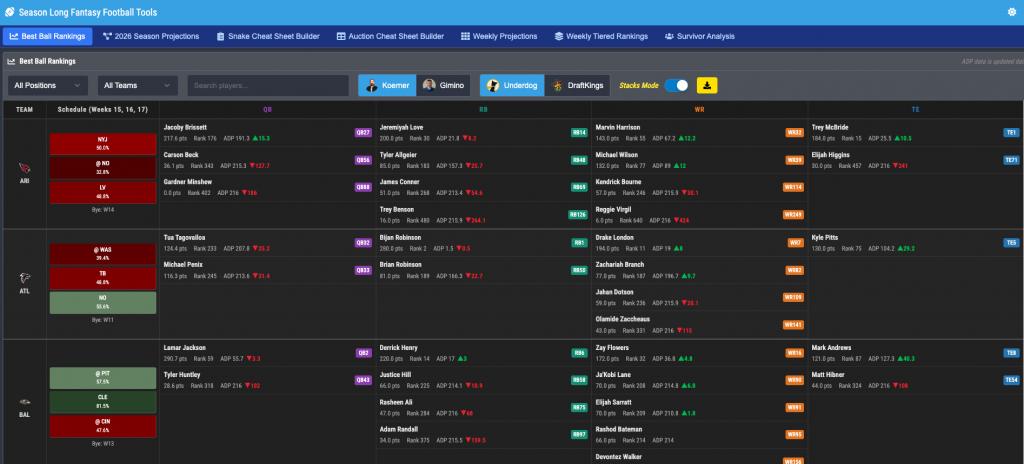
Fortunately, we have some tools available to help you. Our new Best Ball tool combines our expert rankings and ADPs across the two biggest best ball sites. It is also scheduled to include a stacking feature, which can help you increase your correlation in your various lineups.

Stacking will be the main focus of this article. It has become almost universally accepted that you need to stack your lineups in order to contend for the biggest prize pools in Best Ball. Let’s dive into everything you need to know.

What is Stacking?

For those who already play DFS, the concept of stacking is nothing new. Essentially, stacking involves rostering players from the same lineup in order to increase your weekly ceiling. The most typical stack involves pairing a quarterback with a pass-catcher, but other combinations are also possible.

In Best Ball contests, we are aiming for ceiling. It doesn’t matter if your lineup comes in dead last or in the middle of the pack in your initial 12-team leagues; neither of those teams is advancing to the playoff rounds. You need to focus on maximizing your chances of advancing through the regular season and doing so again in the playoffs. The easiest way to do that is by correlating your lineups.

Don’t forget to check out our new “Stacks Mode” feature in our Best Ball tools, where you can see each stacking partner’s ADP, along with their Week 15, 16, and 17 opponents.
Think about it this way. If you start your lineup with Ja’Marr Chase and then select Joe Burrow, you’re really only betting on the Bengals’ offense to be productive. As long as that’s the case – and both players stay healthy – they’re likely going to put up plenty of fantasy points. If you pair Chase with an unrelated quarterback like Dak Prescott, you’re now betting on the Bengals and Cowboys offenses. It introduces more variables, which means you need to get more things “right” to have a successful lineup.

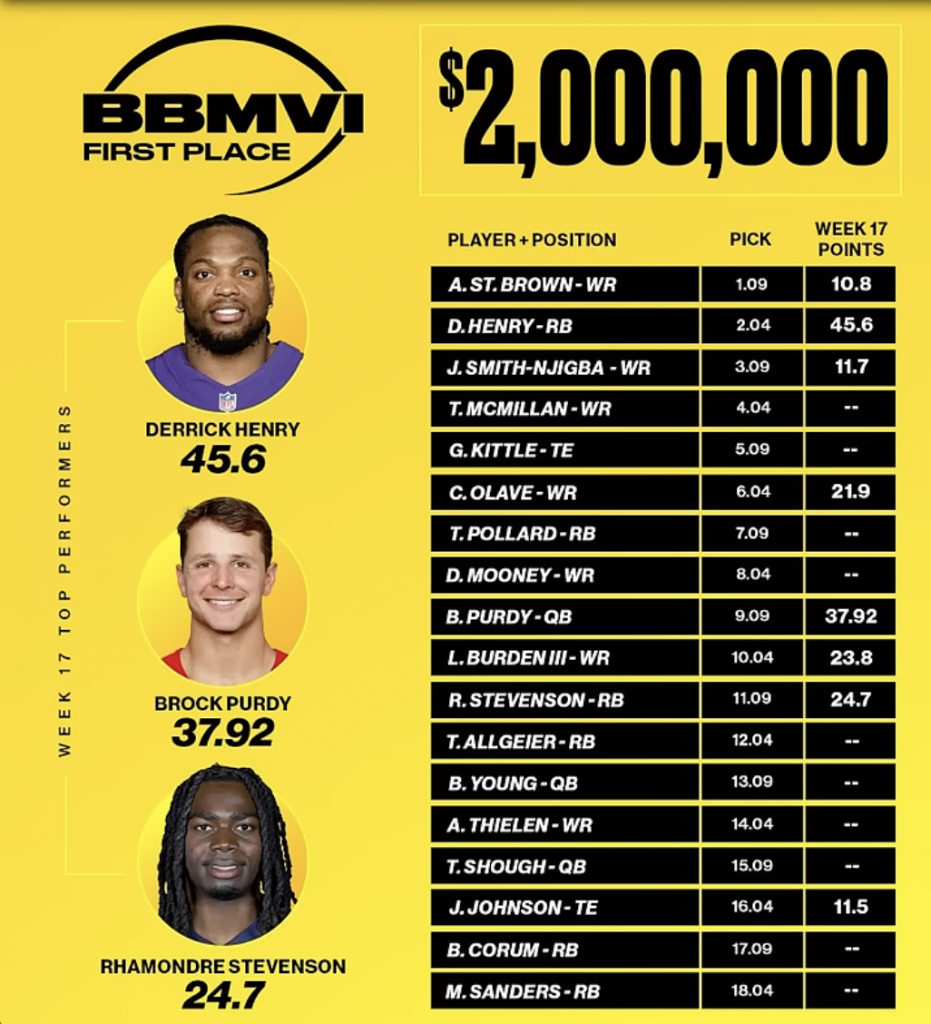
The more you stack your lineups, the less you need to get right. Last season, the winning lineup in the big Underdog contest featured three quarterbacks, and all three were paired with at least one pass-catcher:
Team Stacking

This is the most common type of stacking, but it can be accomplished in various ways. Stacking will almost always involve your quarterback, but how should you stack them? Let’s look at a few different strategies.

Early-Round Stacks

If you’re using ADP to determine your draft strategy, you’re almost never going to be taking a quarterback in the first few rounds. Josh Allen is the only quarterback currently going inside the top 55 picks on Underdog, while Lamar Jackson just narrowly makes the cut on DraftKings. That means that your first handful of picks should all be running backs, receivers, or tight ends.

Do you look to pair those players with their quarterbacks? It’s a definite possibility, though it’s not as easy as it sounds. Most of the top players in fantasy (specifically the receivers) tend to play for high-scoring offenses. That means that their quarterbacks are not cheap.

The potential upside here stems primarily from the ability of a stack to ride you to the playoffs. For example, if you go heavy on a Bengals’ stack, the combination of Burrow and Chase has the potential to carry you past your initial league mates. However, once you make it out of that round, you’re probably going to be competing against a lot of additional Burrow-Chase teams.

If you’re building a full portfolio of Best Ball rosters, you’ll certainly want to have some premier combinations. However, I don’t think the upside here is necessarily as great as in the next bucket.

Underdog
Play $5, Get $50 in Bonus Entries!
Must be 18+ (19+ in AL, NE; 19+ in CO for some games; 21+ in AZ, MA, and VA) and present in a state where Underdog Fantasy operates. Terms a...See More
LABSNEWS
Promo Code

Middle/Late-Round Stacks

This is where these contests are truly won. On paper, you’re going to need your early-round picks to smash in order to advance to the playoffs. That’s a given. You might be able to survive one bust, but if you’re not getting elite production from your top players, it’s going to be nearly impossible to compete.

What separates good teams from winning teams is what happens after that. The middle and late rounds are where you find the true “league winners,” aka the guys who massively outperform expectations. In Best Ball, a league-winner can be someone who doesn’t contribute to your lineup for the vast majority of the season but makes a legit difference in the playoffs.

Last season’s winning lineup on Underdog featured a host of players who fit that description. At quarterback, Brock Purdy was the starter for the winning lineup in all three playoff weeks. He suited up for only nine games last season and was basically a non-factor for the first 10 weeks. One of the other two quarterbacks on that team – Tyler Shough – didn’t earn his first start until Week 9. That meant that the team that won it all was essentially relying on Bryce Young for the first half of the season, and that was still good enough to get the job done.

Landing on three mid-to-late-round quarterbacks netted the winning lineup three excellent stacking partners. Tetaroia McMillan, Chris Olave, and George Kittle all outperformed expectations last season, and they complemented the top-three core of Amon-Ra St. Brown, Derrick Henry, and Jaxon Smith-Njigba perfectly. By the time Week 17 rolled around, JSN and ARSB were two of the three lowest-scoring starters in the winning lineup. The guys who lived on the periphery all season took center stage, and that propelled this team to $2M.

There’s no guarantee that this strategy will work again in 2026, but it makes a ton of sense on paper. By letting your midround targets dictate your quarterback choices, you’re building in tons of weekly upside to your lineups. If it goes well, you’ll have your studs and stacks to lean on in the playoff rounds, which gives you the potential to be both high-scoring and unique.

Updated on 5/29/26

DraftKings Pick6
Play $5, Get $50 Instantly in Bonus Picks!
Gambling Problem? Call 1-800-GAMBLER. Help is available for problem gambling. Call (888) 789-7777 or visit ccpg.org (CT). 18+ (19+ AL/NE, 21+ AZ/MA/VA). Valid only where Pick6 operates, see dkng.co/pick6states. Void in NY, ONT, and where prohibited. Eligibility restrictions apply. 1 per new DraftKings customer. First $5+ paid Pick Set to receive max. $50 issued as non-withdrawable Bonus Picks that expire in 14 days (336 hours). Ends 6/19/26 at 11:59 PM ET. Terms: pick6.draftkings.com/promos. Sponsored by DraftKings. Sponsored by DK.

RB Stacks

This is not something that you typically consider under the “stacking” umbrella. However, the best running backs in fantasy are now almost always a featured part of the passing attack. Using our Correlations tool, RB1s have a correlation of +0.37 with their starting quarterback. That’s not quite as good as the mark for WR1s (+0.54), WR2s (+0.48), or TEs (+0.49), but it’s also not nothing.

In general, stacking a quarterback and a running back tends to raise the floor of your lineup instead of its ceiling. In theory, having a team’s top running back and quarterback gives you access to most of the touchdowns that they’ll score throughout the season. Either one of those players will run the ball in, or the quarterback will throw it to a pass-catcher. While we’re not necessarily looking to increase our floor in Best Ball, that is a positive for the 14-week regular season.

The good news is that certain running backs offer significantly more correlation with their QBs than others. Someone like Christian McCaffrey is a bona fide receiver in a running back’s body. He had 102 receptions, 904 receiving yards, and seven receiving touchdowns last season, so he can certainly be stacked with his quarterback. Six other running backs had at least 55 receptions last year, while five other RBs had at least five receiving TDs.

Ultimately, stacking a running back with a quarterback can work, but you’re going to want to reserve it for the right types of players. As long as you’re focusing on guys who can catch passes, it could be an undervalued option in Best Ball drafts.

Game Stacking

Game stacking is another concept that is not new to DFS players, and it has become a huge part of Best Ball as well. But how do you “game stack” across a 17-week season?

Essentially, the game-stacking part of the equation comes into play in Week 17. You’re going to want to focus on players who go head-to-head in the championship round because that is the one that decides where the big money goes.

Going back to the winning lineup from last season, a game stack provided the crucial difference-maker. Luther Burden was not someone who was a particularly useful fantasy asset for most of the season. He only eclipsed 15 PPR points once in the first 16 weeks, but he erupted for the top score at the receiver position in Week 17.

Why was Burden on this roster? Because he played against the 49ers in Week 17. Since the winning drafter already had Kittle and Purdy, he took a chance on the rookie receiver in the 10th round. That paid tremendous dividends. The game between the Bears and the 49ers featured 80 points and 936 yards of total offense, and Purdy and Burden combined for more than 60 fantasy points.

That’s the premise. If you can select the right game in Week 17 and it turns into a shootout, having multiple pieces attached to it can vault you up the leaderboard.

Looking at the schedule for 2026-27, a few different games jump off the page:

  • Ravens at Bengals
  • Rams at Buccaneers
  • Lions at Bears
  • Eagles at 49ers

That said, you don’t necessarily need to only target those games. Maybe the game between the Raiders and Cardinals goes bonkers. Who knows? But getting exposure to at least one contest in Week 17 makes a lot of sense.

The easiest way to do this is to build in a “bring back” into your existing stacks. Simply look at who each team is playing in Week 17 and grab a player from the opposing team.

This also works in the opposite direction. You might want to be a bit lower on players who play in tough Week 17 conditions, either in terms of opponent, location, or potential weather. Week 17 isn’t the only thing that matters in Best Ball, but it should be the tiebreaker. You obviously have to make it there first, but if you don’t have players who can go off in the finals, you’re not really playing for the big money.

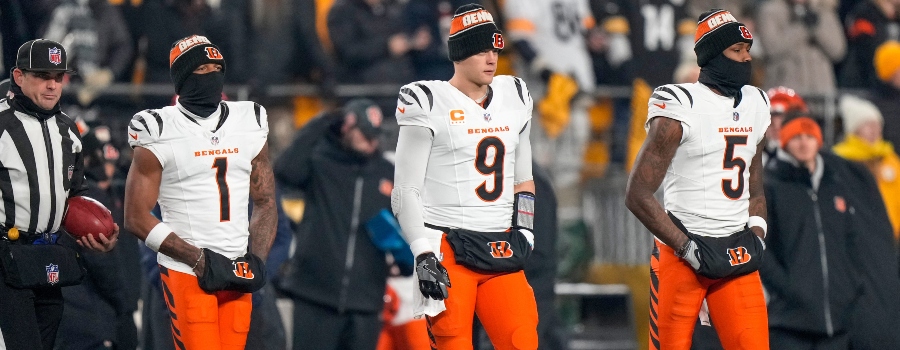
Pictured: Ja’Marr Chase, Joe Burrow, Tee Higgins
Photo Credit: Imagn

This season at FantasyLabs, we’re taking a much deeper look into Best Ball contests. Between Underdog and DraftKings, there are millions of dollars up for grabs. That’s potential life-changing money, and someone out there is going to win it.

Of course, it’s not going to be easy. You’ll need to beat hundreds of thousands of other competitors to take home the top prize.

Fortunately, we have some tools available to help you. Our new Best Ball tool combines our expert rankings and ADPs across the two biggest best ball sites. It is also scheduled to include a stacking feature, which can help you increase your correlation in your various lineups.

Stacking will be the main focus of this article. It has become almost universally accepted that you need to stack your lineups in order to contend for the biggest prize pools in Best Ball. Let’s dive into everything you need to know.

What is Stacking?

For those who already play DFS, the concept of stacking is nothing new. Essentially, stacking involves rostering players from the same lineup in order to increase your weekly ceiling. The most typical stack involves pairing a quarterback with a pass-catcher, but other combinations are also possible.

In Best Ball contests, we are aiming for ceiling. It doesn’t matter if your lineup comes in dead last or in the middle of the pack in your initial 12-team leagues; neither of those teams is advancing to the playoff rounds. You need to focus on maximizing your chances of advancing through the regular season and doing so again in the playoffs. The easiest way to do that is by correlating your lineups.

Don’t forget to check out our new “Stacks Mode” feature in our Best Ball tools, where you can see each stacking partner’s ADP, along with their Week 15, 16, and 17 opponents.

Think about it this way. If you start your lineup with Ja’Marr Chase and then select Joe Burrow, you’re really only betting on the Bengals’ offense to be productive. As long as that’s the case – and both players stay healthy – they’re likely going to put up plenty of fantasy points. If you pair Chase with an unrelated quarterback like Dak Prescott, you’re now betting on the Bengals and Cowboys offenses. It introduces more variables, which means you need to get more things “right” to have a successful lineup.

The more you stack your lineups, the less you need to get right. Last season, the winning lineup in the big Underdog contest featured three quarterbacks, and all three were paired with at least one pass-catcher:

Team Stacking

This is the most common type of stacking, but it can be accomplished in various ways. Stacking will almost always involve your quarterback, but how should you stack them? Let’s look at a few different strategies.

Early-Round Stacks

If you’re using ADP to determine your draft strategy, you’re almost never going to be taking a quarterback in the first few rounds. Josh Allen is the only quarterback currently going inside the top 55 picks on Underdog, while Lamar Jackson just narrowly makes the cut on DraftKings. That means that your first handful of picks should all be running backs, receivers, or tight ends.

Do you look to pair those players with their quarterbacks? It’s a definite possibility, though it’s not as easy as it sounds. Most of the top players in fantasy (specifically the receivers) tend to play for high-scoring offenses. That means that their quarterbacks are not cheap.

The potential upside here stems primarily from the ability of a stack to ride you to the playoffs. For example, if you go heavy on a Bengals’ stack, the combination of Burrow and Chase has the potential to carry you past your initial league mates. However, once you make it out of that round, you’re probably going to be competing against a lot of additional Burrow-Chase teams.

If you’re building a full portfolio of Best Ball rosters, you’ll certainly want to have some premier combinations. However, I don’t think the upside here is necessarily as great as in the next bucket.

Underdog
Play $5, Get $50 in Bonus Entries!
Must be 18+ (19+ in AL, NE; 19+ in CO for some games; 21+ in AZ, MA, and VA) and present in a state where Underdog Fantasy operates. Terms a...See More
LABSNEWS
Promo Code

Middle/Late-Round Stacks

This is where these contests are truly won. On paper, you’re going to need your early-round picks to smash in order to advance to the playoffs. That’s a given. You might be able to survive one bust, but if you’re not getting elite production from your top players, it’s going to be nearly impossible to compete.

What separates good teams from winning teams is what happens after that. The middle and late rounds are where you find the true “league winners,” aka the guys who massively outperform expectations. In Best Ball, a league-winner can be someone who doesn’t contribute to your lineup for the vast majority of the season but makes a legit difference in the playoffs.

Last season’s winning lineup on Underdog featured a host of players who fit that description. At quarterback, Brock Purdy was the starter for the winning lineup in all three playoff weeks. He suited up for only nine games last season and was basically a non-factor for the first 10 weeks. One of the other two quarterbacks on that team – Tyler Shough – didn’t earn his first start until Week 9. That meant that the team that won it all was essentially relying on Bryce Young for the first half of the season, and that was still good enough to get the job done.

Landing on three mid-to-late-round quarterbacks netted the winning lineup three excellent stacking partners. Tetaroia McMillan, Chris Olave, and George Kittle all outperformed expectations last season, and they complemented the top-three core of Amon-Ra St. Brown, Derrick Henry, and Jaxon Smith-Njigba perfectly. By the time Week 17 rolled around, JSN and ARSB were two of the three lowest-scoring starters in the winning lineup. The guys who lived on the periphery all season took center stage, and that propelled this team to $2M.

There’s no guarantee that this strategy will work again in 2026, but it makes a ton of sense on paper. By letting your midround targets dictate your quarterback choices, you’re building in tons of weekly upside to your lineups. If it goes well, you’ll have your studs and stacks to lean on in the playoff rounds, which gives you the potential to be both high-scoring and unique.

Updated on 5/29/26

DraftKings Pick6
Play $5, Get $50 Instantly in Bonus Picks!
Gambling Problem? Call 1-800-GAMBLER. Help is available for problem gambling. Call (888) 789-7777 or visit ccpg.org (CT). 18+ (19+ AL/NE, 21+ AZ/MA/VA). Valid only where Pick6 operates, see dkng.co/pick6states. Void in NY, ONT, and where prohibited. Eligibility restrictions apply. 1 per new DraftKings customer. First $5+ paid Pick Set to receive max. $50 issued as non-withdrawable Bonus Picks that expire in 14 days (336 hours). Ends 6/19/26 at 11:59 PM ET. Terms: pick6.draftkings.com/promos. Sponsored by DraftKings. Sponsored by DK.

RB Stacks

This is not something that you typically consider under the “stacking” umbrella. However, the best running backs in fantasy are now almost always a featured part of the passing attack. Using our Correlations tool, RB1s have a correlation of +0.37 with their starting quarterback. That’s not quite as good as the mark for WR1s (+0.54), WR2s (+0.48), or TEs (+0.49), but it’s also not nothing.

In general, stacking a quarterback and a running back tends to raise the floor of your lineup instead of its ceiling. In theory, having a team’s top running back and quarterback gives you access to most of the touchdowns that they’ll score throughout the season. Either one of those players will run the ball in, or the quarterback will throw it to a pass-catcher. While we’re not necessarily looking to increase our floor in Best Ball, that is a positive for the 14-week regular season.

The good news is that certain running backs offer significantly more correlation with their QBs than others. Someone like Christian McCaffrey is a bona fide receiver in a running back’s body. He had 102 receptions, 904 receiving yards, and seven receiving touchdowns last season, so he can certainly be stacked with his quarterback. Six other running backs had at least 55 receptions last year, while five other RBs had at least five receiving TDs.

Ultimately, stacking a running back with a quarterback can work, but you’re going to want to reserve it for the right types of players. As long as you’re focusing on guys who can catch passes, it could be an undervalued option in Best Ball drafts.

Game Stacking

Game stacking is another concept that is not new to DFS players, and it has become a huge part of Best Ball as well. But how do you “game stack” across a 17-week season?

Essentially, the game-stacking part of the equation comes into play in Week 17. You’re going to want to focus on players who go head-to-head in the championship round because that is the one that decides where the big money goes.

Going back to the winning lineup from last season, a game stack provided the crucial difference-maker. Luther Burden was not someone who was a particularly useful fantasy asset for most of the season. He only eclipsed 15 PPR points once in the first 16 weeks, but he erupted for the top score at the receiver position in Week 17.

Why was Burden on this roster? Because he played against the 49ers in Week 17. Since the winning drafter already had Kittle and Purdy, he took a chance on the rookie receiver in the 10th round. That paid tremendous dividends. The game between the Bears and the 49ers featured 80 points and 936 yards of total offense, and Purdy and Burden combined for more than 60 fantasy points.

That’s the premise. If you can select the right game in Week 17 and it turns into a shootout, having multiple pieces attached to it can vault you up the leaderboard.

Looking at the schedule for 2026-27, a few different games jump off the page:

  • Ravens at Bengals
  • Rams at Buccaneers
  • Lions at Bears
  • Eagles at 49ers

That said, you don’t necessarily need to only target those games. Maybe the game between the Raiders and Cardinals goes bonkers. Who knows? But getting exposure to at least one contest in Week 17 makes a lot of sense.

The easiest way to do this is to build in a “bring back” into your existing stacks. Simply look at who each team is playing in Week 17 and grab a player from the opposing team.

This also works in the opposite direction. You might want to be a bit lower on players who play in tough Week 17 conditions, either in terms of opponent, location, or potential weather. Week 17 isn’t the only thing that matters in Best Ball, but it should be the tiebreaker. You obviously have to make it there first, but if you don’t have players who can go off in the finals, you’re not really playing for the big money.

Pictured: Ja’Marr Chase, Joe Burrow, Tee Higgins
Photo Credit: Imagn