
Week 6 Survivor Pool Picks From the FantasyLabs Survivor Tool

As a longtime survivor pool player — and one-time winner — I’m thrilled that we have added survivor pool coverage to our industry-best suite of NFL tools.

In the old days, before the season started, I would manually build out a table with every NFL team’s projected chance of winning every game of the season. This was an extremely difficult and time-consuming task, but a valuable one for survivor contests.

In survivor pools, the aim is simple: pick one team each week, and if they win, you survive. However, you can use each team only once. That means finding the optimal spot to use the best teams in the league is important to avoid being in a tough position later in the season.


Be sure to check out all the updates we made for the 2026-2027 NFL season to our Season-Long, Best Ball, and Survivor tools.


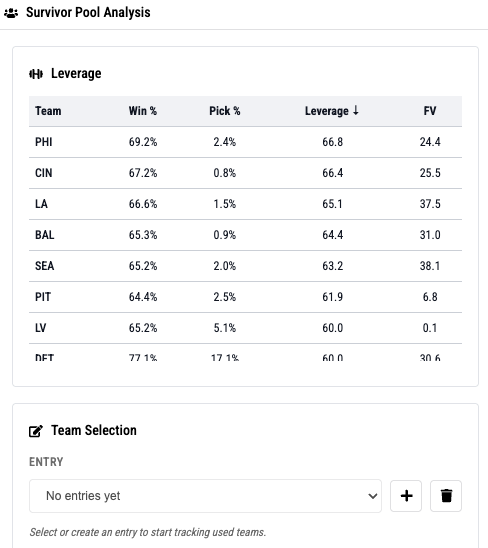
Being able to visualize each team’s odds at various points is crucial, as it helps you avoid situations where you can’t use any of the week’s strong favorites. Our new tool does exactly that — plus includes the projected popularity of each team for the current week, as well as their aggregate “future value” at a glance:
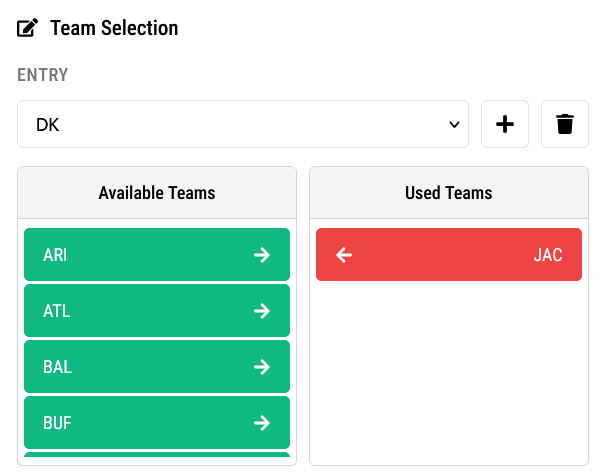
The tool also allows you to mark which teams you’ve already used, eliminating them from the full season table:
New for 2026, the tool also allows you to save multiple entries, allowing you to plan different strategies for the season based on your pool rules, size, and any potential hedging you plan on doing.

Before we get into my favorite Week 5 options, let’s touch on some general survivor pool strategy.

General Strategy

Much like daily fantasy sports, survivor pools are more about overall strategy than predicting the outcome of football games.

While the obvious goal is to survive as long as possible, the actual aim is to survive longer than your opponents. Most pools pay out only to the first-place finisher, with the prize pool chopped in case multiple entrants last the entirety of the season.

That means not all winning weeks are created equal, as advancing on a week where other entries fail is more valuable. That gives us a third variable to consider in our selections. Not only are the team’s odds of winning and future value important, but their popularity is as well.

If you can fade a popular team with strong future value and advance, it’s a double-whammy of leverage. Not only were you unique this week, but you’ll also be able to use a team that most of the field doesn’t have later in the season.

It’s also vital to consider your pool’s settings and size. Some pools have different rule sets, including weeks with multiple picks, whether ties count as a win or not, and even potentially opportunities to return following a loss. For this column I’ll be assuming a standard rule set, where one loss is an elimination and there are no multi-pick weeks.


Pool size is also important. Using our tool, we can do some back-of-the-envelope math to figure out the rough odds of surviving all season using the best available option. Based on my estimates, about 1% of the field is likely to last 17 weeks, and about half of those make it all 18 weeks. That means pools of 100 entrants or less are likely to wrap up before the end of the season, so the strategy is different based on pool size.

What that means for players is that small-field contests are all about maximizing the odds to advance, even at the cost of future value. Saving a team for Week 17 in a pool that wraps up in Week 15 is obviously pointless. On top of that, it’s also less important to be unique. If we expect a solo winner, there’s no expected-value benefit to being the only one to pick a team.

On the other hand, we want to be riskier in large-field contests. Hypothetically, I’d rather have a 10% chance of winning the contest solo than a 25% chance of sharing it five ways, so taking riskier picks and hoping for big favorites to fall is worth the gamble. Plus, those typically result in saving more future value, which not only gives you safer options down the line but also provides a second chance to be unique.

Here’s another sneak peek of what the tool shows, plus dark mode:


Pictured: Jonathan Taylor
Photo Credit: Imagn

As a longtime survivor pool player — and one-time winner — I’m thrilled that we have added survivor pool coverage to our industry-best suite of NFL tools.

In the old days, before the season started, I would manually build out a table with every NFL team’s projected chance of winning every game of the season. This was an extremely difficult and time-consuming task, but a valuable one for survivor contests.

In survivor pools, the aim is simple: pick one team each week, and if they win, you survive. However, you can use each team only once. That means finding the optimal spot to use the best teams in the league is important to avoid being in a tough position later in the season.


Be sure to check out all the updates we made for the 2026-2027 NFL season to our Season-Long, Best Ball, and Survivor tools.


Being able to visualize each team’s odds at various points is crucial, as it helps you avoid situations where you can’t use any of the week’s strong favorites. Our new tool does exactly that — plus includes the projected popularity of each team for the current week, as well as their aggregate “future value” at a glance:

The tool also allows you to mark which teams you’ve already used, eliminating them from the full season table:

New for 2026, the tool also allows you to save multiple entries, allowing you to plan different strategies for the season based on your pool rules, size, and any potential hedging you plan on doing.

Before we get into my favorite Week 5 options, let’s touch on some general survivor pool strategy.

General Strategy

Much like daily fantasy sports, survivor pools are more about overall strategy than predicting the outcome of football games.

While the obvious goal is to survive as long as possible, the actual aim is to survive longer than your opponents. Most pools pay out only to the first-place finisher, with the prize pool chopped in case multiple entrants last the entirety of the season.

That means not all winning weeks are created equal, as advancing on a week where other entries fail is more valuable. That gives us a third variable to consider in our selections. Not only are the team’s odds of winning and future value important, but their popularity is as well.

If you can fade a popular team with strong future value and advance, it’s a double-whammy of leverage. Not only were you unique this week, but you’ll also be able to use a team that most of the field doesn’t have later in the season.

It’s also vital to consider your pool’s settings and size. Some pools have different rule sets, including weeks with multiple picks, whether ties count as a win or not, and even potentially opportunities to return following a loss. For this column I’ll be assuming a standard rule set, where one loss is an elimination and there are no multi-pick weeks.


Pool size is also important. Using our tool, we can do some back-of-the-envelope math to figure out the rough odds of surviving all season using the best available option. Based on my estimates, about 1% of the field is likely to last 17 weeks, and about half of those make it all 18 weeks. That means pools of 100 entrants or less are likely to wrap up before the end of the season, so the strategy is different based on pool size.

What that means for players is that small-field contests are all about maximizing the odds to advance, even at the cost of future value. Saving a team for Week 17 in a pool that wraps up in Week 15 is obviously pointless. On top of that, it’s also less important to be unique. If we expect a solo winner, there’s no expected-value benefit to being the only one to pick a team.

On the other hand, we want to be riskier in large-field contests. Hypothetically, I’d rather have a 10% chance of winning the contest solo than a 25% chance of sharing it five ways, so taking riskier picks and hoping for big favorites to fall is worth the gamble. Plus, those typically result in saving more future value, which not only gives you safer options down the line but also provides a second chance to be unique.

Here’s another sneak peek of what the tool shows, plus dark mode:


Pictured: Jonathan Taylor
Photo Credit: Imagn

About the Author

Billy Ward writes NFL, MLB, and UFC DFS content for FantasyLabs. He has a degree in mathematical economics and a statistics minor. Ward's data-focused education allows him to take an analytical approach to betting and fantasy sports. Prior to joining Action and FantasyLabs in 2021, he contributed as a freelancer starting in 2018. He is also a former Professional MMA fighter.