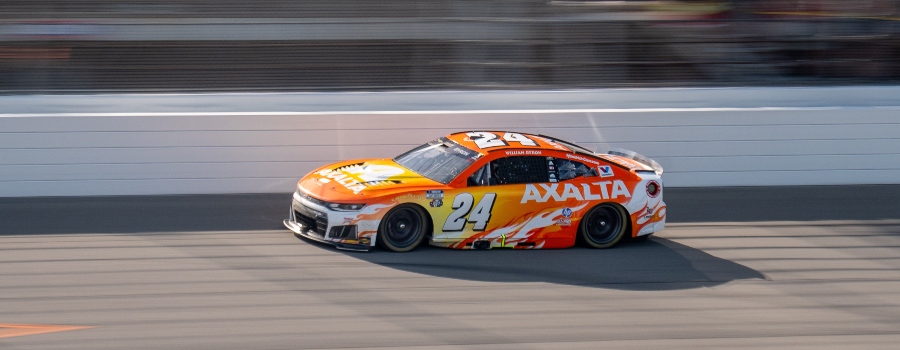
NASCAR heads to its next Crown Jewel race at the famed Indianapolis Motor Speedway for the Brickyard 400.
Indy is a 2.5-mile large, flat oval that most similarly compares to Pocono, but Michigan and Texas also have strong comps to it in terms of which drivers tend to perform well on speed at each track.
With only 160 laps and plenty of strategy, dominators will be less important than in other weeks, so this week we can definitely focus on the combination of place differential and finishing position.
My practice FLAGS for Indy will also come in handy as one of the most important features in my model.
As usual, be sure to check out my NASCAR projections in the NASCAR Models on FantasyLabs, complete with floor, ceiling, median, and ownership projections.
My projections, along with Stephen Young’s from RotoGrinders, are available in our NASCAR DFS package. You can read more about what the package entails here.
Let’s not skip the best part, my Perfect% metric, a metric that tells you how often certain racers appear in the optimal lineup when running 250,000 race simulations.
And don’t forget about the tools that FantasyLabs has to offer, like our Lineup Optimizer to effortlessly create up to 300 lineups or our Lineup Builder if you like to hand-build your lineups.
So, without further ado, here’s my strategy guide and NASCAR DFS picks for the Brickyard 400 at Indianapolis Motor Speedway.
Brickyard 400 Cash Game Picks
William Byron ($9700): Byron has been a top-four car in race FLAGS each of the two years the series has run here in the Next Gen era.
Add in his top-three practice FLAGS ranking, and he’s a must start by rolling off 21st, which allows a ton of place differential for an elite car.
Austin Cindric ($7900): Cindric had electrical issues in practice and didn’t really get a chance to run a lot, so his car isn’t perfectly optimized, which is reflected in his 35th-place starting spot.
That said, when he did get laps in during practice, he ranked inside the top half of cars, which makes sense given that he’s driving for a top team.
That’s a lot of place differential just based off speed alone, and he’s at a below-median price tag.
Christopher Bell ($10,000): C-Bell starts 23rd, but he ranked inside the top five in both practice FLAGS metrics.
People might be off of him after his shocking performance at North Wilkesboro, but this is a totally different race and track type, so I’d expect a much improved performance for one of the top-six fastest drivers across the balance of the season, despite the inconsistent finishes.
That finishing luck eventually turns around.
Brickyard 400 Tournament Picks
Dominators: Here are my top dominators by likelihood of dominating:
- Denny Hamlin
- Carson Hocevar
- Ty Gibbs
- Kyle Larson
As I mentioned at the top, dominators are de-prioritized this week, and among these four they all grade out almost equally in terms of my model’s dominator potential.
Ty Gibbs ($8800): In particular, from the four dominators, Gibbs really stands out as the practice darling, cracking 0.7 in all five rank-based practice metrics (FLAGS, PEAK, LONG, DEG, CON).
It’s very rare that a driver cracks 0.7 in every metric while topping the most important of them all (FLAGS), so he’s the clear upside play based off practice.
Corey Heim ($8100): Heim ranked second behind Gibbs in the five-metric, rank-based composite and also ranked top-five in both FLAGS metrics (speed-based and rank-based).
He projects to be one of the most under-rostered drivers of the slate. My projections have him at 12.7% usage but 16.5% optimal, so if you want to get some leverage on him, I can see using him in around 20% of lineups.
Erik Jones ($7300): I believe my model is too low on Jones, and thus he won’t really pop when looking at leverage scores (Perfect% vs. Own%).
Instead, I’d manually bump his projection up a modest amount, since Jones ranked third in the five-metric composite and had a top-six run at Pocono, the other 2.5-mile large flat track on the series schedule, just over a month ago.
Ryan Preece ($6700): Preece had incredible consistency and super-low tire degradation, while suffering in peak speed.
But we’re going to get long runs here at Indy, so Preece’s poor peak-lap time in both practice and qualifying is somewhat assuaged by sustaining his moderate pace longer over the course of a long run compared to his competitors.
That might limit his upside in an overtime finish, but if we get a long run to the end, he could captialize.
Pictured: William Byron
Photo credit: Paul Barnick, Imagn
YOU MAY ALSO LIKE
 DraftKings NASCAR DFS Picks for Kansas: Fantasy NASCAR Strategy and Picks for the AdventHealth 400
 DraftKings NASCAR DFS Picks for Charlotte: Fantasy NASCAR Strategy and Picks for the Coca-Cola 600
 DraftKings NASCAR DFS Picks for Mexico City: Fantasy NASCAR Strategy and Picks for the Viva México 250
 DraftKings NASCAR DFS Picks for Pocono: Fantasy NASCAR Strategy and Picks for The Great American Getaway 400