
Looking for something different from the standard season-long league — bigger stakes, bigger prizes, and a completely different kind of pressure? Underdog’s Eliminator tournament might be exactly what you need. It takes the Best Ball format and adds a brutal twist: instead of a full regular season leading into a small playoff bracket, you’re locked into a head-to-head elimination gauntlet that stretches across all 17 weeks of the NFL season. Lose your matchup in any given week, and you’re out — entry fee and all. But survive, and the payouts climb fast. Hit the module below, grab our Underdog promo code, and start drafting.
Here’s a full breakdown of how the contest works, the rules you need to know before you draft, and the strategy that gives you the best shot at outlasting a field of nearly 200,000 entries.

What Is The Eliminator?
The Eliminator is Underdog’s Best Ball tournament, so there are no waivers, no trades, and no lineup decisions to make once you’ve drafted. Each week, Underdog automatically plugs your highest-scoring eligible players into your starting lineup based on how your roster is built. That leaves you with one job, simple on paper but ruthless in practice: draft a team capable of putting up strong scores week after week, because that’s the only way you keep advancing.
Most Best Ball contests split the season into a regular-season stretch, followed by a playoff bracket at the end. The Eliminator scraps that structure entirely — every week from Week 1 on plays like a playoff game. There’s no surviving a bad week and clawing your way back later; one underwhelming performance relative to the rest of your group can end your run on the spot.
Entry Details
- Entry fee: $10 per entry
- Entry limit: Up to 150 entries per person
- Entry deadline: Closes prior to the first game of the NFL season (this can shift if the season’s start date changes)
- Format: Snake draft, 12 teams per group in Round 1
- Roster construction: 1 QB, 2 RB, 3 WR, 1 TE, 1 Flex, and 10 bench spots (18 total players)

How the Bracket Works
This is what sets The Eliminator apart from every other Best Ball product out there. The tournament spans 17 rounds, one per week of the NFL regular season, and the field thins out fast as the weeks go by.
Round 1 (Week 1): Around 196,608 entries are grouped into 12-person pods. The top six scorers in each pod move on; the bottom six are eliminated on the spot.
Round 2 (Week 2) and onward: Survivors get reshuffled into 2-person, head-to-head matchups. From here, it’s win-or-go-home — only the higher scorer in each matchup advances, week after week, all the way through Week 17.
Cash prizes kick in starting with Round 3 (Week 3), and from Round 7 (Week 8) onward, simply reaching that round earns a payout on top of advancing. Whoever’s still standing after Week 17 takes home the Grand Prize.
Prize Breakdown
The pay structure rewards deep survival heavily, with the biggest jumps coming in the season’s final stretch:
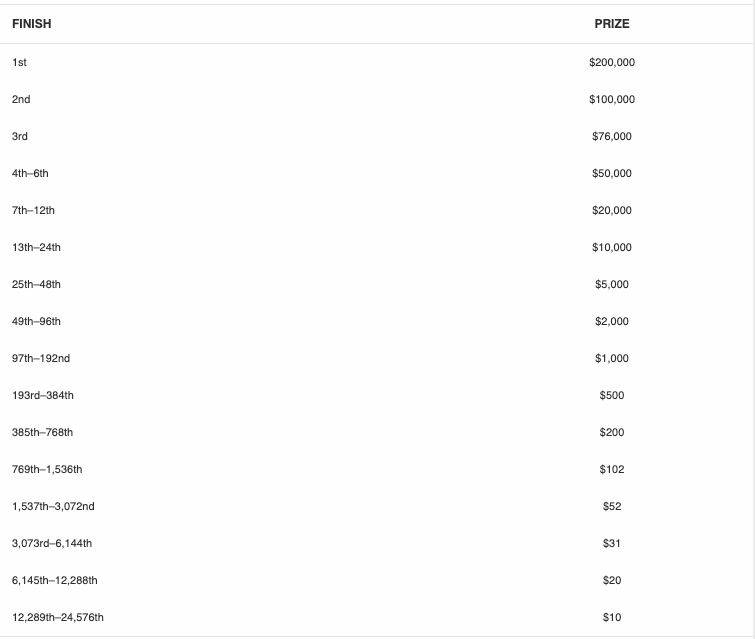
That means just making it to Week 8 or so. Clearing that first stretch of head-to-head matchups a handful of times is enough to turn a $10 entry into real money, long before you’re anywhere near the final table.
The Best Strategy for The Eliminator
Winning a traditional Best Ball league and winning The Eliminator call for two completely different mindsets. In a standard season-long contest, finishing third or fourth in your pod is essentially no better than finishing 11th or 12th, so it makes sense to build for outlier upside with hyper-fragile rosters — think a single elite QB or extreme zero-RB builds. The Eliminator punishes that approach. Since all you need to do is outscore the rest of your group to survive, and a single bad week can end your tournament no matter how strong your other 16 weeks were, the smarter play is to treat every week like its own standalone cash game rather than chasing the highest possible ceiling.
Prioritize Balance Over Hyper-Fragile Builds
Steer clear of the extreme, top-heavy builds that dominate traditional Best Ball strategy. A single elite QB/TE stack or an aggressive zero-RB approach can pay off in a large-field, single-round tournament, but in The Eliminator that same fragility just increases your odds of a disaster week that knocks you out early. A well-rounded roster with depth at every position gives you a better shot at clearing the bar each week, and that’s really all that matters here.
Prioritize Median Outcomes, Not Ceiling Weeks
This is the biggest mental adjustment the format demands. Instead of drafting players and stacks built to deliver a 30-point spike week, prioritize players with a strong, reliable median outcome — steady volume, a secure role, and a low bust rate. You’re not trying to win any single week outright; you’re trying to avoid the disaster week that sends you home. Over 16-plus weeks, consistency compounds in your favor, while chasing ceiling just raises the odds that you eventually turn in a week that isn’t good enough.
Map Out Bye Weeks Before You Draft
Since rosters lock at the draft and there’s no way to manage around a bad bye-week alignment later, stacking too many key contributors into the same bye week can sink an otherwise strong team in a single round. Reference a bye-week chart while drafting to make sure your roster has enough playable, productive depth for every week of the season instead of loading your best players into the same week off.

Avoid Over-drafting Correlation and Same-Game Stacks
Traditional Best Ball tournament strategy often leans on stacking a QB with his pass-catchers to boost ceiling outcomes in large-field tournaments. In The Eliminator, that heavy correlation can work against you, since a bad game script or tough matchup can drag down multiple players on your roster in the same week — exactly the kind of disastrous, elimination-causing outcome you’re trying to avoid. Spreading your roster across more teams and game environments tends to smooth out your week-to-week floor.
Enter Multiple Lineups if Your Bankroll Allows
With up to 150 entries allowed, volume is a legitimate way to boost your odds in a field this large. Rather than chasing one “perfect” team, spreading your player exposure across several balanced, high-floor entries increases the likelihood that at least one build survives the randomness of bye weeks, injuries, and tough matchups long enough to make a real run.
Remember the Payout Structure Rewards Strictly Surviving
You don’t need to win your matchup by a lot each week — you just need to win it. Since payouts start after Round 3 and climb from there, a conservative, high-floor approach that survives to Week 8 or beyond is already a profitable outcome. There’s no bonus for beating your opponent by 50 points instead of 5, so there’s no reason to draft as if bigger margins matter.
Final Thoughts
The Eliminator stands alone in the Best Ball space: it combines the season-long commitment of a traditional draft-and-hold format with the tension of a single-elimination bracket, all for a $10 buy-in and a life-changing top prize. The keys to success are building a balanced, high-floor roster from the jump, treating every week like its own cash game instead of a swing for a huge score, and mapping out your bye weeks so no single round blindsides you. Nail that approach, and you’ll have as good a shot as anyone at outlasting a field of nearly 200,000 entries.
Pictured: James Cook
Photo Credit: Imagn