The NASCAR Cup Series makes its way to the high banks of Talladega Superspeedway this weekend.
Talladega is a 2.667-mile drafting track, marking the third drafting race of the year.
Since drafting tracks have a huge amount of variance, we’re mostly relying on two things this weekend:
- Ownership leverage
- Place differential
And with only 188 laps scheduled, there are only around 115 dominator points available spread among 40 drivers, and the fastest-lap points favor drivers in the back of the pack.
That means forget dominators; this is 100% whether you will have the right combination of finishing position and place differential. And we can often leverage strong finishes in DFS tournaments by people not using enough of certain drivers.
With no practice, there’s no FLAGS, but as always, you can check out my NASCAR projections in the NASCAR Models on FantasyLabs, complete with floor, ceiling, median, and ownership projections.
My projections, along with Stephen Young’s from RotoGrinders, are available in our new NASCAR DFS package. You can read more about what the package entails here.

Let’s not skip the best part — my Perfect% metric — a metric that tells you how often certain racers appear in the optimal lineup when running 10,000 race simulations.
And don’t forget about the tools that FantasyLabs has to offer, like our Lineup Optimizer to effortlessly create up to 300 lineups or our Lineup Builder if you like to hand-build your lineups.
So, without further ado, here’s my strategy guide and NASCAR DFS picks for the Jack Link’s 500 at Talladega Superspeedway.
Jack Link’s 500 DraftKings DFS Tournament Picks
Stack the Back: It goes without saying, but stacking the back of the field is always a strong strategy at drafting tracks.
With that said, it’s not quite as effective as Daytona, since Talladega tends to be on the calmer side of the two tracks, but chaos can absolutely erupt at any moment.
Additionally, with all the cars so equal in the draft, it’s still nearly impossible to predict a reasonable finishing order, so we mostly rely on leveraging ownership from our plays in the back.
The top five leverages by my model all come from drivers starting 26th or worse, as well as seven of the top eight leverages.
That means I highly suggest using my projections and the optimizer to find the best leverage drivers.
In particular, my model’s top leverage is…
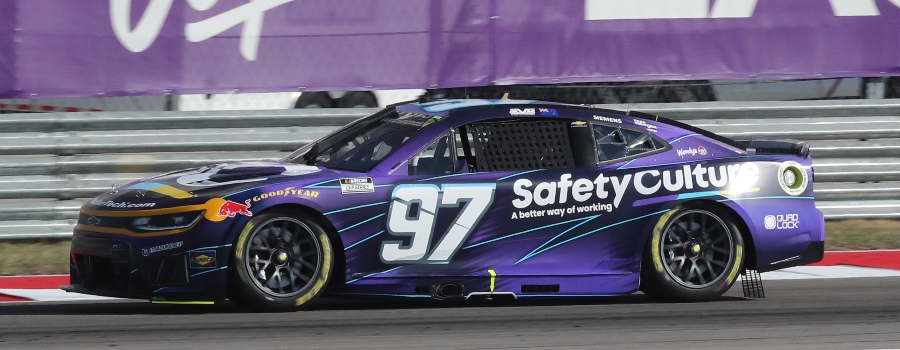
Shane van Gisbergen: SVG has quietly performed well at drafting tracks, grabbing an 11th-place finish at the most recent Talladega race and a sixth-place finish at the most recent drafting track race earlier this year at EchoPark Speedway (AKA Atlanta).
The New Zealand native has led laps in three of the last four drafting races, and he has had an average running position of 20th or better in each of the last five drafting races despite three of those starts coming from 28th or worse.
Given he’s starting 33rd, there’s a ton of place-differential potential up for grabs, and people aren’t quite caught up to the fact that the road-course ace has been quietly solid at this style of racing as well.
Leverage Ownership: Just as it’s important to figure out who, like SVG, will be under-rostered, it’s also important to figure out who will be overutilized in DFS tournaments.
The two clear answers this week are Joey Logano and Kyle Busch, both of whom project in the 40% range. However, my model gives each driver between a 32-36% chance of being optimal, so there is some opportunity to go underweight on these drivers and gain an advantage if the craziness and randomness of superspeedway racing rears its head and either has a bad finish as a result.
Aside from those two who start 25th (Logano) and 34th (Busch), the other 11 drivers who make up the top 13 in expected over-usage all start 15th or better.
How to play the backmarker tier: Three drivers are clear backmarkers this weekend, and there’s another two you could argue are possible backmarkers.
Let’s start with the three drivers who are in clearly inferior equipment, Chad Finchum, Joey Gase, and Daniel Dye.
Of those three, Dye has the best prospects, racing in what I would consider to be the best equipment of the low tier, and he also starts the farthest back. He is absolutely playable in all DFS formats.
Gase and Finchum are more borderline piloting two cars with inferior equipment, and I’d consider Gase’s equipment to be the worst, but he does start one spot behind Finchum; I also rate Gase as a better driver. Finchum is in slightly better equipment, but he starts one spot closer forward and isn’t a driver I rate highly.
That means I’d probably avoid the latter two in cash games and likely avoid them in smaller tournaments. But in large-field contests, they are playable in small amounts, especially if you are mass multi-entering.
The other two “candidates” for backmarkers are Cody Ware, who is a full-time driver in the Rick Ware Racing No. 51 car, and Jesse Love, who is a rookie who races full time in the lower NASCAR O’Reilly Auto Parts Series but only part time in cup.
These two are both playable in all formats, as their equipment is absolutely good enough to hang with the pack. Should chaos reign and they avoid it, they stand a strong chance of being optimal, although very little chance of pushing for much more than a back half of the top-10 finish.
Pictured: Shane van Gisbergen
Photo Credit: Michael C. Johnson
YOU MAY ALSO LIKE
 DraftKings NASCAR DFS Picks for Las Vegas: Fantasy NASCAR Strategy and Picks for the Pennzoil 400
 DraftKings NASCAR DFS Picks for Phoenix: Fantasy NASCAR DFS Strategy and Picks for the Shriners Children’s 500
 DraftKings NASCAR DFS Picks for Dover: Fantasy NASCAR DFS Strategy and Picks for the Würth 400
 DraftKings NASCAR DFS Picks for Phoenix: Fantasy NASCAR Strategy and Picks for the Shriners Children’s 500