David Montgomery: What to Make of His Fantasy Prospects in Houston

On paper, David Montgomery appears poised for an increase in production this season. He’s spent the past three seasons working in tandem with Jahmyr Gibbs in Detroit. Now, he has a chance to lead a backfield in Houston. He’s coming off the board as RB22, with an ADP of approximately 53.5 across the industry.

Be sure to check out all the updates we made for the 2026-2027 NFL season to our Season-Long, Best Ball, and Survivor tools.

Underdog
Play $5, Get $50 in Bonus Entries!
Must be 18+ (19+ in AL, NE; 19+ in CO for some games; 21+ in AZ, MA, and VA) and present in a state where Underdog Fantasy operates. Terms a...See More
LABSNEWS
Promo Code

However, Montgomery will have to deal with much less favorable situations in Houston than he did in Detroit. The Lions had one of the best offenses in football, while the Texans have struggled in recent years. It’s also not a guarantee that he’ll serve as a true “bell-cow” back, with second-year player Woody Marks a threat to eat into his touches.

Overall, does the good outweigh the bad with Montgomery? Let’s make the case for and against for fantasy purposes before delivering our final verdict.

The Case For Montgomery

For fantasy football, volume is king at the running back position. There is little doubt that Montgomery will see more volume with the Texans than he did in Detroit.

While Montgomery was able to keep Gibbs at bay for a while, he ceded plenty of opportunities to him down the stretch last season. As a result, Montgomery finished with just 158 carries across 17 games. That’s 27 fewer carries than he had in 2024–25, despite playing three fewer games.

Despite the reduction in volume, Montgomery remained a very efficient runner. He averaged 4.5 yards per attempt last season, ranking 21st among 49 running backs with at least 100 carries. His primary competition for touches in 2026–27, Marks, finished 48th.

Montgomery’s advanced metrics are also promising. Among running backs with at least 100 carries, he ranked 16th in EPA per rush and 17th in success rate while tying for 13th in yards after contact per attempt. If he can get 15–20 carries per game, Montgomery’s ability should shine through more than it did last year.

Montgomery wasn’t asked to do much pass-catching last year, but that’s another skill we should see more of in Houston. He was elite as a receiver two years ago, averaging 9.0 yards per target with a 73.7% success rate. If the Texans make him a three-down back, it could pay huge dividends.

The biggest question with Montgomery comes down to the Texans’ offensive line. They were dismal last year, ranking last in ESPN’s Run Block Win Rate. However, they did address the position this offseason, signing Wyatt Teller and Braden Smith while drafting Keylan Rutledge in the first round. They still probably won’t be world-beaters in the trenches, but they should be much closer to league average than they were last year.

With better offensive line play—and potentially a healthy Tank Dell—the Texans offense could improve significantly. Their defense is already elite, which could create favorable game scripts for Montgomery and the running game.


The Case Against Montgomery

While Montgomery was a quality committee back in Detroit, he did not fare nearly as well as a starter in Chicago. He averaged just 3.9 yards per attempt in four years, despite those years coming during his athletic prime.

It’s very possible that Montgomery was simply a product of the Lions’ elite offense. They’ve been in the top five in both yards and points per game in five straight seasons, and a rising tide lifts all boats. Guys like Gibbs, Amon-Ra St. Brown, Jameson Williams, and Sam LaPorta were doing most of the heavy lifting, so Montgomery was often an afterthought for opposing defenses.

Even with Gibbs taking over as the clear feature back last season, Montgomery was still ninth in the NFL in carries inside the five-yard line. He was sixth in that department in both 2023-24 and 2024-25, so Montgomery has had plenty of touchdown-scoring opportunities. He could get the majority of those looks for the Texans this season and still have fewer chances than he did the past few years.

If Montgomery’s touchdown output declines, he’s going to need to make up for it as a receiver. Unfortunately, that’s where Marks could really eat into his workload. He was in the 90th percentile for target share in college, and he was targeted on 14% of his routes run as a rookie. The reports out of camp are that Marks is going to be a factor on third down and that he is “adapting smoothly” to his new role. Head coach DeMeco Ryans also stated that Marks is making a “year two jump,” so he could even factor into the equation on early downs.

Ultimately, Montgomery might not see as big of a volume bump as expected in Houston. If that’s the case, the efficiency probably won’t be there to make up for it like it was in Detroit.

Final Verdict

As with most of the players I’ve discussed in this series, Montgomery has a wide range of outcomes this year. There’s definitely some upside for 1,000+ yards and double-digit touchdowns, but there’s also a chance he’s just a committee back for a poor rushing offense. That doesn’t even include the injury downside, with Montgomery recently turning 29 years old.

Our experts are down on Montgomery compared to his price tag. He’s coming off the board as RB20 on Underdog, with an ADP of 47.3 overall. Sean Koerner has him at 51st in his rankings, while Chris Gimino has him at 53rd overall (RB22).

I personally lean towards the bearish outcome with Montgomery. While Marks wasn’t great as a rookie, he showed more than enough to solidify a spot in the backfield rotation in 2026-27. If he can improve during his sophomore season, it’s even possible that he overtakes Montgomery in the pecking order.

I’d rather put my chips in Marks’ basket, which is significantly cheaper. His ADP is outside the top 140 picks on Underdog (RB45), and I like his prospects of returning value more than his teammate’s.

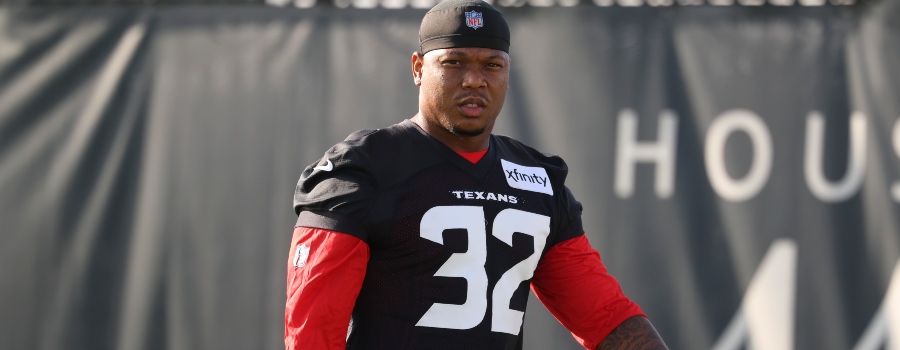
Pictured: David Montgomery
Photo Credit: Imagn

On paper, David Montgomery appears poised for an increase in production this season. He’s spent the past three seasons working in tandem with Jahmyr Gibbs in Detroit. Now, he has a chance to lead a backfield in Houston. He’s coming off the board as RB22, with an ADP of approximately 53.5 across the industry.

Be sure to check out all the updates we made for the 2026-2027 NFL season to our Season-Long, Best Ball, and Survivor tools.

Underdog
Play $5, Get $50 in Bonus Entries!
Must be 18+ (19+ in AL, NE; 19+ in CO for some games; 21+ in AZ, MA, and VA) and present in a state where Underdog Fantasy operates. Terms a...See More
LABSNEWS
Promo Code

However, Montgomery will have to deal with much less favorable situations in Houston than he did in Detroit. The Lions had one of the best offenses in football, while the Texans have struggled in recent years. It’s also not a guarantee that he’ll serve as a true “bell-cow” back, with second-year player Woody Marks a threat to eat into his touches.

Overall, does the good outweigh the bad with Montgomery? Let’s make the case for and against for fantasy purposes before delivering our final verdict.

The Case For Montgomery

For fantasy football, volume is king at the running back position. There is little doubt that Montgomery will see more volume with the Texans than he did in Detroit.

While Montgomery was able to keep Gibbs at bay for a while, he ceded plenty of opportunities to him down the stretch last season. As a result, Montgomery finished with just 158 carries across 17 games. That’s 27 fewer carries than he had in 2024–25, despite playing three fewer games.

Despite the reduction in volume, Montgomery remained a very efficient runner. He averaged 4.5 yards per attempt last season, ranking 21st among 49 running backs with at least 100 carries. His primary competition for touches in 2026–27, Marks, finished 48th.

Montgomery’s advanced metrics are also promising. Among running backs with at least 100 carries, he ranked 16th in EPA per rush and 17th in success rate while tying for 13th in yards after contact per attempt. If he can get 15–20 carries per game, Montgomery’s ability should shine through more than it did last year.

Montgomery wasn’t asked to do much pass-catching last year, but that’s another skill we should see more of in Houston. He was elite as a receiver two years ago, averaging 9.0 yards per target with a 73.7% success rate. If the Texans make him a three-down back, it could pay huge dividends.

The biggest question with Montgomery comes down to the Texans’ offensive line. They were dismal last year, ranking last in ESPN’s Run Block Win Rate. However, they did address the position this offseason, signing Wyatt Teller and Braden Smith while drafting Keylan Rutledge in the first round. They still probably won’t be world-beaters in the trenches, but they should be much closer to league average than they were last year.

With better offensive line play—and potentially a healthy Tank Dell—the Texans offense could improve significantly. Their defense is already elite, which could create favorable game scripts for Montgomery and the running game.


The Case Against Montgomery

While Montgomery was a quality committee back in Detroit, he did not fare nearly as well as a starter in Chicago. He averaged just 3.9 yards per attempt in four years, despite those years coming during his athletic prime.

It’s very possible that Montgomery was simply a product of the Lions’ elite offense. They’ve been in the top five in both yards and points per game in five straight seasons, and a rising tide lifts all boats. Guys like Gibbs, Amon-Ra St. Brown, Jameson Williams, and Sam LaPorta were doing most of the heavy lifting, so Montgomery was often an afterthought for opposing defenses.

Even with Gibbs taking over as the clear feature back last season, Montgomery was still ninth in the NFL in carries inside the five-yard line. He was sixth in that department in both 2023-24 and 2024-25, so Montgomery has had plenty of touchdown-scoring opportunities. He could get the majority of those looks for the Texans this season and still have fewer chances than he did the past few years.

If Montgomery’s touchdown output declines, he’s going to need to make up for it as a receiver. Unfortunately, that’s where Marks could really eat into his workload. He was in the 90th percentile for target share in college, and he was targeted on 14% of his routes run as a rookie. The reports out of camp are that Marks is going to be a factor on third down and that he is “adapting smoothly” to his new role. Head coach DeMeco Ryans also stated that Marks is making a “year two jump,” so he could even factor into the equation on early downs.

Ultimately, Montgomery might not see as big of a volume bump as expected in Houston. If that’s the case, the efficiency probably won’t be there to make up for it like it was in Detroit.

Final Verdict

As with most of the players I’ve discussed in this series, Montgomery has a wide range of outcomes this year. There’s definitely some upside for 1,000+ yards and double-digit touchdowns, but there’s also a chance he’s just a committee back for a poor rushing offense. That doesn’t even include the injury downside, with Montgomery recently turning 29 years old.

Our experts are down on Montgomery compared to his price tag. He’s coming off the board as RB20 on Underdog, with an ADP of 47.3 overall. Sean Koerner has him at 51st in his rankings, while Chris Gimino has him at 53rd overall (RB22).

I personally lean towards the bearish outcome with Montgomery. While Marks wasn’t great as a rookie, he showed more than enough to solidify a spot in the backfield rotation in 2026-27. If he can improve during his sophomore season, it’s even possible that he overtakes Montgomery in the pecking order.

I’d rather put my chips in Marks’ basket, which is significantly cheaper. His ADP is outside the top 140 picks on Underdog (RB45), and I like his prospects of returning value more than his teammate’s.

Pictured: David Montgomery
Photo Credit: Imagn