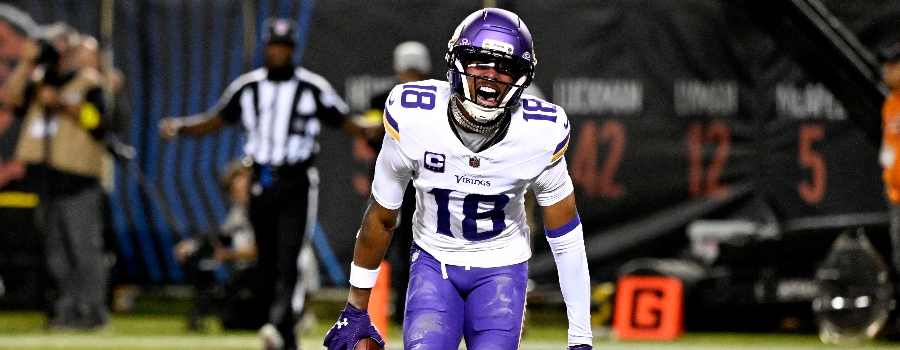
For the second consecutive week, the Minnesota Vikings will take the field in a primetime contest. This time, they’ll host the Falcons in Minnesota. They’re currently listed as 3.5-point home favorites, while the total sits at 44.5.
The Vikings’ offense was basically in a malaise for the first three quarters in Week 1 before erupting for three touchdowns in the fourth. It resulted in a comeback win over the Bears, giving them a key win in a head-to-head matchup. Unfortunately, the Falcons weren’t as fortunate against the Bucs, suffering a three-point home loss. The good news is that they outgained the Buccaneers by nearly 100 yards, but a missed FG attempt as time expired ultimately sealed their fate.
Let’s dive into the top DFS options for Sunday Night Football.
You can check out our in-depth SimLabs guide here if you want to use our NFL DFS sims to effortlessly create advanced NFL DFS lineups.
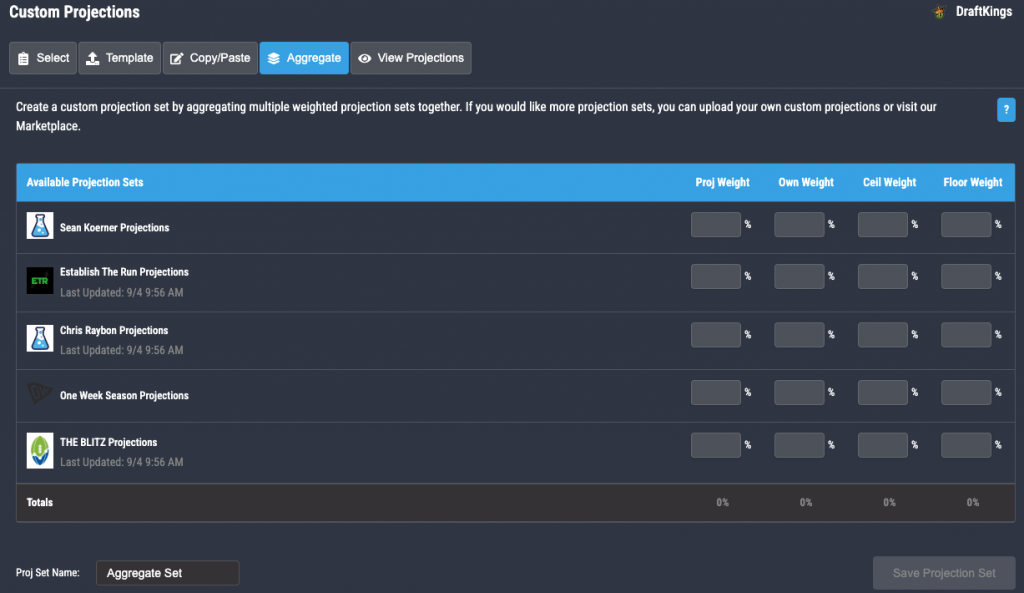
Finally, make sure to check out all the projections available for purchase (Chris Raybon’s come included with a FantasyLabs subscription) within the FantasyLabs Models. Subscribers now have the option to purchase Derek Carty’s THE BLITZ from our Marketplace. Projections from One Week Season and Establish the Run are available if you’re a subscriber to those specific sites (our optimizer is a separate add-on feature).
You can also combine them to create your own aggregate DFS projections:
NFL DFS Stud Picks
This game doesn’t feature a ton of DFS firepower, but it does feature a couple of true “blue chippers.” That starts with Bijan Robinson at running back.
Robinson was routinely drafted as the top running back in fantasy leagues this offseason, and he lived up to the hype in Week 1. He was ineffective on the ground, rushing for just 24 yards on 12 carries, but his work as a receiver more than made up for it. He snagged six of seven targets for 100 yards and a touchdown, bringing him to 27.4 DraftKings points. Robinson ultimately finished as the No. 2 running back for the week in PPR formats, only trailing Derrick Henry.
Unfortunately, the underlying utilization isn’t quite as rosy. Robinson benefited from a 50-yard touchdown catch in Week 1, and he’s not going to do that every single week. From a volume standpoint, Robinson was pretty underwhelming. He had just 52% of the team’s designed rushing attempts, and he was targeted on just 19% of his routes run. It’s only one game, but those are not the types of numbers we expected from him this season.
The good news is that Robinson was still on the field for 83% of the team’s offensive snaps. Backup RB Tyler Allgeier was only at 25%, so Robinson has the potential to increase the gap from a workload perspective moving forward.
The bad news is that Robinson is going to have to navigate a brutal Week 2 matchup. The Vikings were one of the best defenses in football last season. They were No. 1 in rush defense EPA, and they allowed the eighth-fewest PPR points per game to the position. Minnesota completely stifled D’Andre Swift in Week 1, and while Robinson is infinitely better than Swift, it’s still going to be tough sledding.
Ultimately, he stands out as a bit overpriced in our NFL Models. He has just the fourth-highest ceiling projection, which is not ideal for the most expensive player on the slate. However, that could make him an interesting contrarian choice at Captain. He’s projected for just 10.2% ownership in that spot, but his optimal rate is greater than 12%. That’s the biggest discrepancy at Captain in Sim Labs.


Justin Jefferson is among the best receivers in fantasy, though there are some questions about his upside this year. He’ll be playing with another new quarterback, and J.J. McCarthy is very much a work in progress. He threw the ball just 20 times in Week 1, and he finished with just 143 passing yards. If McCarthy doesn’t improve moving forward, it’s going to be hard for Jefferson to post the same type of numbers he did with Kirk Cousins and Sam Darnold.
The positive is that when McCarthy did throw it, he leaned heavily on his star receiver. Jefferson amassed a 39% target share and 53% air-yards share in Week 1. He also had the team’s only end-zone target.
There are also plenty of reasons to believe in improvement for the Vikings offense as the year progresses. Kevin O’Connell is one of the top offensive minds in the league, and he’s gotten the best out of whoever has been under center for him. Darnold was not considered an NFL-caliber starter before linking up with O’Connell, yet Jefferson still had an outstanding 2024 campaign.
With the Vikings’ offense picking up in the fourth quarter last week, it’s possible they carry that momentum into a solid matchup vs. the Falcons. Atlanta was 25th in pass defense EPA last season, and it allowed the third-most fantasy points per game to opposing receivers.
Add it all up, and Jefferson stands out as the best non-quarterback on this slate.
Drake London doesn’t have quite the same pedigree as Jefferson, but he could be poised for a career year in 2025. He was a target monster after Michael Penix Jr. took over at quarterback last season, and he followed that up with 15 targets in Week 1. He finished with “just” eight catches for 55 yards, but he has the potential for much better performances moving forward.
Like Robinson, London will have to navigate a tough matchup vs. the Vikings. However, Minnesota was much more generous towards opposing receivers last season. In fact, they allowed the most PPR points per game to the position.
One X-factor here is that London will have a bit more competition for targets in Week 2. Darnell Mooney was out of the lineup vs. the Buccaneers, but he’s good to go for Sunday Night Football.

NFL DFS Midrange Picks
Sunday Night Football features a rematch between the two quarterbacks in the 2023 NCAA National Championship. McCarthy’s Michigan Wolverines got the better of Penix’s Washington Huskies, so we’ll see if history repeats itself Sunday.
Penix is the more expensive quarterback on this slate, despite being an underdog. He also has a bit more experience than his counterpart after getting three starts at the end of last year.
Penix looked very competent in Week 1 vs. the Buccaneers. He attempted a whopping 42 passes, and he racked up 292 yards, one touchdown, and zero turnovers. That was good for a respectable 7.57 adjusted yards per attempt.
Penix also displayed a bit more rushing upside than expected. He had six carries for 21 yards and a score, bringing his final fantasy tally to 24.02 DraftKings points. He ultimately finished as the 10th-highest-scoring quarterback in a relatively low-scoring week.
Penix will likely not throw the ball 40-plus times every week, but it’s another game where the Falcons might have to lean on his arm. If they can’t get Robinson going against a tough run defense, Penix might have to air it out once again.
Like Penix, McCarthy also found the end zone with his legs in Week 1. His athleticism is expected to be a big part of his game at the NFL level, though he had just two total carries vs. the Bears. He figures to bring much more upside to the table in that department overall, with Penix notching just 11 total rushing yards in his three starts last year.
Rushing ability is the “Konami Code” for fantasy quarterbacks. If you can provide some value with your legs, it’s hard to be too disappointing from a fantasy perspective.
McCarthy overcame his slow start to finish with 23.22 DraftKings points vs. the Bears. That put him just slightly behind Penix as QB11. With McCarthy favored in this matchup and his team implied for more points, it makes sense that he has a slight edge between the two in terms of projections. However, both players have the top two projections on the slate, and at relatively cheap price tags, playing both together is extremely viable.
There’s a pretty significant dropoff after the passers. Aaron Jones is next on the pricing spectrum, and it’s tough to get too excited about him at the moment. He managed to salvage his day in Week 1 with a 27-yard receiving touchdown, but the rest of his stat line was pretty uninspiring.
Jones is stuck in a committee with Jordan Mason, and Mason is the guy who is getting most of the looks. Mason had a 57% snap share compared to Jones’ 47% mark, and he had a 15-8 edge in terms of carries.
One interesting nugget was that Jones still played on 80% of the short-down-and-distance snaps in Week 1. That was expected to be Mason’s area, and if Jones can keep that role moving forward, it would be phenomenal for his fantasy stock. He already has most of the pass-catching responsibilities locked up, so if he can handle the goal-line touches, he would excel in the two most important areas for fantasy scoring. The Vikings’ RBs didn’t have a carry from inside the five-yard line in Week 1, so that’s still a bit of a mystery.
Ultimately, Jones still has a slight edge in our projections, but Mason’s cheaper price tag gives him the superior projected Plus/Minus. Jones figures to have better correlation with McCarthy, while Mason is the better choice in lineups that don’t feature the Vikings quarterback.
Mooney should step right back into his WR2 role for the Falcons in Week 2. He was an undervalued fantasy asset for much of last season, posting a very healthy 21% target share and 33% air-yards share. He finished with just under 1,000 receiving yards and five touchdowns, good for a WR31 finish in PPR scoring.
However, it’s worth noting that most of Mooney’s production came with Cousins at QB. When the team switched to Penix, his numbers suffered. His target share dipped to just 17%, while his air yards dipped to 23%. London finished as the WR2 over the final three weeks of last year, while Mooney was merely WR66.
It’s possible that the gap between the two players will be larger this season than it was in 2024. Add in the fact that this will be Mooney’s first game back from injury, and he’s a risky option vs. the Vikings.
T.J. Hockenson was the biggest fantasy disappointment for the Vikings in Week 1. He was expected to be a borderline top-five TE in 2025, but he was far from that vs. the Bears. He finished with just three catches for 15 yards, which put him outside the top 30 at the position for the week.
The good news is that Hockenson’s underlying metrics were strong. He had a 22% target share, and he was on the field for more than 80% of the team’s passing plays. In fact, his 84% route participation was tied for the sixth-best mark at the position. There should be better days coming in the future, especially as his quarterback gets more comfortable at the NFL level. He’s a solid buy-low candidate.
Kyle Pitts is the other tight end in this matchup, and he got off to a solid start in Week 1. Pitts has been a massive disappointment throughout his NFL career, but he’s still an absolute beast from an athleticism standpoint. Perhaps a new quarterback will help him tap into his seemingly unlimited potential?
Pitts finished with a 21% target share and 83% route rate in Week 1, and he racked up seven catches for 59 yards. Penix talked Pitts up all offseason, so he’s a potential breakout candidate in 2025. Trusting Pitts has been a recipe for disaster in the past, but there’s no denying his potential at his current price tag.
Ray-Ray McCloud is the Falcons’ No. 3 receiver, and the Falcons run a ton of three-receiver sets. He had an 81% route participation in Week 1, though he ultimately finished with a subpar 8% target share. McCloud had a 16% mark last season, and he was at 13% in Penix’s three starts. He’s another potential buy-low candidate, though he doesn’t grade out nearly as favorably as the tight ends in our NFL Models.
NFL DFS Value & Punt Picks
- Defenses & Kickers – These options are always in play in the single-game format. The kickers are showing up as the better values in our NFL Models, but the Falcons’ defense is the most undervalued per Sim Labs. Also, take note that Younghoe Koo has been benched by the Falcons and did not travel with the team, so John Parker Romo will handle the kicking responsibilities for Atlanta.
- Adam Thielen ($4,800 DraftKings, $5,400 FanDuel) – With Jordan Addison still out with a suspension, there are opportunities for the rest of the team’s receivers to see a bit more action. Thielen operated as the No. 3 receiver in Week 1, posting a 68% route share. He failed to catch his only target, though he did secure a grab on a two-point conversion. Thielen was also a late addition to the roster after being traded from the Panthers following the preseason, so it’s possible his role is a bit bigger in Week 2.
- Jalen Nailor ($4,000 DraftKings, $3,800 FanDuel) – While Nailor is slightly cheaper than Thielen, he stands out as the Vikings’ No. 2 option at receiver. He was on the field for nearly every pass play last week, posting an outstanding 96% route participation. From a pure volume standpoint, it doesn’t get much better than that.
- Tyler Allgeier ($3,000 DraftKings, $4,200 FanDuel) – Apparently, the days of Allgeier being a thorn in Robinson’s side are not quite finished. He had 10 carries in Week 1, though he managed just 24 rushing yards. He’ll probably continue to siphon off enough carries to have some appeal at these prices.
- Josh Oliver ($2,400 DraftKings, $2,000 FanDuel) – Oliver is the Vikings’ No. 2 TE, and he did see a target in Week 1. However, he was not a big factor in the pass game overall, posting just a 16% route rate. He likely needs to score a touchdown to be relevant.
Pictured: Justin Jefferson
Photo Credit: Matt Marton, Imagn
YOU MAY ALSO LIKE
 Week 17 NFL DFS RB Picks Breakdown: Plenty of Running Back Value
 Daily Fantasy Football NFL DFS Picks: Landon’s Locks for Week 17
 Bills-Bengals Same Game Parlay: NFL Player Prop Picks, Over/Under, More, Using Parlay IQ for Monday Night Football
 NFL DFS Lineup Optimizer Rules and My Favorite Angle for Week 18’s Main Slate