One of the most important factors in fantasy football is where you host your league. Sure, all the bells and whistles offered by various platforms are fun—remember when live scoring was a premium feature?—but that’s not what I’m talking about. No, I’m talking about the default rankings.
You might come in with a well-researched list of tiers and rankings and a strategy of certain positions to target in specific rounds. How many of your league mates do the same thing? My guess is not many. Or those that do have a great plan for a few rounds but wing it after that.
That’s where the site’s default rankings come in. Not sure what running back to take in Round 9? Just click whoever is on top of the internal rankings. At least, that’s what less-prepared drafters do.
These rankings tend to vary heavily from site to site—particularly in the middle and late rounds—creating opportunities for well-prepared drafters to get players at bargain prices. This is especially true if you’re in multiple leagues on multiple platforms, since you can draft Player A where he’s lower ranked and fade Player B, but then reverse it elsewhere.
First up in this series of articles, we’ll take a look at players ESPN is lower on than our season-long projections indicate they should be. We’ll be using the consensus PPR rankings unless otherwise noted.
And don’t forget to sign up for your fantasy football league on Yahoo Sports!
Quarterbacks
While they’re the most important position in real football, quarterbacks might be the least important in fantasy football. Not because they don’t score many points, but because their points are fairly predictable and steady. There’s also not as big of a difference between the best starting QB and the 10th or 12th (outside of non-standard scoring systems) as there is at other spots.
Due to that, we won’t have as many QBs listed here as other positions. ESPN’s default rankings in particular have QBs considerably higher as a position than we do. While we can’t entirely avoid drafting them, for leagues hosted on ESPN, the best strategy is likely to be the last player in your league to draft a QB, picking up surplus value at other positions.
With that in mind, here are some lower-ranked starters that we have as a value relative to where ESPN ranks them.
Caleb Williams: ESPN Ranking QB14 – Labs Ranking QB10
I’ve been drafting a ton of Williams across all fantasy formats this summer. A large part of that is due to our rankings, which are broadly higher than the market on him in all league types. He was one of the QBs mentioned in my article examining the Yahoo rankings but is an even better value on ESPN, where his QB14 ranking implies he’s being drafted as a backup.
Williams has arguably the best situation for a young quarterback in the league. The Bears brought in former Lions offensive coordinator Ben Johnson as their head coach — the same Ben Johnson who revived the career of Jared Goff and turned the Lions into an offensive juggernaut.
Beyond that, the Bears invested heavily in their offense in the 2025 draft, using their first three picks on a tight end, wide receiver, and offensive tackle. They now have a top-five offensive line according to PFF and a talented group of skill position players reminiscent of the early years of Johnson in Detroit.
Plus, Williams brings far more rushing upside than Goff ever did, making him even more interesting as a fantasy option. I’m more than happy to wait on a quarterback until the double-digit rounds and come away with Williams.
Trevor Lawrence: ESPN Ranking QB22 – Labs Ranking QB12
If you’re waiting on QB and miss out on Williams, a flier on Trevor Lawrence is an interesting alternative. Like Williams, Lawrence is a former #1 overall pick in the NFL draft. He broke out in his second year in the league, throwing for over 4,000 yards and 25 touchdowns, with five additional rushing scores.
Lawrence has regressed since then, failing to match any of those statistical marks while also dealing with injuries. However, there’s some optimism moving forward. The Jags drafted dynamic WR/CB Travis Hunter with the #2 overall pick, with the early indication that he’s playing the bulk of his snaps on offense.
That gives the Jags a talented WR corps with 2024 first-rounder Brian Thomas Jr. Plus, with Jacksonville’s win total lined at just 7.5, they’ll have plenty of negative game scripts — which typically leads to more passing attempts.
Plus, if you’re drafting a QB this late, it would make sense to “stream” the position — that is add and drop players each week based on matchup. The Jaguars start the year against the Panthers, the worst defense in points per game last season. At worst, Lawrence is a solid Week 1 starter that you could move on from.
Dominate your Best Ball and season-long fantasy football leagues with our brand-new app that’s available in the Apple App Store and on Android!

Running Backs
Paradoxically, running backs are one of the least important in real football—but remain the most important for fantasy. Despite the passing revolution the league has undergone over the past decade or so, the true separators in fantasy football remain the running backs.
Pro Football Reference has a stat they call “Value Based Drafting (VBD)” points. It works similarly to WAR in baseball, in that it takes a player’s total fantasy points and subtracts the points scored by the worst (fantasy) starter at the position. For running backs, that means RB24 since most leagues force teams to start two backs.
Last season, the top player in VBD was Saquon Barkley, who outscored the RB24 by 163 points. The second and third spots were also occupied by running backs, and six of the top 10 overall.
Here are some backs going too low on ESPN that we can look to target.
Bucky Irving: ESPN Ranking 20 – Labs Ranking 19
While our WR-heavy rankings are only one overall spot ahead of ESPN with our Irving ranking, we’re even more bullish from a positional standpoint. We have Irving listed at RB7, while ESPN has him at RB10, making him a solid value around the R2/R3 turn.
The likeliest reason why is that ESPN’s rankings aren’t accurately adjusting for PPR scoring enough. Our rankings have Irving ahead of Josh Jacobs, Jonathan Taylor, and Derrick Henry, all of whom ESPN ranks higher. Henry and Taylor combined for 10 fewer receptions last season than Irving, while Jacobs had 11 fewer than Irving.
If anything, Irving’s targets and target share should be on the rise in 2025. Chris Godwin is likely to miss significant time to start the season, opening up more short-area looks for Irving. Plus, Irving started last season as the backup to Rachaad White but has fully taken over the starting role.
This is a prime example of knowing your scoring settings and how they impact individual players. In half PPR or standard leagues, Henry is certainly a better pick than Irving, while Jacobs and Taylor arguably are. Adjusting for your league’s settings better than your opponents is an easy way to get an edge in season-long fantasy.
Chase Brown: ESPN Ranking 32 – Labs Ranking 25
Brown is another back in the Irving archetype that provides value in fantasy by catching a lot of passes. In 2024, he was fifth at the running back position with 54 receptions, while running for just shy of 1,000 yards and seven touchdowns.
Also, like Irving, Brown opened the season in a committee role before becoming the full-time starter for the Bengals, so there’s optimism in terms of the workload for the third-year back. He’ll need to continue to produce through the air, though, with the Bengals offensive line rated as one of the worst in the league.
Brown is a bit risky, as there’s no guarantee that Cincinnati continues to use him like a workhorse. However, the Bengals ended the season with five wins after opening the season 4-8, so the likelier outcome is they stick with what was working down the stretch.
Brown has a late third-round ADP, making him a solid choice for teams with a later pick that went with one or two WRs in the first two rounds of the draft.
Zach Charbonnet: ESPN Ranking 130 – Labs Ranking 116
We’re now getting into the late-round fliers portion of our running back discussion, with Seahawks backup Zach Charbonnet ranked higher on Lans than in ESPN’s default rankings.
More of a 1B than a #2 back, Charbonnet trailed starter Kenneth Walker by just 18 carries and one target last year, though Walker missed six games throughout the season. Charbonnet has plenty of standalone value in PPR formats thanks to his passing-down work but would be a huge value at his R13/R14 ADP if Walker were to miss time.
Walker is already sitting out practices with a foot injury, which, although nothing serious in and of itself, is certainly concerning for his outlook. Walker has had progressively fewer carries and yards in each of his three NFL seasons, and this could be the year he finally misses significant time.
Drafting players who are one injury away from a starting role is a strong strategy late in drafts, as they could massively outperform their draft slot if things break right. I especially like players like Charbonnet, who have some standalone value as a RB3/Flex option anyway but with upside for more production.

Wide Receivers
It’s particularly important to be aware of your league’s scoring settings at wide receiver. High-volume possession receivers like Amon-Ra St. Brown are more valuable in full-PPR, while in non-PPR leagues a player like Brian Thomas is relatively more valuable—since he totaled more yards than ASB on 38 fewer receptions.
Since ESPN defaults to full-PPR scoring, that’s what we’re using for comparison, but as always be aware of your league settings.
Amon-Ra St. Brown: ESPN Ranking 8 – Labs Ranking 3
This appears to be another example of ESPN’s rankings not fully adjusting for the full-PPR format, where a high-volume receiver like St. Brown is likely to be more valuable than running backs. Especially considering the historically higher injury rate of running backs, which makes them more of a risk.
St. Brown might be the one Lion to benefit from a downgraded offensive line this season. He typically runs short-area, ball-out-quick-style routes that don’t rely on much time to develop. Additionally, the Lions taking a step back would mean more negative game scripts, and this would mean more passing situations.
The Sun God’s ADP on ESPN is sitting at 10.0, meaning he can likely be had with a mid-first-round pick in leagues hosted there. Starting a draft with St. Brown and one of the top six or seven running backs might be the dream scenario this season.
Ladd McConkey: ESPN Ranking 30 – Labs Ranking 15
McConkey came on strong in the second half of 2024, with the Chargers switching to a pass-heavy approach following their bye week. Overall on the season he accounted for about 25% of the Chargers targets, with a solid 9.9-yard average depth of target (aDOT).
In some ways, the 2024 2nd-rounder profiles similarly to St. Brown, as a high-volume possession-style receiver. However, he’s a bit bigger and faster than St. Brown, giving him more deep ball upside. Especially with the strong-armed Justin Herbert throwing him the ball in an offense light on target competition.
McConkey is going as a late third-round pick in ESPN, but we have him ranked much higher. He’s one of my preferred options in drafts where I used an early first-round pick on a running back, since he offers WR1 upside at a bargain price.
DJ Moore: ESPN Ranking 50 – Labs Ranking 30
This ranking reflects the overall enthusiasm for the Bears offensive outlook this season from our expert rankers — an outlook I share. We hit on most of those reasons in the section on Caleb Williams, but Moore is another way to get exposure to the Bears offense.
There’s also an argument for “stacking” receivers and their quarterback even in redraft leagues. A popular Best Ball strategy, stacking still has some value even in traditional formats. While using two valuable picks on players who share a bye week makes that week hard to win, it raises the upside of your team overall.
Essentially, it’s a way to reduce how many things you need to guess right on. If Williams and the Bears really do exceed expectations, there’s a high likelihood that his #1 WR DJ Moore, does as well. We’re also bullish on Bears’ rookie Luther Borden, who we rank at 102 compared to 137 in ESPN.
With Moore going around the 5/6 turn and Williams in the double-digit rounds, it’s fairly easy to pair those players together without spending too much draft capital.
DeVonta Smith: ESPN Rank 56 — Labs Rank 41
Smith seems to go perpetually overlooked in fantasy drafts, finishing as a top-20 PPR receiver (in terms of points per game) in each of the past three seasons, with considerably lower ADP/rankings in most places.
That includes ours, which has him as WR25 — and we’re still higher than ESPN and other sites’ default rankings by a solid margin. That he was able to maintain that performance despite the Eagles shifting more run-heavy and Jalen Hurts having a down year through the air was even more impressive and points to some likely positive touchdown regression for Smith this season.
Smith also functions like the WR version of a timeshare running back, in that he provides solid value on his own but massive upside in case A.J. Brown or Dallas Goedert were to miss time for the Eagles. While his likeliest outcome is similar to the players ranked around him, it’s hard to project as strong of a ceiling for other wideouts being drafted outside of the first six rounds.

Tight Ends
Just like quarterbacks, most fantasy leagues require just one tight end to be started. Also, like QB, there’s typically not a huge difference between a back-end starter at tight end and one who can be picked off the waiver wire.
For that reason, the optimal strategy is to draft a star tight end early and truly separate from your competition — or punt the position entirely and hope to find a diamond in the rough. With that in mind, here are some players who fit more with the latter strategy and could win you your league.
Since tight ends tend to be lower scoring and our projections aren’t based on positional value, we’re behind ESPN’s ranking on almost every player at the position. I’ll be using positional ranks instead of overall to reflect where we view a player more favorably than your opponents likely will.
Colston Loveland: ESPN Ranking TE12 – Labs Ranking TE10
Stop me if you’ve heard this one before — but we’re high on the Bears offense this year. That extends to rookie tight end Colston Loveland, the 10th overall pick in the 2025 NFL draft.
Loveland steps into the Ben Johnson-led system that turned Sam LaPorta into the overall TE1 in fantasy in his rookie season, and LaPorta was a second-round selection. The Bears wouldn’t have drafted him if they didn’t plan on him making an immediate impact in the offense.
His TE12 rank at ESPN means he’s the last starting TE off the board in 12-team leagues, with massive upside at a low cost.
Cade Otton: ESPN Ranking TE25 – Labs Ranking TE 18
The Bucs’ Cade Otton is ranked as the TE25 in ESPN’s default rankings, which means he’s likely to go undrafted in most 12-team leagues. He was the TE14 in overall fantasy scoring last season despite missing three games, creating obvious value in the fourth-year player.
Otton, unlike Loveland, probably isn’t going to give you many huge games. However, he’s a fairly steady option, with reduced target competition early in the season as Bucs wide receiver Chris Godwin works his way back from injury.
I like taking Otton late in drafts where I used an earlier pick on Loveland or fellow rookie tight end Tyler Warren of the Colts. Those players could take a few weeks to develop, and we’d be able to rely on steady points from Otton in the interim.
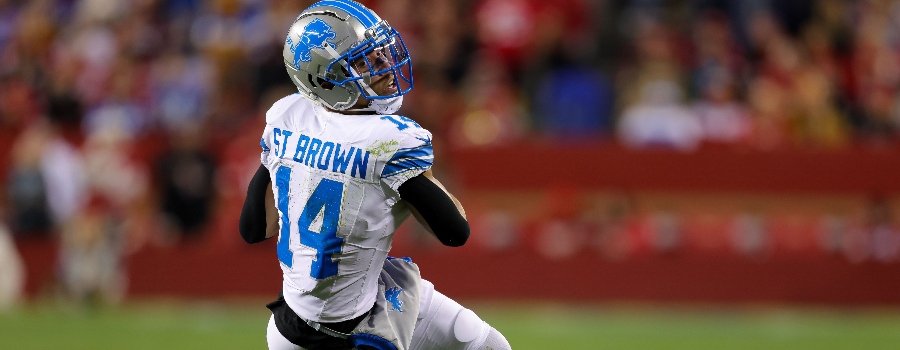
Pictured: Amon-Ra St. Brown
Photo Credit: Imagn
YOU MAY ALSO LIKE
 NFL Player Props: Michael Pittman, Zack Moss Picks for Chargers-Colts on Monday Night Football
 Bills-Bengals Same Game Parlay: NFL Player Prop Picks, Over/Under, More, Using Parlay IQ for Monday Night Football
 Week 18 NFL DFS TE Picks Breakdown: Pat Freiermuth is a Strong Value
 NFL DFS Showdown Picks Breakdown (January 26) for Bills vs. Chiefs