Sean Koerner’s Fantasy Football QB Rankings and Tiers

The quarterback position is the most valuable one in real-life football, but in fantasy, it’s usually not the priority. That’s especially true in traditional 12-team, season-long, 1QB leagues (the format this tier breakdown is built around). RBs and WRs dominate early rounds due to positional scarcity and the sheer volume you need to start each week. So, while elite QBs can make a difference, drafting one early isn’t always the optimal path.

That said, I’m not a fan of a rigid “QB early” or “late-round QB” strategy (although I do lean toward the latter). I tend to let the position fall to me, adapting based on my draft slot, how the room is drafting, and which tier of QB is available at each turn. You can absolutely build a strong roster by landing one of the top 3–5 QBs… or by punting the position entirely and playing matchups. I’ll talk through these scenarios in more detail within each tier.

Before we dive in, here’s a quick breakdown of how the QB landscape shifts in other formats.

Dominate your Best Ball and season-long fantasy football leagues with our brand-new app that’s available in the Apple App Store and on Android!

How Format Changes QB Strategy

2QB / Superflex Leagues

This is where the biggest QB value spike occurs. With every team needing at least two starting QBs and only 32 available at any time, scarcity drives QBs up the board fast. It’s common to see multiple QBs off the board in Round 1. If you wait too long, you might be left without 2-3 Week 1 starters, which is not ideal. In these formats it’s critical to have 2-3 starting QBs at a given time.

4-point vs. 6-point Passing TDs

Dual-threat QBs are borderline cheat codes in 4-point leagues thanks to their rushing stats providing them with higher weekly floors and ceilings. But if your league uses 6-point passing TDs, it slightly boosts pocket passers like Tua Tagovailoa or Dak Prescott, while dual-threats like Jalen Hurts or Kyler Murray take a small hit. Our customizable scoring tools allow you to tweak projections for this setting, but I’ll be sticking with the standard 4-point format for these tiers.

Best Ball Formats

Best Ball leagues usually have you draft 2–3 QBs, but since only the top weekly score counts, most drafts treat QB value similarly to 1QB leagues. The biggest difference? You can’t stream, so long-term outlook and stacking are more relevant to Best Ball formats. It’s ideal to pair your QB with 1–3 of his pass catchers to maximize your team’s ceiling. So if you’ve already drafted Justin Jefferson or Brian Thomas Jr., that may influence whether you grab J.J. McCarthy or Trevor Lawrence later. You don’t need to stack, but it certainly helps.

Season-Long H2H, 12-Team, 1QB Leagues

This is the most common format — and the one that gives you the most flexibility at QB. It’s also the format where you can most reasonably “punt” the position. Why? Because the waiver wire is your friend. Most leagues will have 10+ starting QBs available at any given time. That means if you miss out on a top-tier guy, you can play matchups, stream the position early on, and still end up with a long-term QB1.

I’ve done this countless times. You start out streaming, then stumble into a breakout like Bo Nix (who was widely available to start last season) and ride him to a top-10 finish. The worst-case scenario is that you stream all year, which still usually lands you around a QB15 outcome, but more often than not, you’ll end up with someone startable for the rest of the season. This flexibility is what makes punting QB viable.

Bottom Line

There’s no one-size-fits-all QB strategy. You can win your league drafting a QB in Round 3, Round 9, or after Round 12. It all depends on your format, draft flow, and how well you navigate value. 

Let’s dive in.
Tier 1

  • Josh Allen
  • Lamar Jackson

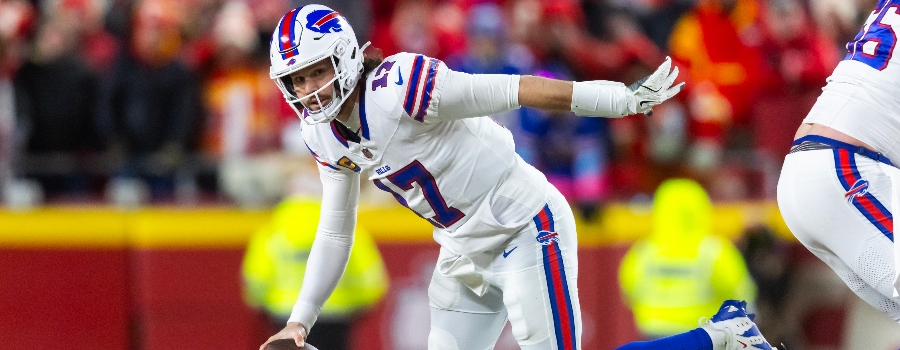
Josh Allen has finished inside the top 2 for 5 straight seasons. That’s as elite as it gets. Last season, he was the QB2 despite only throwing for 3,731 yards. It was the first time he threw for fewer than 4,300 yards in the last 5 seasons. That’s a concern, as OC Joe Brady has run a more run-heavy offense, but Allen was able to make up for it with 12 rushing TDs—his 2nd straight season with 10+ TDs.

Lamar Jackson is coming off a QB1 season and had pretty much a perfect year, throwing for career highs in passing yards (4,172) and TDs (41) while rushing for 915 yards. He thrived in OC Todd Monken’s new scheme, and having a future Hall of Famer in Derrick Henry in the backfield helped open things up even more for Jackson. He’s unlikely to match last year’s ridiculous numbers, but there’s also no reason to expect significant regression.

I have both QBs pretty even in terms of projection and could make the case for either to go QB1. However, I think if you’re going to draft one of them, the ideal scenario would be to let your league draft the first QB (either one of these two), and if the other is still on the board when it gets to you, consider taking him.

Tier 2 

  • Jayden Daniels
  • Jalen Hurts
  • Joe Burrow

Daniels is coming off an incredible rookie season where he finished as the QB5. He was forced out of their Week 7 game due to a rib injury that was expected to be one where he missed games but returned the very next week. He was very inconsistent the next few games and imagined his rookie season would have been even better had he not gotten injured. Either way, I expect him to only improve in Year 2 and having a weapon like Deebo Samuel added to the mix will only help.

The quarterback position is the most valuable one in real-life football, but in fantasy, it’s usually not the priority. That’s especially true in traditional 12-team, season-long, 1QB leagues (the format this tier breakdown is built around). RBs and WRs dominate early rounds due to positional scarcity and the sheer volume you need to start each week. So, while elite QBs can make a difference, drafting one early isn’t always the optimal path.

That said, I’m not a fan of a rigid “QB early” or “late-round QB” strategy (although I do lean toward the latter). I tend to let the position fall to me, adapting based on my draft slot, how the room is drafting, and which tier of QB is available at each turn. You can absolutely build a strong roster by landing one of the top 3–5 QBs… or by punting the position entirely and playing matchups. I’ll talk through these scenarios in more detail within each tier.

Before we dive in, here’s a quick breakdown of how the QB landscape shifts in other formats.

Dominate your Best Ball and season-long fantasy football leagues with our brand-new app that’s available in the Apple App Store and on Android!

How Format Changes QB Strategy

2QB / Superflex Leagues

This is where the biggest QB value spike occurs. With every team needing at least two starting QBs and only 32 available at any time, scarcity drives QBs up the board fast. It’s common to see multiple QBs off the board in Round 1. If you wait too long, you might be left without 2-3 Week 1 starters, which is not ideal. In these formats it’s critical to have 2-3 starting QBs at a given time.

4-point vs. 6-point Passing TDs

Dual-threat QBs are borderline cheat codes in 4-point leagues thanks to their rushing stats providing them with higher weekly floors and ceilings. But if your league uses 6-point passing TDs, it slightly boosts pocket passers like Tua Tagovailoa or Dak Prescott, while dual-threats like Jalen Hurts or Kyler Murray take a small hit. Our customizable scoring tools allow you to tweak projections for this setting, but I’ll be sticking with the standard 4-point format for these tiers.

Best Ball Formats

Best Ball leagues usually have you draft 2–3 QBs, but since only the top weekly score counts, most drafts treat QB value similarly to 1QB leagues. The biggest difference? You can’t stream, so long-term outlook and stacking are more relevant to Best Ball formats. It’s ideal to pair your QB with 1–3 of his pass catchers to maximize your team’s ceiling. So if you’ve already drafted Justin Jefferson or Brian Thomas Jr., that may influence whether you grab J.J. McCarthy or Trevor Lawrence later. You don’t need to stack, but it certainly helps.

Season-Long H2H, 12-Team, 1QB Leagues

This is the most common format — and the one that gives you the most flexibility at QB. It’s also the format where you can most reasonably “punt” the position. Why? Because the waiver wire is your friend. Most leagues will have 10+ starting QBs available at any given time. That means if you miss out on a top-tier guy, you can play matchups, stream the position early on, and still end up with a long-term QB1.

I’ve done this countless times. You start out streaming, then stumble into a breakout like Bo Nix (who was widely available to start last season) and ride him to a top-10 finish. The worst-case scenario is that you stream all year, which still usually lands you around a QB15 outcome, but more often than not, you’ll end up with someone startable for the rest of the season. This flexibility is what makes punting QB viable.

Bottom Line

There’s no one-size-fits-all QB strategy. You can win your league drafting a QB in Round 3, Round 9, or after Round 12. It all depends on your format, draft flow, and how well you navigate value. 

Let’s dive in.

Tier 1

  • Josh Allen
  • Lamar Jackson

Josh Allen has finished inside the top 2 for 5 straight seasons. That’s as elite as it gets. Last season, he was the QB2 despite only throwing for 3,731 yards. It was the first time he threw for fewer than 4,300 yards in the last 5 seasons. That’s a concern, as OC Joe Brady has run a more run-heavy offense, but Allen was able to make up for it with 12 rushing TDs—his 2nd straight season with 10+ TDs.

Lamar Jackson is coming off a QB1 season and had pretty much a perfect year, throwing for career highs in passing yards (4,172) and TDs (41) while rushing for 915 yards. He thrived in OC Todd Monken’s new scheme, and having a future Hall of Famer in Derrick Henry in the backfield helped open things up even more for Jackson. He’s unlikely to match last year’s ridiculous numbers, but there’s also no reason to expect significant regression.

I have both QBs pretty even in terms of projection and could make the case for either to go QB1. However, I think if you’re going to draft one of them, the ideal scenario would be to let your league draft the first QB (either one of these two), and if the other is still on the board when it gets to you, consider taking him.

Tier 2 

  • Jayden Daniels
  • Jalen Hurts
  • Joe Burrow

Daniels is coming off an incredible rookie season where he finished as the QB5. He was forced out of their Week 7 game due to a rib injury that was expected to be one where he missed games but returned the very next week. He was very inconsistent the next few games and imagined his rookie season would have been even better had he not gotten injured. Either way, I expect him to only improve in Year 2 and having a weapon like Deebo Samuel added to the mix will only help.