I have a confession to make. Well, perhaps two confessions, if you prefer your fantasy analysts to play in more than one season-long fantasy league. I haven’t won my home league since 2022. That might not sound bad, but in a league filled with friends from high school who don’t write about fantasy sports, it’s pretty embarrassing. The biggest problem? I got Best Ball brain.
I spend my summers the way they’re intended: drafting Best Ball teams. Unfortunately, the best practices in Best Ball aren’t quite the same as those in redraft leagues, especially at the running back position. A few years ago, this was a pretty big edge in Best Ball, since most of the field was drafting like it was a standard home league.
The past few years have been different, though, as Best Ball (and Best Ball content) has become more popular. Every summer, we seem to have bigger tournaments, more operators, and new twists to the format.

One thing that hasn’t changed, though, is that running back is the most important position. Nothing can torpedo your chances faster than blowing a first-round pick on a back that gets injured, and nothing is more valuable than grabbing a late-round flier who ends up in a starting role.
In this article, I’ll discuss a few of the common overall strategies being used to draft backs, the pros and cons of each, and the best formats to use them in. This will be light on specific player analysis, but at times I’ll reference our Best Ball rankings and projections in order to illustrate a point. Finally, I’ll give my favorite strategy based on where you land in the draft, as your pick also has a major impact on how you should approach the position.
Unless otherwise noted, I’ll be using DraftKings ADPs, rankings, and scoring for this piece. As a reminder, DraftKings is full-PPR, whereas Underdog and Drafters are both half.
Be sure to check out all the updates we made for the 2026-2027 NFL season to our Season-Long, Best Ball, and Survivor tools.

Zero RB
All the rage a few years ago, “Zero RB” has fallen out of favor recently. There’s some debate over what truly counts as “Zero RB” – since you obviously aren’t actually abstaining entirely from drafting backs – but the general concept is investing very little early draft capital in the position while loading up late on backups, rookies, or time-share backs who could be extremely valuable later in the season.
The “later in the season” qualifier makes this especially interesting for most Best Ball formats, where your points effectively reset for the fantasy playoffs. It doesn’t matter if Isaiah Pacheco sits behind Jahmyr Gibbs all season – presuming you qualify for the playoffs – if he posts monster numbers in Weeks 15-17 and helps you win the tournament. It’s worth noting that some formats, notably Drafters (all contests) and Underdog’s “Marathon” contests, determine winners by the total points in a season, which makes Zero-RB somewhat less valuable.
The driving force behind Zero-RB is – or was – the injury rate to running backs. Since they’re much more injury-prone than wide receivers, it makes sense to take fewer risks with your early picks and try to recreate that scoring in the aggregate with a portfolio of players.
However, in the last two seasons, running backs have been remarkably healthy. Here’s a graph (from a post on BlueSky) illustrating the numbers before last season:
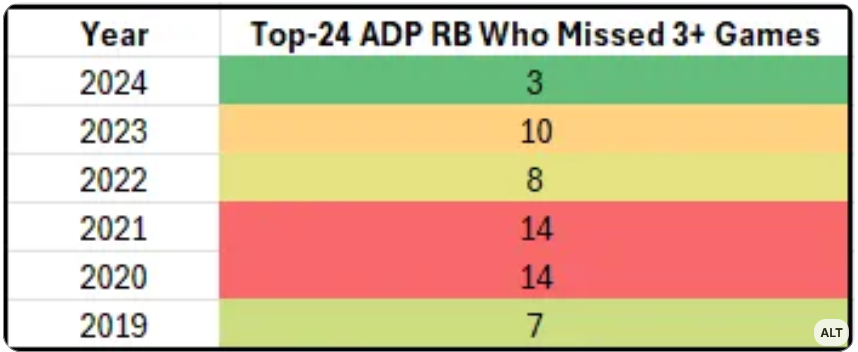
The post says that 2024 was an outlier and was likely to swing back in 2025. Based on Yahoo’s preseason 2025 rankings, though, just two backs in their preseason top-24 played 14 or fewer games, with Bucky Irving playing ten and Quishon Judkins playing 14. At the same time, top receivers have suffered more injuries, with six of the preseason top-25 playing 14 or fewer in 2025.
That has a double impact on Zero RB as a strategy. Not only was the wide receiver you took early more likely to be injured than the running back you skipped, but the backup RB you drafted later is less likely to see the field.
I’m not sure how sticky this trend will be, with just two seasons of running backs being more injury-prone. Teams are being more careful with their backs, with far fewer true workhorses than even a few years ago, but it still feels like we’ll see the injury rate for top backs come back up – and potentially go back down for wide receivers.
For that reason, I’m cautiously optimistic about a comeback for Zero RB this season, especially if you aren’t drafting in either of the top two spots. The two best fantasy assets this season are pretty clearly Gibbs and Bijan Robinson, but most of the remaining top 12 backs in our rankings are being drafted at or ahead of where they’re ranked. We’re also showing value on some second-round receivers like Drake London (DK ADP of 21.08, overall #14 in Koerner’s rankings), AJ Brown (ADP 16.13, ranked 14), and Nico Collins (ADP 23.13, ranked 19). Those players make sense to draft as your second choice in a WR-WR start, assuming you drafted in the mid or late part of the first round.
Obviously, Zero RB is also more powerful on full-PPR DraftKings than half-PPR sites, since we’re investing more overall capital in players likely to catch more passes. For that reason, I’m limiting my Zero RB builds to DraftKings drafts where I don’t have the 1.01 or 1.02, which helps hedge my overall exposure.
Updated on 9/14/26

On Handcuffs
While not originally part of my plan for this article, I’d like to take the time to go on my semi-regular rant about “handcuffing” in fantasy football. A popular strategy in redraft leagues, handcuffing is the practice of selecting the backup to your highly drafted players so that if they get injured, you’ll still get (most of) the scoring from that position.
Handcuffing is incredibly stupid in Best Ball – and it’s not even a great redraft strategy. Here’s why:
Imagine you got the 1.01 pick and took consensus top back Jahmyr Gibbs. Then in the 12th round you reach just a bit for his backup, Isaiah Pacheco, so you don’t have to worry about an injury to Gibbs. Best-case scenario, Gibbs stays healthy and performs as expected – and you wasted a late-round pick.
Let’s say Gibbs does get hurt, though. Now you get Pacheco at, generously, 80% of Gibbs’ production in the weeks Gibbs is out – except you’ve used the first overall and a 12th-round pick to get the production of our RB5 or 6 based on current projections. That’s bad in redraft (especially with the opportunity cost of taking up a roster spot) but disastrous in Best Ball, since it’s very hard to advance without your top back anyway.
Instead of drafting Pacheco, what if you draft Woody Marks (who is going just two spots earlier)? Marks is expected to be the primary backup to David Montgomery in Texas, and would typically be considered the handcuff for Montgomery.
Now you’ve used the same draft capital on Gibbs and Marks. If Gibbs gets hurt for an extended period, you’re out of luck – but that was probably the case anyway. However, if Gibbs stays healthy but Montgomery gets hurt? Now you have an additional top-25-ish back for the price of a 12th-round pick. If both starters stay healthy, you’ve only lost a late-round pick, which you could potentially absorb and still advance to the Best Ball playoffs and/or have a high score in marathon-style contests.
Thus, in almost every scenario, it’s superior to draft the handcuff to somebody else’s back rather than your own. The only exception is if the back you draft high gets hurt – but you weren’t going to win anything significant if that happens anyway. Zero RB, and the strategy we’ll talk about next, are both based around this concept of loading up on “handcuff” backs not attached to your main player.

Hero RB
I won’t spend as much time on “Hero RB,” since it is effectively an offshoot of Zero RB. Instead of totally skipping backs early, the idea is to draft a back with one of your first two picks, then go “Zero RB” from there, loading up on other positions and taking lots of lottery-ticket backs later on.
Obviously, this is also a spectrum, as it could make sense to draft two “Hero” backs early (since most Best Ball formats require at least two starting backs), and “early” could be defined liberally. With that said, this is probably my favorite general strategy, for a few reasons.
The first is that it gives you a shot at having contrarian lineups. Since teams are all regrouped for the Best Ball playoffs, you’ll be competing against tons of teams with similar rosters as your own, especially if one of the two best “hero” backs – Bijan Robinson or Gibbs – has a monster season. Hypothetically, if Gibbs scores 1,000 points on DraftKings this season, everyone who had the 1.01 pick and drafted Gibbs will move on to round two of the playoffs. Most of those teams will also have two of the five or so receivers being drafted around the 2/3 turn.
What those teams won’t have as much in common is the same late-round running backs. Maybe you drafted Rico Dowdle, and he grabs the Steelers’ starting job just in time for the playoffs but didn’t contribute much in the Best Ball regular season – how many of your opponents will also have him? By loading up on these types of players, you have more chances to have a true separator on your roster, which is what turns advancing teams into tournament-winning teams.
The downsides are two-fold. One, your hero doesn’t truly separate as much as anticipated, and you’re thin at the position and fail to advance. Two, your handcuffs either get starting roles too soon – which means they appear on more advancing teams – or not at all, which means a dead spot on your roster. The remedy for the latter is a diverse portfolio, where you mix and match the backup RBs you draft, giving you exposure to them all. The former doesn’t have an easy solution – but if your first-round pick fails, you weren’t going to win anyway.
This strategy is more valuable in formats with a playoff system than total-points contests (where being unique in Week 15 and on doesn’t matter), but even in those it can be viable, as getting a ton of points from a late pick is a good thing no matter what the format.

RB-RB Start (or “Traditional Drafting”)
For many years of fantasy football, one strategy ruled supreme: draft two running backs early. The logic is simple: they score the most points, and we have to start two of them. This fell out of favor as the league became more pass-heavy, PPR ruled the lobbies, and workhorse RBs went the way of the dinosaurs – but maybe it’s time to reconsider.
Last season, in half-PPR non-bonus scoring formats (matching those used by Underdog and Drafters), the top-four non-QBs in scoring were all RBs. In 2024, five of the top six players were. In 2024, you could’ve drafted two of those six players (Robinson or Gibbs along with Josh Jacobs) in the late first round, but the market corrected a bit in 2025, with all four of the top scorers drafted in the first round.
Still, even in 2025, Derrick Henry (overall #9 scorer) was going as an early 2nd-round pick, so you could start RB-RB and end up with Henry and Jonathan Taylor (#2 overall scorer) or maybe De’Von Achane (#7, but was drafted ahead of Taylor).
At the end of the day, the point (pun intended) is points. Top RBs, when they stay healthy, score more than anyone else – so why shouldn’t they get the most capital?
Obviously, the risk is a rash of running back injuries that strikes back after two relatively quiet seasons. The other problem is actually executing the strategy – there are currently six backs drafted in Round 1 on DraftKings and another six in Round 2.
Due to the market dynamics this year, this is my favorite strategy if I have a mid or late draft selection. Not only does it put you in position to get two of the more valuable backs, but we also have five wide receivers with 3rd-round ADPs that are undervalued based on our rankings.
Overall, this strategy is Hero RB on steroids. If going this route, it’s important to load up on wide receivers in the middle of your draft – also known as “the RB dead zone” – and only draft a couple of backup RBs later on. This also changes the type of late-round RBs I’m interested in. Rather than handcuff backs with a wide range of outcomes, I’m looking for players who have a consistent, yet smaller, role.
Much like Hero RB, if one of your top-two picks gets a significant injury, you’re not winning anyway, so a high-upside/low-floor late-round back would only contribute after you’ve already jumped the shark. Passing-down or goal-line change-of-pace backs, though, can help fill in bye weeks so you don’t take a zero at the RB position, which in this instance is far more valuable.
Instead of handcuff picks like Pacheco or Jordan James, think players likely to be in some form of a committee, like Rico Dowdle or Kenny Gainwell. Those players are less valuable in most cases since they likely wouldn’t become workhorses even with an injury in front of them, but they should provide a solid floor most weeks.
Cliff Notes of Various Strategies
- Zero RB: Drafts wide receivers early and loads up on late-round backup running backs who could see heavy late-season workloads. It works best on full-PPR sites like DraftKings that feature playoff structures.
- Hero RB: Selects one elite running back early, pivots to other positions, and fills late roster spots with lottery-ticket running backs. I consider this the best strategy for creating unique, tournament-winning playoff lineups.
- RB-RB Start: Secures two top-tier running backs in the first two rounds to lock in high-scoring assets, then relies on floor/committee backs later in the draft for depth.
- Don’t Handcuff Your Own RBs: Drafting the backup to your own top running back caps your lineup’s ceiling. Instead, draft the backup to someone else’s starter to maximize overall upside if injuries occur across the league.
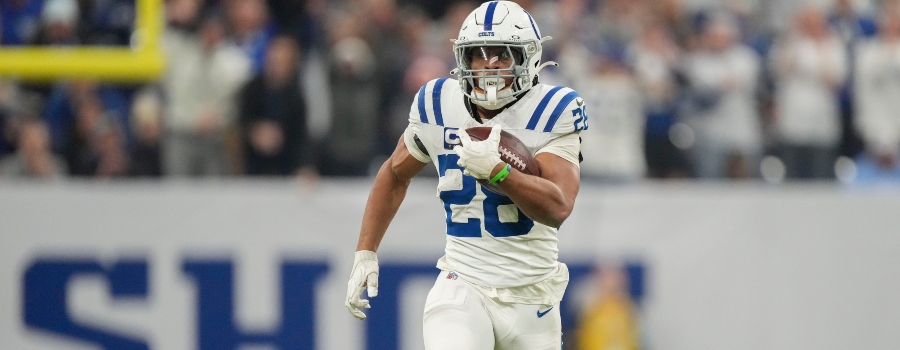
Pictured: Jonathan Taylor
Photo Credit: Imagn
YOU MAY ALSO LIKE
 Daily Fantasy Football Week 5 NFL DFS Pricing Risers and Fallers on DraftKings
 Week 5 NFL DFS Top Model Picks and Value Plays on DraftKings and FanDuel
 Week 5 NFL DFS Cheat Sheet: Top Picks, Stacks, Values, Leverage Plays, Simulations, More
 Week 2 NFL DFS TE Breakdown: Top Cash Game and Tournament Picks