A Beginner’s Guide to UFC DFS: What to Play When NFL Is Over

With the NFL season nearly complete and baseball still a few months away, it’s a relatively slow time for DFS players. Fortunately, the UFC is making their return after six weeks off — and with it comes the absolute best DFS sport.

I’ve already written about why you should be playing UFC DFS contests in the past, but if that wasn’t enough for you, I’m back with a guide on how to get started. For a slightly deeper dive into some data, you can also check out the article I wrote when DraftKings changed their scoring system in 2021.

While some of the specific numbers don’t hold up, the general concept still works — the scoring system hasn’t been changed since. This piece will build off of that one now that we’re five years into the scoring system, with some general principles for both cash games and GPPs, targeted at the novice player.

As a quick intro, on DraftKings we pick six fighters with a $50,000 salary cap. The most important points come from winning the fight, with bonuses provided for winning by knockout or submission as opposed to decisions. Outside of that, points are scored for knockdowns, takedowns, strikes (significant strikes score double), control time, and reversals.

We’ll get more into what those mean as we go through the article, but my previous piece on the scoring system explains each scoring category in detail.

Our MMA DFS Model

We have built out a full player-projection model using the FantasyLabs Tools and Player Models to help put together some winning DFS lineups in UFC. You can use our optimizer to build optimal lineups using these projections.

The model, created by our own Sean Koerner, is based on 10,000 simulations of all the fights. He then pulled the DraftKings score from each bout to create floor, median, and ceiling projections for every fighter. Here is how he defined each projection:

  • Floor: Fighter has an 80% chance of going over this score, 20% chance of going under
  • Median: Fighter has a 50% chance of going over this score, 50% chance of going under
  • Ceiling: Fighter has a 20% chance of going over this score, 80% chance of going under

These should give us a better sense of which fighters we should target based on the game type – maximizing ceiling in GPPs, for example.

Become an All-Access Member Today

Lineup builder and optimizer

Real-time DFS models & projections

Data-driven analysis & tutorials
 

Cash Games

Cash games in all sports are much less popular than they used to be. However, they can still be an excellent tool to build a bankroll, get used to a new fantasy sport, or smooth out the volatility inherent in playing GPPs only.

I’ve long been an advocate for UFC cash games in particular, as the field is still nowhere near as sharp as it is in other sports. Since fights can be over in an instant, projections are inherently more variable, and we don’t typically encounter tons of players running the same “optimal” lineup from a popular source. Additionally, there are still fairly obvious mistakes being made by a good chunk of the field.

Pricing

The most important thing to understand in DFS is the salary structure. This article is primarily focused on DraftKings, though we’ll also touch on some FanDuel wrinkles where appropriate.

While the pricing system in some sports is fairly opaque, featuring a mixture of players’ past performances, prior ownership, role changes, and the matchup, things are much simpler in UFC contests on DraftKings.

DraftKings typically releases salaries on Monday before events, with the salary 100% a reflection of the fighter’s moneyline odds. The exceptions to that rule are when a fight is added or an opponent pivots after the initial release of salaries, or when fighters have extremely close moneyline odds.

DraftKings is extremely resistant to pricing two fighters identically, so the vast majority of the time one will be semi-arbitrarily elevated in price, though this is fairly rare. There’s a small edge there in taking the cheaper fighter in these instances, but it’s not common enough to worry about.

The bigger edge comes when fighters’ winning odds change. Since DraftKings salaries are static, often sharp bets or late news will significantly change a fighter’s (market-based) odds of winning without their salary moving.

The most notable example is when a fighter is an underdog, gets a new opponent, and becomes a favorite. Those situations are must-plays for cash games. We also have instances when fighters’ odds move considerably even against their original opponent, and if the move is large enough, that typically makes them strong cash game plays as well.

FanDuel typically releases salaries later in the week and will often update salaries if opponents are changed.

Roster Construction

The biggest difference between cash and GPP lineups for UFC contests is the concept of stacking. Unlike other sports where a stack means players from the same team, in MMA it refers to rostering two fighters from the same fight.

The main reason for doing so is that UFC title fights and main events are five rounds, while most fights are three. That means you either get ten extra minutes of scoring from both fighters, or you guarantee a win by finish (with the accompanying large score) from at least one of the pair. Since fighters aren’t priced any higher for five-round fights, that makes them inherently valuable.

The vast majority of the time, we should be stacking both five-round fighters in cash games. Some cards have multiple five-round fights, which complicates the issue, as guaranteeing two losses can be a problem. Additionally, extremely lopsided main events sometimes justify fading the underdog—though those underdogs are sometimes cheap enough that it’s worth playing them anyway. I make it a point to discuss stacking strategy in my weekly breakdowns, particularly when there are multiple five-round fights on the slate.

Finding Value

Outside of fighters who have seen significant line movement, the other main source of value in cash games is cheap fighters whose fight likely goes the distance. Typically, heavy underdogs are likely to lose more quickly, which makes it hard for them to score points. Sometimes—often with female and lighter-weight fighters—that isn’t the case.

This is an important dynamic for cash games. If a fighter is cheap enough, they can usually stumble into enough points to help your lineup in a decision loss. While we’d of course prefer to roster fighters who win, the salary cap makes that difficult, so the best option is often cheap fighters with a solid floor.

I discuss fighters who fit that archetype in the “Value Plays” section of my breakdowns. Often, we’re forced to pick between a fighter with line movement in their direction and one likely to see a decision, but occasionally we find one who meets both criteria.

Paying For Safety

In GPPs, we typically want to pay up for ceiling. In UFC DFS, that means fighters who can pile up a ton of takedowns or finish the fight early. However, in cash games, I want favorites who are solid bets to pick up a win—even if their ceiling is a bit lower.

In practice, that means avoiding fighters who aggressively hunt finishes, since that can leave openings for their opponent. It also means prioritizing fighters based on their moneyline odds rather than their odds to win by a finish.

Often, the best fighters for cash games are also the strongest GPP plays—especially wrestlers who score points with takedowns rather than trading strikes—but sometimes there are solid cash game plays who lack the upside for GPPs, or high-ceiling options a bit too risky for cash games.

Overall Builds

Each slate is different, so take everything in this section with a grain of salt. Broadly speaking, though, my goal in cash game lineups is to stack the main event and include three other favored fighters I feel reasonably confident will pick up a win.

The average salary per fighter with a $50,000 cap is $8,333. DraftKings prices favorites at $8,200 or higher and underdogs at $8,000 or below, with both fighters’ salaries adding up to $16,200. That means when we stack the five-round fight, we’re left with a bit more salary per remaining fighter—$8,450, to be exact.

If the pricing breaks right, that means we could, in theory, roster four other favorites for a total of five. However, it typically doesn’t line up to make that possible, plus those other favorites would all be in fights that are close to a coin flip.

Instead, after stacking the main event, I’ll then add my favorite value play and, hopefully, three of the safer favored fighters on the card. Having a lineup with four wins is typically enough to cash in most double-ups, so this is a solid jumping-off point if you’re interested in trying out UFC DFS cash games.

Updated on 1/22/26

DraftKings Pick6
Play $5 Get $50 in Pick6 Credits + Gimme Pick for Every Playoff Round!
Gambling Problem? Call 1-800-GAMBLER. Help is available for problem gambling. Call (888) 789-7777 or visit ccpg.org (CT). 18+ (19+ AL/NE, 21+ AZ/MA/VA). Valid only where Pick6 operates, see http://dkng.co/pick6states. Void in NY, ONT, and where prohibited. Eligibility restrictions apply. 1 per new DraftKings customer. First $5+ paid Pick Set to receive max. $50 issued as non-withdrawable Pick6 Credits that expire in 14 days (336 hours). Ends 1/25/26 at 11:59 PM ET. Terms: http://pick6.draftkings.com/promos. Sponsored by DraftKings.

Large-Field Tournaments

Many of the same principles that we apply in cash games carry over to GPPs, but there are of course some key differences. We’re still hunting the same type of fighters, those with strong odds of winning and high per-minute output, but with a shift from safety to ceiling. Here’s some of what I look for in GPPs.

Finding Finishes

With DraftKings scoring providing more points for stoppage victories—and those points increasing based on how fast the stoppage comes—the vast majority of the time we’re looking for fighters who are likely to knock out or submit their opponent.

The simplest way to identify those fighters is to look up the odds of a fight ending inside the distance or that fighter’s specific odds of winning with a finish. Strikers and larger weight class fighters get priority here, as I showed in my previous article on the scoring system. By and large, the size of the fighter directly correlates with how likely a finish is in their fight.

Of course, since we can’t stack a roster completely with favorites, this makes fighters in highly volatile fights much more valuable in GPPs. In my weekly breakdown, I discuss these in the “Swing Fight” section. These are usually reasonably closely matched fighters who both have a “kill or be killed” style. Odds are, the winner will post a big score, the loser will end up with next to nothing, and identifying which is which is extremely difficult but valuable.

If you’re playing multiple lineups, the best course of action is to mix both fighters in fights like this across your portfolio. For single-entry players, you’ll have to take a stand, but getting it right can be massively important.

Takedown Artists

With DraftKings awarding five points per takedown, an ability to pile them up becomes massively important. While knockdowns score twice as much, it’s extremely unlikely a fighter can land multiple knockdowns in a fight, while we somewhat regularly have fighters who push for double-digit takedowns in a fight.

However, identifying these fighters is somewhat tricky. They need to be in the sweet spot of good enough wrestling to land takedowns but not dominant enough to keep their opponent down. If the opponent doesn’t escape back to their feet, the maximum number of takedowns they can land in a round is one. While control time somewhat makes up for this, it takes nearly three minutes of control time to equal a takedown.

This is where the lighter-weight fighters come into play. Fighters in lighter weight classes typically have better cardio—enabling them to continuously shoot takedowns—but the lower bodyweight means it’s harder to hold their opponents down. There are some higher weight class fighters who pile up takedowns as well, but they typically only shine when paired with opponents who can get back to their feet effectively.

Roster Construction

The other crucial difference between GPPs and cash games is the value (or lack thereof) of stacking. Obviously, stacking fighters in GPPs is typically a bad move, since you’re guaranteeing a loss in your lineup. The majority of GPPs are won by rosters with six winners, but sometimes that’s not possible. That typically happens when most or all of the favorites win, making it mathematically impossible to fit six winners.

I tracked whether one, both, or neither fighter in every five-round fight made the optimal lineup for a period of about six months. Most of the time (roughly 70%), one fighter from the five-round fight(s) made the optimal lineup. The average combined ownership of five-round fighters was about 80% in that timeframe, with that number being lower on cards with multiple five-rounders.

That means there’s a slight edge in fading the main event, since neither fighter made it about 25% of the time, while only 20% of lineups didn’t include a five-round fighter, though the actual number is slightly higher, since some of the 80% combined ownership were lineups with both fighters from a single fight.

Speaking of, both fighters made the optimal lineup about 5% of the time, which could be an unexplored edge, though it’s hard to figure out what proportion of lineups included them together. The takeaway here is to not be afraid to pivot from the typical roster construction of one fighter from each five-round fight—but consider the context of the slate. If there are a ton of high-priced favorites and you don’t like any of the underdogs, stacking the main event makes sense. When there are closer lines and some highly volatile fights, fading a lackluster five-rounder might be the best move.

Be sure to check our MMA DFS page for all our coverage, along with my Lineup Optimizer tutorial.

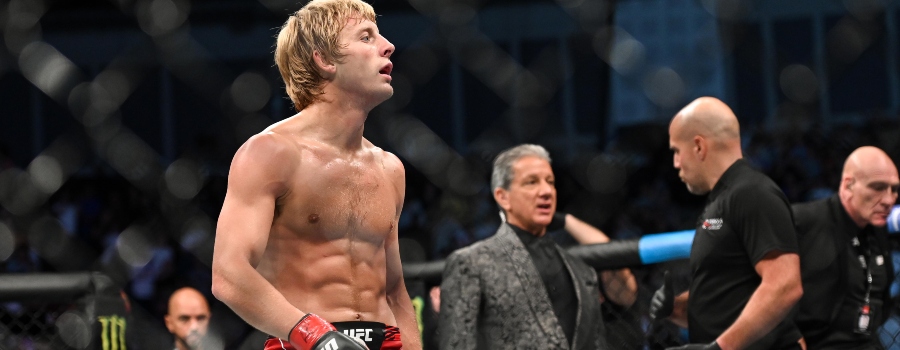
Pictured: Paddy Pimblett
Photo Credit: Imagn

With the NFL season nearly complete and baseball still a few months away, it’s a relatively slow time for DFS players. Fortunately, the UFC is making their return after six weeks off — and with it comes the absolute best DFS sport.

I’ve already written about why you should be playing UFC DFS contests in the past, but if that wasn’t enough for you, I’m back with a guide on how to get started. For a slightly deeper dive into some data, you can also check out the article I wrote when DraftKings changed their scoring system in 2021.

While some of the specific numbers don’t hold up, the general concept still works — the scoring system hasn’t been changed since. This piece will build off of that one now that we’re five years into the scoring system, with some general principles for both cash games and GPPs, targeted at the novice player.

As a quick intro, on DraftKings we pick six fighters with a $50,000 salary cap. The most important points come from winning the fight, with bonuses provided for winning by knockout or submission as opposed to decisions. Outside of that, points are scored for knockdowns, takedowns, strikes (significant strikes score double), control time, and reversals.

We’ll get more into what those mean as we go through the article, but my previous piece on the scoring system explains each scoring category in detail.

Our MMA DFS Model

We have built out a full player-projection model using the FantasyLabs Tools and Player Models to help put together some winning DFS lineups in UFC. You can use our optimizer to build optimal lineups using these projections.

The model, created by our own Sean Koerner, is based on 10,000 simulations of all the fights. He then pulled the DraftKings score from each bout to create floor, median, and ceiling projections for every fighter. Here is how he defined each projection:

  • Floor: Fighter has an 80% chance of going over this score, 20% chance of going under
  • Median: Fighter has a 50% chance of going over this score, 50% chance of going under
  • Ceiling: Fighter has a 20% chance of going over this score, 80% chance of going under

These should give us a better sense of which fighters we should target based on the game type – maximizing ceiling in GPPs, for example.

Become an All-Access Member Today

Lineup builder and optimizer

Real-time DFS models & projections

Data-driven analysis & tutorials
 

Cash Games

Cash games in all sports are much less popular than they used to be. However, they can still be an excellent tool to build a bankroll, get used to a new fantasy sport, or smooth out the volatility inherent in playing GPPs only.

I’ve long been an advocate for UFC cash games in particular, as the field is still nowhere near as sharp as it is in other sports. Since fights can be over in an instant, projections are inherently more variable, and we don’t typically encounter tons of players running the same “optimal” lineup from a popular source. Additionally, there are still fairly obvious mistakes being made by a good chunk of the field.

Pricing

The most important thing to understand in DFS is the salary structure. This article is primarily focused on DraftKings, though we’ll also touch on some FanDuel wrinkles where appropriate.

While the pricing system in some sports is fairly opaque, featuring a mixture of players’ past performances, prior ownership, role changes, and the matchup, things are much simpler in UFC contests on DraftKings.

DraftKings typically releases salaries on Monday before events, with the salary 100% a reflection of the fighter’s moneyline odds. The exceptions to that rule are when a fight is added or an opponent pivots after the initial release of salaries, or when fighters have extremely close moneyline odds.

DraftKings is extremely resistant to pricing two fighters identically, so the vast majority of the time one will be semi-arbitrarily elevated in price, though this is fairly rare. There’s a small edge there in taking the cheaper fighter in these instances, but it’s not common enough to worry about.

The bigger edge comes when fighters’ winning odds change. Since DraftKings salaries are static, often sharp bets or late news will significantly change a fighter’s (market-based) odds of winning without their salary moving.

The most notable example is when a fighter is an underdog, gets a new opponent, and becomes a favorite. Those situations are must-plays for cash games. We also have instances when fighters’ odds move considerably even against their original opponent, and if the move is large enough, that typically makes them strong cash game plays as well.

FanDuel typically releases salaries later in the week and will often update salaries if opponents are changed.

Roster Construction

The biggest difference between cash and GPP lineups for UFC contests is the concept of stacking. Unlike other sports where a stack means players from the same team, in MMA it refers to rostering two fighters from the same fight.

The main reason for doing so is that UFC title fights and main events are five rounds, while most fights are three. That means you either get ten extra minutes of scoring from both fighters, or you guarantee a win by finish (with the accompanying large score) from at least one of the pair. Since fighters aren’t priced any higher for five-round fights, that makes them inherently valuable.

The vast majority of the time, we should be stacking both five-round fighters in cash games. Some cards have multiple five-round fights, which complicates the issue, as guaranteeing two losses can be a problem. Additionally, extremely lopsided main events sometimes justify fading the underdog—though those underdogs are sometimes cheap enough that it’s worth playing them anyway. I make it a point to discuss stacking strategy in my weekly breakdowns, particularly when there are multiple five-round fights on the slate.

Finding Value

Outside of fighters who have seen significant line movement, the other main source of value in cash games is cheap fighters whose fight likely goes the distance. Typically, heavy underdogs are likely to lose more quickly, which makes it hard for them to score points. Sometimes—often with female and lighter-weight fighters—that isn’t the case.

This is an important dynamic for cash games. If a fighter is cheap enough, they can usually stumble into enough points to help your lineup in a decision loss. While we’d of course prefer to roster fighters who win, the salary cap makes that difficult, so the best option is often cheap fighters with a solid floor.

I discuss fighters who fit that archetype in the “Value Plays” section of my breakdowns. Often, we’re forced to pick between a fighter with line movement in their direction and one likely to see a decision, but occasionally we find one who meets both criteria.

Paying For Safety

In GPPs, we typically want to pay up for ceiling. In UFC DFS, that means fighters who can pile up a ton of takedowns or finish the fight early. However, in cash games, I want favorites who are solid bets to pick up a win—even if their ceiling is a bit lower.

In practice, that means avoiding fighters who aggressively hunt finishes, since that can leave openings for their opponent. It also means prioritizing fighters based on their moneyline odds rather than their odds to win by a finish.

Often, the best fighters for cash games are also the strongest GPP plays—especially wrestlers who score points with takedowns rather than trading strikes—but sometimes there are solid cash game plays who lack the upside for GPPs, or high-ceiling options a bit too risky for cash games.

Overall Builds

Each slate is different, so take everything in this section with a grain of salt. Broadly speaking, though, my goal in cash game lineups is to stack the main event and include three other favored fighters I feel reasonably confident will pick up a win.

The average salary per fighter with a $50,000 cap is $8,333. DraftKings prices favorites at $8,200 or higher and underdogs at $8,000 or below, with both fighters’ salaries adding up to $16,200. That means when we stack the five-round fight, we’re left with a bit more salary per remaining fighter—$8,450, to be exact.

If the pricing breaks right, that means we could, in theory, roster four other favorites for a total of five. However, it typically doesn’t line up to make that possible, plus those other favorites would all be in fights that are close to a coin flip.

Instead, after stacking the main event, I’ll then add my favorite value play and, hopefully, three of the safer favored fighters on the card. Having a lineup with four wins is typically enough to cash in most double-ups, so this is a solid jumping-off point if you’re interested in trying out UFC DFS cash games.

Updated on 1/22/26

DraftKings Pick6
Play $5 Get $50 in Pick6 Credits + Gimme Pick for Every Playoff Round!
Gambling Problem? Call 1-800-GAMBLER. Help is available for problem gambling. Call (888) 789-7777 or visit ccpg.org (CT). 18+ (19+ AL/NE, 21+ AZ/MA/VA). Valid only where Pick6 operates, see http://dkng.co/pick6states. Void in NY, ONT, and where prohibited. Eligibility restrictions apply. 1 per new DraftKings customer. First $5+ paid Pick Set to receive max. $50 issued as non-withdrawable Pick6 Credits that expire in 14 days (336 hours). Ends 1/25/26 at 11:59 PM ET. Terms: http://pick6.draftkings.com/promos. Sponsored by DraftKings.

Large-Field Tournaments

Many of the same principles that we apply in cash games carry over to GPPs, but there are of course some key differences. We’re still hunting the same type of fighters, those with strong odds of winning and high per-minute output, but with a shift from safety to ceiling. Here’s some of what I look for in GPPs.

Finding Finishes

With DraftKings scoring providing more points for stoppage victories—and those points increasing based on how fast the stoppage comes—the vast majority of the time we’re looking for fighters who are likely to knock out or submit their opponent.

The simplest way to identify those fighters is to look up the odds of a fight ending inside the distance or that fighter’s specific odds of winning with a finish. Strikers and larger weight class fighters get priority here, as I showed in my previous article on the scoring system. By and large, the size of the fighter directly correlates with how likely a finish is in their fight.

Of course, since we can’t stack a roster completely with favorites, this makes fighters in highly volatile fights much more valuable in GPPs. In my weekly breakdown, I discuss these in the “Swing Fight” section. These are usually reasonably closely matched fighters who both have a “kill or be killed” style. Odds are, the winner will post a big score, the loser will end up with next to nothing, and identifying which is which is extremely difficult but valuable.

If you’re playing multiple lineups, the best course of action is to mix both fighters in fights like this across your portfolio. For single-entry players, you’ll have to take a stand, but getting it right can be massively important.

Takedown Artists

With DraftKings awarding five points per takedown, an ability to pile them up becomes massively important. While knockdowns score twice as much, it’s extremely unlikely a fighter can land multiple knockdowns in a fight, while we somewhat regularly have fighters who push for double-digit takedowns in a fight.

However, identifying these fighters is somewhat tricky. They need to be in the sweet spot of good enough wrestling to land takedowns but not dominant enough to keep their opponent down. If the opponent doesn’t escape back to their feet, the maximum number of takedowns they can land in a round is one. While control time somewhat makes up for this, it takes nearly three minutes of control time to equal a takedown.

This is where the lighter-weight fighters come into play. Fighters in lighter weight classes typically have better cardio—enabling them to continuously shoot takedowns—but the lower bodyweight means it’s harder to hold their opponents down. There are some higher weight class fighters who pile up takedowns as well, but they typically only shine when paired with opponents who can get back to their feet effectively.

Roster Construction

The other crucial difference between GPPs and cash games is the value (or lack thereof) of stacking. Obviously, stacking fighters in GPPs is typically a bad move, since you’re guaranteeing a loss in your lineup. The majority of GPPs are won by rosters with six winners, but sometimes that’s not possible. That typically happens when most or all of the favorites win, making it mathematically impossible to fit six winners.

I tracked whether one, both, or neither fighter in every five-round fight made the optimal lineup for a period of about six months. Most of the time (roughly 70%), one fighter from the five-round fight(s) made the optimal lineup. The average combined ownership of five-round fighters was about 80% in that timeframe, with that number being lower on cards with multiple five-rounders.

That means there’s a slight edge in fading the main event, since neither fighter made it about 25% of the time, while only 20% of lineups didn’t include a five-round fighter, though the actual number is slightly higher, since some of the 80% combined ownership were lineups with both fighters from a single fight.

Speaking of, both fighters made the optimal lineup about 5% of the time, which could be an unexplored edge, though it’s hard to figure out what proportion of lineups included them together. The takeaway here is to not be afraid to pivot from the typical roster construction of one fighter from each five-round fight—but consider the context of the slate. If there are a ton of high-priced favorites and you don’t like any of the underdogs, stacking the main event makes sense. When there are closer lines and some highly volatile fights, fading a lackluster five-rounder might be the best move.

Be sure to check our MMA DFS page for all our coverage, along with my Lineup Optimizer tutorial.

Pictured: Paddy Pimblett
Photo Credit: Imagn

About the Author

Billy Ward writes NFL, MLB, and UFC DFS content for FantasyLabs. He has a degree in mathematical economics and a statistics minor. Ward's data-focused education allows him to take an analytical approach to betting and fantasy sports. Prior to joining Action and FantasyLabs in 2021, he contributed as a freelancer starting in 2018. He is also a former Professional MMA fighter.