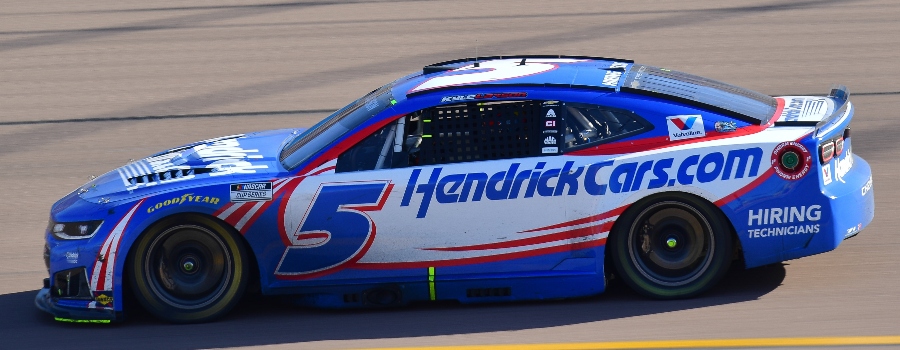
NASCAR stays on the western third of the country this weekend for the first intermediate-package race of the 2026 season at Las Vegas Motor Speedway.
LVMS is a 1.5-mile track that uses the intermediate package, which has no changes from last year. That should provide us with a great baseline of track and type history, and then we get to add in weekend data.
With 267 laps scheduled, this is usually a 1-2 dominator race, but on occasion there can be a three-dominator race.
Make sure to check out my practice FLAGS data for Vegas, as it’ll help guide you on who was fast in practice.
Additionally, you can check out my NASCAR projections in the NASCAR Models on FantasyLabs, complete with floor, ceiling, median, and ownership projections.
My projections, along with Stephen Young’s from RotoGrinders, are available in our NASCAR DFS package. You can read more about what the package entails here.
Let’s not skip the best part, my Perfect% metric, a metric that tells you how often certain racers appear in the optimal lineup when running 250,000 race simulations.
And don’t forget about the tools that FantasyLabs has to offer, like our Lineup Optimizer to effortlessly create up to 300 lineups or our Lineup Builder if you like to hand-build your lineups.
So, without further ado, here’s my strategy guide and NASCAR DFS picks for the Pennzoil 400 at Las Vegas Motor Speedway.
Pennzoil 400 Cash Game Picks
Christopher Bell ($10,700): Let’s start with the polesitter who ranked as a top-eight car in FLAGS and should cover us for the early laps in dominator points.
Additionally, Bell’s pit crew has been blazing fast this year, posting some of the fastest stops at every race.
That should get him back out in front a few more times over the course of the race, thanks to a fast crew using the preferred pit stall selection as the polesitter.
My model projects Bell as the second-most likely dominator for the race.
Kyle Larson ($11,000): The most likely dominator is none other than the man himself at Vegas, Kyle Larson.
Larson will start fifth, but he could grab the lead relatively quickly from being so close to the front, and was No. 1 in practice FLAGS, No. 1 in peak speed, No. 1 in long-run speed, and had relatively low tire degradation and strong consistency in practice.
That makes him my top pick to win the race.
Noah Gragson ($5,500): On a slate where we may need 2-3 big hitters in our lineups, Gragson is the perfect salary-relief option. He has the highest delta between his projected usage and his projected Perfect%.
He also starts 34th, raising his floor massively, since the only way he’d get negative place differential is to be one of the first two cars to crash out of the race.
Gragson was solid in practice, ranking 21st in speed-based and 24th in rank-based practice FLAGS, showing he’s likely at least 10 spots better on speed than his starting spot.
This is also a strong track for him historically, so he’s the perfect punt play for your cash lineups.
Pennzoil 400 Tournament Picks
Dominators: Like I said, we’ll want 1-2 dominators per lineup, or rarely three. Here are my top dominators by likelihood of dominating:
- Kyle Larson
- Christopher Bell
- Denny Hamlin
(intentional gap left to show tiers) - William Byron
- Ty Gibbs
- Tyler Reddick
- Bubba Wallace
- Chase Briscoe
Chase Briscoe ($9200): This is going to sound math nerdy, but that’s why I do this: Chase Briscoe ranked third in a geometric mean of FLAGS, tire degradation, and consistency in practice.
In other words, in the three most important categories for a car’s ability, Briscoe was broadly strong enough that I’m willing to overlook a one-lap qualifying run, or a lack of peak pace, and focus on how the car and driver should fare over multiple laps.
If we have a green-white-checkered finish, that could hurt Briscoe. But the overtime probability is relatively low, and this race is more likely to end on a medium-to-long run than a sprint, which should favor the practice stats of Briscoe.
Justin Allgaier ($6800): “Gator” projects to be in the low teens for usage, but my model has him close to 20% optimal. Looking at his lap times, I agree he should be heavily used.
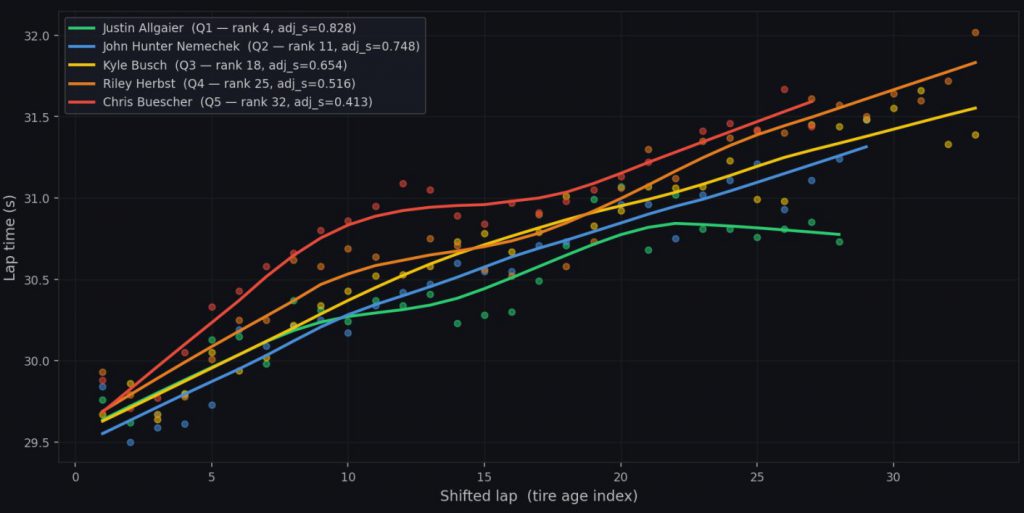
Relative to some other drivers in lower practice FLAGS tiers, Allgaier (green curve) had really flat lap times beyond lap 20, which shows his tire falloff was exceptionally low.
In addition, he was still one of the quicker drivers early in his run, too.
Pennzoil 400 Paul Menard Pick of the Week
I have *two* PMPOTW candidates this week, but you probably shouldn’t use both in the same lineup (except in a super tiny amount if you are mass multi-entering).
The first is Zane Smith ($5900), who I’ve been high on all week. Smith starts 12th and was a top-five car by practice FLAGS, but he did have some falloff and lacked a bit of consistency.
Still, my model gives him a 15% chance to be in the optimal lineup compared to around 10% ownership.
The other is Erik Jones ($6500), who starts two spots behind Smith but checked all the practice boxes as well. Unfortunately my model doesn’t love him, but I’m personally overriding my model here and counting Jones as my other PMPOTW.
When I talked about that geometric mean for Briscoe, Jones actually ended up sixth in that metric, showing he has a great blend of pace (FLAGS), as well as relatively low tire degradation and strong consistency. I’d actually go overweight to the field on Jones as well, despite my model giving him only 5% on the Perfect% metric.
Pictured: Kyle Larson
Photo credit: Gary A. Vasquez, Imagn
YOU MAY ALSO LIKE
 DraftKings NASCAR DFS Picks for Texas: Fantasy NASCAR Strategy for Sunday’s Race at Texas
 DraftKings NASCAR DFS Picks for Las Vegas: Fantasy NASCAR Strategy for Sunday’s South Point 400
 DraftKings NASCAR DFS Picks for Homestead: Fantasy NASCAR Strategy and Picks for the Straight Talk Wireless 400
 DraftKings NASCAR DFS Picks for Martinsville: Fantasy NASCAR Strategy and Picks for the Xfinity 500