Koerner’s Fantasy Football WR Tiers: Rankings for Redraft Leagues

Sign up with the BetMGM bonus code LABSTOP and claim a $1,500 first bet offer for the Steelers vs. Bengals TNF matchup.

The WR position had a brutal 2024 season, with a higher rate of missed games and busts than we typically see from what is usually a more stable spot compared to RB. Running backs, on the other hand, had one of their healthiest seasons in recent memory, which prevented us from tapping into the usual upside of backup RBs stepping into big roles. As a result, targeting RB early (outside of Christian McCaffrey) ended up being the better approach last year.

I think the pendulum swings back in 2025, making it critical to land one or two WR1s in the draft. If you cannot, aim for at least three WRs before the WR2 tier is off the board. Once your starters are set, you can pivot to other positions or take calculated shots on high-upside WRs to fill out your bench. Historically, the top 30 WRs by season’s end are almost always drafted before the late rounds, whereas league-winning QBs, RBs, and TEs can still be found later or added in-season. That scarcity is one more reason I target WRs early and often.

This does not mean you should ignore RB early (I still want a top-12 RB when possible), but my typical goal is to leave the first three rounds with some combination of two WRs and one RB. The order depends on draft position and league format. In leagues that only start two WRs, you can value the position slightly less.

For the format this article is framed around (12-team, 0.5 PPR, starting three WRs and one Flex), my favorite possible start is from the 9–12 slots and would be: Puka Nacua / Amon-Ra St. Brown / Brian Thomas Jr. + De’Von Achane / Derrick Henry / Ashton Jeanty + Jaxon Smith-Njigba in the first three rounds. Based on my current projections, the optimal start from that range would be very possible based on current ADP: 1st Puka Nacua / 2nd Derrick Henry / 3rd Jaxon Smith-Njigba.

Dominate your Best Ball and season-long fantasy football leagues with our brand-new app that’s available in the Apple App Store and on Android!

Tier 1 – Ja’Marr Chase Tier

  • Ja’Marr Chase

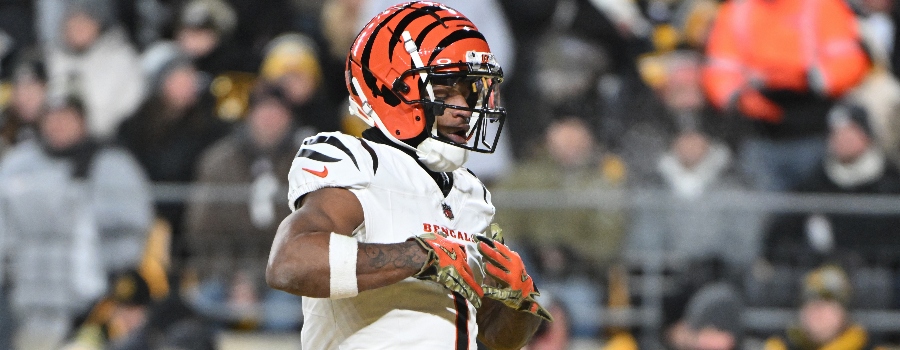
One of the biggest misconceptions in fantasy football is that ranking a player first overall means you’re predicting he will finish there. People treat rankings like absolutes when, in reality, they should be viewed as probability distributions. My WR1 ranking for Ja’Marr Chase (along with pretty much every other analyst out there) is not a guarantee—it’s a reflection that, if we were setting odds for every WR to finish as the overall WR1, Chase would be the clear favorite.

Yes, history tells us it’s unlikely he repeats. We’ve seen a different WR take the WR1 crown in 10 straight seasons, and his odds of doing it are probably under 50 percent. That’s simply how variance works. He could miss games. Joe Burrow could get hurt. Or another elite WR, like Puka Nacua or Nico Collins, could have a career year and edge him out. Every wide receiver has that kind of risk baked into their range of outcomes.

What matters is that Chase has the highest probability in the field. That’s what makes him worth the WR1 pick.

He’s entering Year 5, in his age-25 season, likely the peak of his career. He plays with Joe Burrow, the quarterback he’s had every step of the way since LSU, which gives him unmatched chemistry with one of the league’s best passers. He’s in a pass-heavy offense that led the league in pass rate over expected last year, with a defense that often forces high-scoring game scripts. It’s as close to an ideal setup as you can get.

The takeaway is simple: just because he might not finish as the WR1 doesn’t mean you should draft someone else. Chase is the odds-on favorite, and he belongs in a tier of his own.

Tier 2 – Elite WR1s

  • Justin Jefferson
  • CeeDee Lamb

Justin Jefferson is essentially QB-proof, so I do not expect any meaningful drop-off going from Sam Darnold to JJ McCarthy. I am actually high on McCarthy, and it is within his range of outcomes to be just as good, or even better, than Darnold. Kevin O’Connell’s system has consistently elevated quarterbacks, from Nick Mullens to Josh Dobbs to Kirk Cousins to Darnold, often producing career-best stretches.

One overlooked angle is that if McCarthy struggles, it could actually boost Jefferson’s production. The Vikings led for 34.5 minutes per game last season, second only to Detroit, often jumping out to early leads thanks to an efficient offense and defense. That allowed them to play more balanced, or even run-heavy, later in games. If McCarthy creates negative game scripts with turnovers or stalled drives (early in games), the team would likely be forced into more aggressive passing in the second half. Either way, Jefferson benefits. He remains a locked-in top-three option in any scenario.

CeeDee Lamb was WR6 in points per game through Weeks 1–8 last year with a healthy Dak Prescott, then fell to WR19 after Prescott’s season-ending injury forced Cooper Rush into the lineup. With Prescott fully healthy, Lamb should bounce back to elite status. The addition of George Pickens should help stretch the field and pull defensive attention away, creating more room for Lamb to operate underneath and in the intermediate zones. The volume, talent, and role remain firmly in place, making him one of the safest elite WR1 selections.

Tier 3 – Solid WR1s

The WR position had a brutal 2024 season, with a higher rate of missed games and busts than we typically see from what is usually a more stable spot compared to RB. Running backs, on the other hand, had one of their healthiest seasons in recent memory, which prevented us from tapping into the usual upside of backup RBs stepping into big roles. As a result, targeting RB early (outside of Christian McCaffrey) ended up being the better approach last year.

I think the pendulum swings back in 2025, making it critical to land one or two WR1s in the draft. If you cannot, aim for at least three WRs before the WR2 tier is off the board. Once your starters are set, you can pivot to other positions or take calculated shots on high-upside WRs to fill out your bench. Historically, the top 30 WRs by season’s end are almost always drafted before the late rounds, whereas league-winning QBs, RBs, and TEs can still be found later or added in-season. That scarcity is one more reason I target WRs early and often.

This does not mean you should ignore RB early (I still want a top-12 RB when possible), but my typical goal is to leave the first three rounds with some combination of two WRs and one RB. The order depends on draft position and league format. In leagues that only start two WRs, you can value the position slightly less.

For the format this article is framed around (12-team, 0.5 PPR, starting three WRs and one Flex), my favorite possible start is from the 9–12 slots and would be: Puka Nacua / Amon-Ra St. Brown / Brian Thomas Jr. + De’Von Achane / Derrick Henry / Ashton Jeanty + Jaxon Smith-Njigba in the first three rounds. Based on my current projections, the optimal start from that range would be very possible based on current ADP: 1st Puka Nacua / 2nd Derrick Henry / 3rd Jaxon Smith-Njigba.

Dominate your Best Ball and season-long fantasy football leagues with our brand-new app that’s available in the Apple App Store and on Android!

Tier 1 – Ja’Marr Chase Tier

  • Ja’Marr Chase

One of the biggest misconceptions in fantasy football is that ranking a player first overall means you’re predicting he will finish there. People treat rankings like absolutes when, in reality, they should be viewed as probability distributions. My WR1 ranking for Ja’Marr Chase (along with pretty much every other analyst out there) is not a guarantee—it’s a reflection that, if we were setting odds for every WR to finish as the overall WR1, Chase would be the clear favorite.

Yes, history tells us it’s unlikely he repeats. We’ve seen a different WR take the WR1 crown in 10 straight seasons, and his odds of doing it are probably under 50 percent. That’s simply how variance works. He could miss games. Joe Burrow could get hurt. Or another elite WR, like Puka Nacua or Nico Collins, could have a career year and edge him out. Every wide receiver has that kind of risk baked into their range of outcomes.

What matters is that Chase has the highest probability in the field. That’s what makes him worth the WR1 pick.

He’s entering Year 5, in his age-25 season, likely the peak of his career. He plays with Joe Burrow, the quarterback he’s had every step of the way since LSU, which gives him unmatched chemistry with one of the league’s best passers. He’s in a pass-heavy offense that led the league in pass rate over expected last year, with a defense that often forces high-scoring game scripts. It’s as close to an ideal setup as you can get.

The takeaway is simple: just because he might not finish as the WR1 doesn’t mean you should draft someone else. Chase is the odds-on favorite, and he belongs in a tier of his own.

Tier 2 – Elite WR1s

  • Justin Jefferson
  • CeeDee Lamb

Justin Jefferson is essentially QB-proof, so I do not expect any meaningful drop-off going from Sam Darnold to JJ McCarthy. I am actually high on McCarthy, and it is within his range of outcomes to be just as good, or even better, than Darnold. Kevin O’Connell’s system has consistently elevated quarterbacks, from Nick Mullens to Josh Dobbs to Kirk Cousins to Darnold, often producing career-best stretches.

One overlooked angle is that if McCarthy struggles, it could actually boost Jefferson’s production. The Vikings led for 34.5 minutes per game last season, second only to Detroit, often jumping out to early leads thanks to an efficient offense and defense. That allowed them to play more balanced, or even run-heavy, later in games. If McCarthy creates negative game scripts with turnovers or stalled drives (early in games), the team would likely be forced into more aggressive passing in the second half. Either way, Jefferson benefits. He remains a locked-in top-three option in any scenario.

CeeDee Lamb was WR6 in points per game through Weeks 1–8 last year with a healthy Dak Prescott, then fell to WR19 after Prescott’s season-ending injury forced Cooper Rush into the lineup. With Prescott fully healthy, Lamb should bounce back to elite status. The addition of George Pickens should help stretch the field and pull defensive attention away, creating more room for Lamb to operate underneath and in the intermediate zones. The volume, talent, and role remain firmly in place, making him one of the safest elite WR1 selections.

Tier 3 – Solid WR1s