
If you’re looking for an STX referral code, there’s no live U.S. code. There also aren’t any posted STX promo codes, STX coupon codes, or other working codes for American users at this point. STX is operating in Ontario, Canada, not in the United States, and its public Ontario refer-a-friend page is still marked “Coming Soon.” That said, STX’s Ontario rewards terms do describe a refer-a-friend setup where both users receive 100 STX Points after the new user verifies an email address, deposits funds, and places a first wager.
STX is a sports betting exchange, not a standard sportsbook. Its markets use yes/no contracts priced from 0 to 100, with YES settling at $100 and NO at $0. And, though everything is still pending, STX has made its U.S. interest pretty clear, and the CFTC’s designated contract market filings page lists XV Exchange, LLC (affiliated with STX) as pending as of December 9, 2025, so that’s definitely a starting point.
Quick Facts: STX Referral Code & Exchange Details
| 🎁 STX Referral Code | TBD (Check back for more updates) |
| 💰 Expected Welcome Bonus | TBD (No confirmed U.S. welcome offer yet) |
| 🇨🇦 Current Footprint | Ontario, Canada (US pending CFTC approval) |
| 📉 Trading Model | Peer-to-peer binary options ($0 to 100 contracts) |
| 📊 The Math / Edge | Up to 5% commission on profits, with lower tier rates currently shown on STX’s loyalty page |
| 🤖 Tech Stack | Erlang/Elixir, plus public APIs and SDKs |
| ✅ Info Last Verified | March 2026 |
How To Claim an STX Code
Right now, there’s nothing for a U.S. user to claim.
If STX does go live in the U.S. later, the signup flow should look a lot like what STX already shows on its live registration pages. The current flow includes Basic Information (email, mobile number, and name), Demographic, Address, Professional Details, Password, and Consent. STX’s terms say identity verification may involve a telecommunications provider and/or a credit bureau, explaining this doesn’t affect your credit score.
A likely step-by-step would look like this:
- Go to the STX website or app.
- Click Sign Up.
- Enter your personal details.
- Complete the identity verification process.
- Fund the account once banking is live.
- Start trading the listed markets.
The Math Behind STX: Trading Implied Probabilities
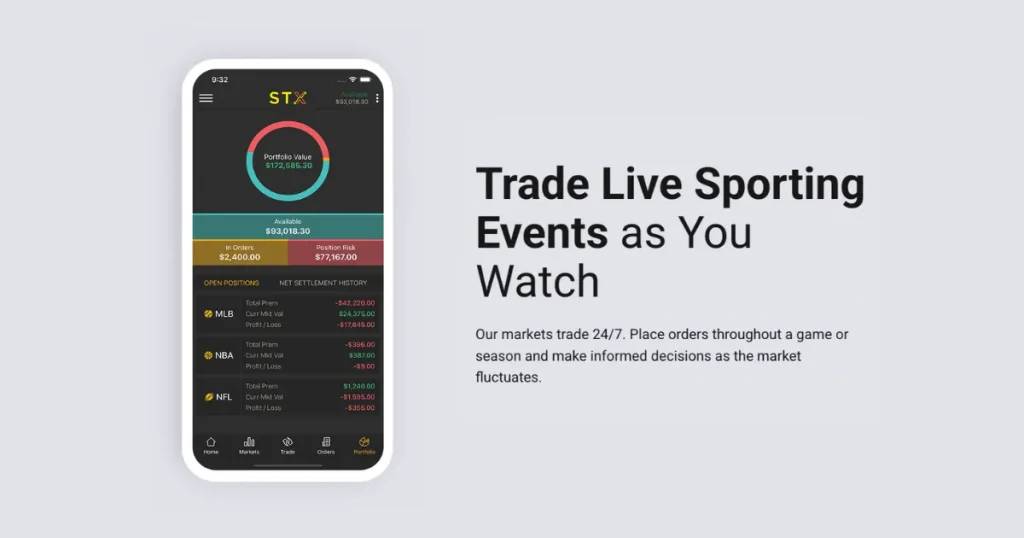
STX’s setup will feel pretty natural to anyone who already follows prediction markets like Kalshi and PrizePicks, or other event-contract products. Each contract is a yes/no position. YES settles at $100, NO settles at $0, and the current price acts like the market’s live read on the probability. If a contract is trading at 49, the market is basically pricing that side at around a 49% chance at that moment. That’s why the format tends to click fast for people who already think in percentages instead of converting everything back and forth in their head.
Say a YES contract is trading at 49.51. If you buy there and the market later resolves YES, the contract settles at $100, so the gross profit is $50.49 before fees. If the price moves from 49.51 to 62.15 before settlement, you can also sell earlier and lock in that move without waiting for the final result, meaning you’re not always stuck sitting on one ticket until the game ends if the market has already moved your way. In short, the order-book setup gives you more ways to manage a position than the usual sportsbook bet-slip model.
This format also makes sense for modelers. The market price is already giving you a probability number, so it’s easier to compare your projection to the market without converting from American odds first. If your number says 58 and the current price is 49.51, you immediately know why that market has your attention. That doesn’t mean you blindly fire: it just means your number and the market number are not lining up, and that’s usually where the real work starts.
STX vs. Traditional Sportsbooks
Besides everything we just said, the biggest difference is who sets the price. On STX, users are matched against other users, and a wager happens when a buy order and a sell order overlap. At a regular sportsbook, the operator posts the number and you decide whether to take it. On STX, the market itself is doing more of the pricing work, which is why the whole thing feels closer to trading than clicking a fixed line on an app for bettors.
The fee setup is different, too. Traditional sportsbooks usually build their margin into the line, while STX says winning settlements incur a fee on profits, and losing settlements don’t carry a fee or rebate. That is a different setup from taking a sportsbook price and knowing the hold is already sitting there before you even decide whether to play it.
There’s also more control over how you get in. STX’s house rules explain that a wager is not approved unless a buy order and a sell order from two users overlap on price. For limit orders, users can set a limit price and no wager will execute at a worse price than that. For market orders, STX may show an estimated fill price, but the user is agreeing to accept the best available price under current market conditions. That matters, because the current price can move on you, especially in a live market. It also means limit orders matter more here than they do on a standard sportsbook page.
There’s more flexibility on the way out, too. STX’s exchange format lets users close positions before the market expires, instead of forcing them to hold every position all the way to settlement. For bettors who hate being locked into one ticket and one outcome with no room to adjust, that actually makes a real difference.
The Tech Stack: High-Frequency Trading & the Smart Wallet
STX has put a lot more of its plumbing in public than most operators do. The white paper says the platform runs on Erlang and Elixir, offers public APIs plus Python and C# SDKs, and uses a matching engine the company says averages 2 microseconds per match. If you’re just trying to log in and get a position down, that may not matter much. But if you care about execution, automation, or how an order-book market behaves when things speed up, it does.
On an exchange, speed isn’t just a line on a website. When prices are moving because users are posting and matching against each other, slower systems can leave you staring at a stale number or getting filled in a spot you didn’t want. That’s also why STX’s engine keeps market and order-book state in memory.
The Smart Wallet is the more day-to-day feature. It can free up available balance when an open order or closing settlement reduces risk, even if the market itself hasn’t expired yet, so you’re not always waiting for the final whistle just to get funds back into circulation.
If you’re active and like moving in and out of positions, tied-up balance is not fun at all. STX’s setup is built to recognize when your exposure has dropped and release some of that balance instead of leaving everything frozen until settlement. It’s not extra money: it’s the platform acknowledging that your liability has changed.
The US Expansion: STX and the CFTC
The public signal on the U.S. side is still the filing trail. The CFTC’s designated contract market filings page lists XV Exchange, LLC as pending, dated December 9, 2025. On the clearing side, the CFTC’s derivatives clearing organization filings page lists XV Clearing, LLC as pending registration, dated February 27, 2026.
That being said, a pending filing is not approval, not a launch date, and not a live U.S. market list. It tells you STX is serious enough about the federal route to be in the process, but it doesn’t tell you when Americans will actually be able to use the product.
So the clean read stays the same: Ontario is live, and the U.S. side is still in filing stage.
Banking on the STX Exchange
STX hasn’t published a live U.S. cashier, so there’s no reason to guess at what an American banking menu will look like.
However, what the Ontario rules say is still useful. Deposits are made through the methods offered on the platform, and withdrawal requests can be subject to deposit-method restrictions, bonus restrictions, transaction limits, processing fees, and security reviews. The house rules also say acceptable withdrawal methods may include cheque, wire, and other methods STX chooses to offer.
For timing, STX says payments are made as soon as reasonably possible, subject to up to five business days of internal processing time, especially if a request gets flagged for review.
Last but not least, for current deposit and withdrawal options and any related fees, STX tells users to log into their account. That is a reminder that live cashier information matters more than any generic information you may see out there. When the U.S. product is real, that’s when the real banking menu should be laid out.
Pros & Cons of the STX Sports Exchange
Pros
- Live Ontario exchange with real order-book pricing. STX runs a live Ontario exchange where orders are matched in an order book, and the rules spell out how matching, fills, and price-time priority work.
- A format that makes sense if you think in probabilities. The 0 to 100 setup is easy to read once you have seen it a couple times, and you don’t need to keep converting back and forth from American odds just to get a feel for where the market stands.
- More public detail than usual. Between the white paper, support materials, house rules, and terms, STX gives users more to work with than most operators do.
Cons
- Still not live in the U.S. For American readers, this is the main drawback. The Ontario product exists, and the U.S. side is still in the filing process.
- No verified STX promo codes in the U.S. There’s no public American welcome offer, and the U.S. version is not far enough along to treat one as imminent.
- The fee language takes a careful read. The simple version is 5% on winning settlements, but the rules also say STX can reduce fees and cannot charge more than 5% of profit. So the basic idea is easy enough, but it’s still the kind of product where reading the actual terms matters.
Responsible Trading on STX
Ontario users have the basic rollout of responsible trading tools: deposit limits, max wager limits, time limits, loss limits, reality checks, cool-off periods, and self-exclusion. Requests to tighten limits take effect immediately, while requests to loosen them are handled after a 24-hour period.
That timing matters. Anyone can talk about discipline when they are thinking clearly. The tougher moment is when a session is going sideways and you want to talk yourself into one more position. A limit that drops right away, and a higher limit that cannot be turned back on instantly is the kind of friction that can save you from yourself.
For breaks, STX says users can choose a cool-off period, and for self-exclusion the listed options are six months, one year, or five years. Once self-exclusion is selected, the user is logged out right away, cannot log back in during that period, and is removed from marketing materials, incentives, and promotions. Also, after self-exclusion, STX says open orders are canceled, while open positions remain until expiration.
Final Thoughts on the STX Referral Code
If you care about order-book pricing, yes/no contracts, and the ability to manage a position instead of just holding a fixed ticket, that is where STX stands out.
For U.S. readers, the answer is still measured. There are pending filings tied to XV Exchange and XV Clearing, but the American product isn’t live yet.
STX Referral Code FAQs
Is STX legal in the U.S.?
No. STX is live in Ontario, not in the U.S. right now, and the CFTC filings page lists XV Exchange, LLC as pending rather than approved.
How do STX binary options work?
STX uses yes/no contracts priced from 0 to 100. If the market resolves YES, the contract settles at $100. If it resolves NO, it settles at $0. The current price is the market’s live read on that outcome at that moment.
What is the STX commission?
STX’s house rules say winning settlements can be charged up to 5% of profit. That said, STX’s current loyalty materials also point to lower rates by tier, so it’s better to think of 5% as the cap, not the automatic answer in every case.
Can I build betting models for STX?
Yes. The 0 to 100 contract structure maps cleanly to probability modeling, and STX also publishes APIs and SDKs for users who want a more technical setup.
What’s the STX referral code?
There are no live U.S discount codes tied to STX right now. In Ontario, STX’s rewards terms describe a refer-a-friend setup tied to 100 STX Points, but the public refer-a-friend page is still marked as “Coming Soon.”
Is STX legit?
Yes, in Ontario. STX appears on Ontario’s regulated iGaming market list, and the STX site says it’s licensed in the province by the AGCO to provide online sports betting services.