NFL DFS Week 11 Millionaire Maker Review: Breaking Down the Winning Lineup

One of my favorite pieces of content to make is my weekly review of the winning Millionaire Maker — or occasionally other large prize pool — lineup. While we (rightfully) spend most of our time looking forward to the next slate, reverse-engineering what works in GPPs is a valuable exercise to make us better DFS players.

Week 11 featured an 11-game slate with the standard $20 buy-in Millionaire Maker contest.

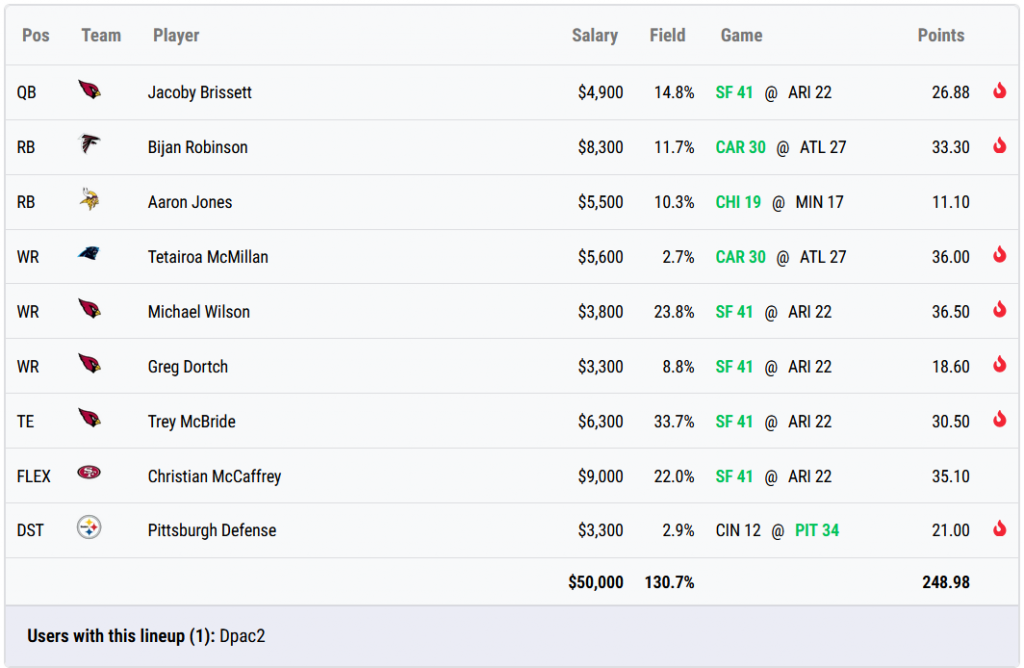
Mass multi-entry player Dpac2 won the contest with one of his 150 lineups. Let’s see how they did it and what type of overall exposures they had.

The Lineup
The Stack

In much of my content last week I highlighted the value in stacking the Cardinals. In my SimLabs building blocks piece, I specifically suggested stacking Jacoby Brissett with Trey McBride and Michael Wilson or Greg Dortch. Turns out where I went wrong there was the word “or,” since in fact a triple-stack of all three players took down the million-dollar first prize.

Which perhaps shouldn’t have been shocking, since last week the winning lineup featured a QB + 2 WR + TE stack with the opposing team’s running back. That’s two weeks in a row where that setupled to a first-place prize, with the running back in question this time being McCaffrey. CMC was a great play on paper heading into the week but somewhat hard to afford, and pairing Brissett with two of his cheap wideouts instead of just one made getting to him much easier.

Dpac2 was well above the field on all four Cardinals players, and beyond McCaffrey had above-the-field exposure to other expensive options like Puka Nacua and Josh Jacobs, among others. McCaffrey had the added benefit of correlating directly with the stack, but the broader logic seemed to be rostering both cheap Cardinals receivers as a way to afford more expensive studs.

Become an All-Access Member Today

Lineup builder and optimizer

Real-time DFS models & projections

Data-driven analysis & tutorials
 

Other Correlations

Other expensive players like Bijan Robinson, who Dpac2 was only slightly above the field on. Still, mixing and matching high-upside players like Robinson is never a bad idea, especially with the field growing frustrated with how many touchdowns were vultured by Tyler Allgeier in recent weeks. While it’s hard to predict when that regression will swing the other way, it was a pretty safe bet that it would at some point.

Dpac2 rostered Robinson alongside opposing wide receiver Tetairoa McMillan who came in under 3% ownership. They only had 6% exposure to McMillan, and my guess is they set an optimizer rule to pair a running back with an opposing wideout, as that remains an underrated correlation.

While Carolina eventually won the game, the game script lined up well for this particular stack, since Atlanta led most of the way and forced the Panthers to go pass-heavy to catch up, while the Falcons leaned on Robinson.

The Chalk

Most of the popular pieces in this lineup were part of the Cardinals stack. While I don’t have firm data to support it, my strong feeling is that the vast majority of lineups stacked at most two pass catchers with Brissett and at most two pass catchers in any stack in general. Thus, the effective ownership on this stack + McCaffrey was much lower.

Outside of that, the only player not yet discussed with double-digit ownership was Vikings running back Aaron Jones, who was also the worst per-dollar performer on the lineup. As always, the best plan isn’t to be contrarian for it’s own sake, as most of the less-popular players aren’t popular for a good reason.

Be sure to check out all the pick’ems Sleeper has to offer with our Sleeper Fantasy promo code.

The Sleepers

Outside of the previously mentioned McMillan play, the lowest-owned piece of this lineup was Pittsburgh Defense. I sound like a broken record at this point, but the takeaway remains the same: don’t play chalk defenses. Or at the very least, diversify your exposures. Dpac2 rostered 17 of the 22 possible team defenses, giving their portfolio a great shot of having exposure to any standout performances like Pittsburgh.

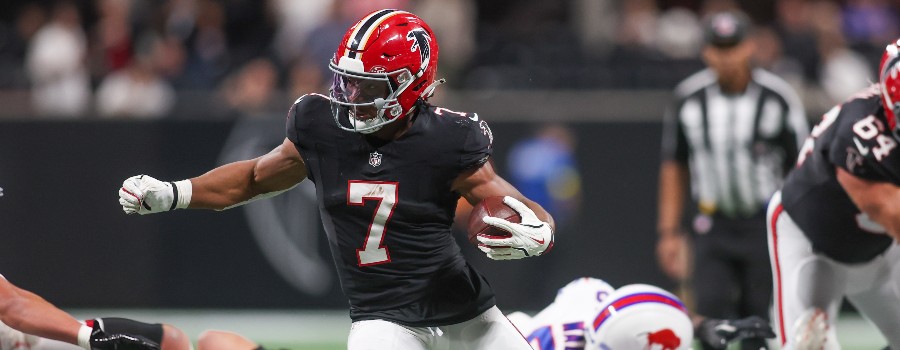
Pictured: Bijan Robinson
Photo Credit: Imagn

One of my favorite pieces of content to make is my weekly review of the winning Millionaire Maker — or occasionally other large prize pool — lineup. While we (rightfully) spend most of our time looking forward to the next slate, reverse-engineering what works in GPPs is a valuable exercise to make us better DFS players.

Week 11 featured an 11-game slate with the standard $20 buy-in Millionaire Maker contest.

Mass multi-entry player Dpac2 won the contest with one of his 150 lineups. Let’s see how they did it and what type of overall exposures they had.

The Lineup

The Stack

In much of my content last week I highlighted the value in stacking the Cardinals. In my SimLabs building blocks piece, I specifically suggested stacking Jacoby Brissett with Trey McBride and Michael Wilson or Greg Dortch. Turns out where I went wrong there was the word “or,” since in fact a triple-stack of all three players took down the million-dollar first prize.

Which perhaps shouldn’t have been shocking, since last week the winning lineup featured a QB + 2 WR + TE stack with the opposing team’s running back. That’s two weeks in a row where that setupled to a first-place prize, with the running back in question this time being McCaffrey. CMC was a great play on paper heading into the week but somewhat hard to afford, and pairing Brissett with two of his cheap wideouts instead of just one made getting to him much easier.

Dpac2 was well above the field on all four Cardinals players, and beyond McCaffrey had above-the-field exposure to other expensive options like Puka Nacua and Josh Jacobs, among others. McCaffrey had the added benefit of correlating directly with the stack, but the broader logic seemed to be rostering both cheap Cardinals receivers as a way to afford more expensive studs.

Become an All-Access Member Today

Lineup builder and optimizer

Real-time DFS models & projections

Data-driven analysis & tutorials
 

Other Correlations

Other expensive players like Bijan Robinson, who Dpac2 was only slightly above the field on. Still, mixing and matching high-upside players like Robinson is never a bad idea, especially with the field growing frustrated with how many touchdowns were vultured by Tyler Allgeier in recent weeks. While it’s hard to predict when that regression will swing the other way, it was a pretty safe bet that it would at some point.

Dpac2 rostered Robinson alongside opposing wide receiver Tetairoa McMillan who came in under 3% ownership. They only had 6% exposure to McMillan, and my guess is they set an optimizer rule to pair a running back with an opposing wideout, as that remains an underrated correlation.

While Carolina eventually won the game, the game script lined up well for this particular stack, since Atlanta led most of the way and forced the Panthers to go pass-heavy to catch up, while the Falcons leaned on Robinson.

The Chalk

Most of the popular pieces in this lineup were part of the Cardinals stack. While I don’t have firm data to support it, my strong feeling is that the vast majority of lineups stacked at most two pass catchers with Brissett and at most two pass catchers in any stack in general. Thus, the effective ownership on this stack + McCaffrey was much lower.

Outside of that, the only player not yet discussed with double-digit ownership was Vikings running back Aaron Jones, who was also the worst per-dollar performer on the lineup. As always, the best plan isn’t to be contrarian for it’s own sake, as most of the less-popular players aren’t popular for a good reason.

Be sure to check out all the pick’ems Sleeper has to offer with our Sleeper Fantasy promo code.

The Sleepers

Outside of the previously mentioned McMillan play, the lowest-owned piece of this lineup was Pittsburgh Defense. I sound like a broken record at this point, but the takeaway remains the same: don’t play chalk defenses. Or at the very least, diversify your exposures. Dpac2 rostered 17 of the 22 possible team defenses, giving their portfolio a great shot of having exposure to any standout performances like Pittsburgh.

Pictured: Bijan Robinson
Photo Credit: Imagn

About the Author

Billy Ward writes NFL, MLB, and UFC DFS content for FantasyLabs. He has a degree in mathematical economics and a statistics minor. Ward's data-focused education allows him to take an analytical approach to betting and fantasy sports. Prior to joining Action and FantasyLabs in 2021, he contributed as a freelancer starting in 2018. He is also a former Professional MMA fighter.