NFL DFS Sims: SimLabs Lineup Generator Building Blocks for Week 11

This season marks the third year of our SimLabs tool being available to the public. It’s a powerful feature that allows casual players to build competitive lineups effortlessly — or serious players to leverage their convictions more effectively. We’ve also added the feature of being able to export lineups from SimLabs directly to our models for easy tweaking of lineups.

I broke down some general uses of the tool from an evergreen perspective last season. Moving forward, we’ll be checking out some suggested starting points for building lineups.

The process is simple: from the SimLabs home screen, first select the field size and desired range of outcomes for your lineups. The field size depends on the contest type, while the “results range” allows you to customize how unique you want your lineups to be.

Then, find the box titled “include players” and type your preferred options — then sit back and let the sims do their thing. You can generate as many or as few lineups as you want, then upload directly to DraftKings to be entered into contests.

For more on what SimLabs is and how it works, check out our user guide.

Let’s check out some potential starting points in Week 11.

Become an All-Access Member Today

Lineup builder and optimizer

Real-time DFS models & projections

Data-driven analysis & tutorials
 

Justin Herbert + Quentin Johnson

As DFS players we have an extremely short memory. The first four weeks of the season saw Chargers WR Quentin Johnson emerge as his team’s #1 option, averaging about 20 DraftKings points per game. Since then, a combination of his own injuries and injuries to the Chargers offensive line have derailed his production.

The latter is relevant because Johnson, as a deep-ball threat, needs Justin Herbert to be protected for a few seconds in order to get open. That’s been hard to come by in recent weeks — but is why I’m on the Chargers this time around. They’re taking on a Jaguars team that’s dead last in sacks and features arguably the league’s worst pass rush.

With the Chargers ranking second in Pass Rate Over Expectation (PROE) and Herbert finally having a shot at a clean pocket, this could be the perfect week to get he and Johnson back on track. Both are projecting for low ownership, and Herbert specifically leads the slate in the “Optimal – Projected ownership” metric among QBs at SimLabs.

Jacoby Brissett + Trey McBride + Michael Wilson (Or Greg Dortch)

With Marvin Harrison out in Week 11, there are some surplus targets to go around in Arizona. He has been the team’s #2 option behind McBride, which could lead to his targets mostly going upwards to the tight end or down to one of the replacement wide receivers.

Trey McBride is probably the best overall play on the slate despite his high ownership, as a $6,300 player with WR1 numbers and tight end eligibility. Jacoby Brissett has put up at least 20 DraftKings points in each of his four starts but is inexplicably priced below $5,000 despite a plus matchup against the 49ers. Michael Wilson is potentially the direct replacement for Harrison but has seen the most targets on the team after Harrison and McBride.

My hope is that this block gives us plenty of two tight end lineups, since that’s my favorite way to limit the effective ownership on McBride. Most players are still reluctant to use a tight end in the flex, so two tight end builds with McBride immediately differentiate themselves from other McBride lineups.

Plus, the savings on McBride and Brissett make it much easier to afford any of the high-priced, high-upside wide receivers on the slate.

Aaron Rodgers + Jaylen Warren

Who has the best scoring offense in the NFL? Trick question, it’s “whoever is playing Cincinnati this week.” The Bengals have allowed 33.3 points per game this season, while no individual team has averaged more than 32.1.

The lucky offense this week is Pittsburgh, who put up 31 points in their first meeting with the Bengals. Rodgers and Warren cost a combined $11,500 and theoretically should give you exposure to every offensive touchdown scored by the Steelers.

Warren isn’t a huge pass-catching back, so this block admittedly limits upside a bit, though I suspect SimLabs will include at least one Steelers wideoutin most of the lineups built around it. For that reason, I’ll be using this more in small field or single entry contests, which I can account for in the SimLabs settings.

In fact, I’ll probably have a handful of lineups around this block entered in different single-entry contests this weekend. While you can only enter one lineup per contest, there’s no rule against multiple builds split across the wide range of single-entry tournaments available most weekends.

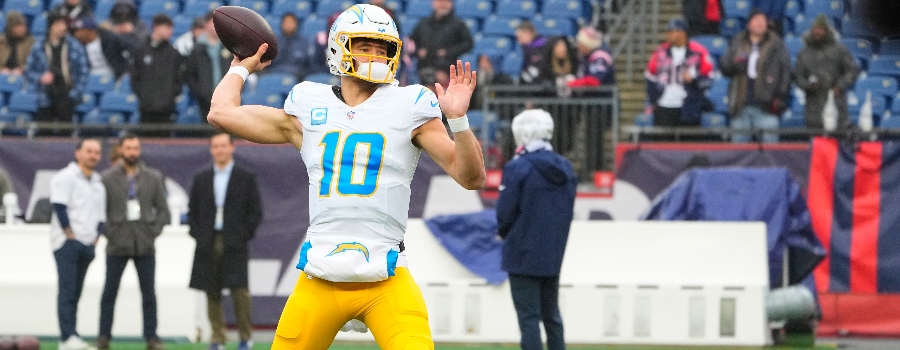
Pictured: Justin Herbert
Photo Credit: Imagn

This season marks the third year of our SimLabs tool being available to the public. It’s a powerful feature that allows casual players to build competitive lineups effortlessly — or serious players to leverage their convictions more effectively. We’ve also added the feature of being able to export lineups from SimLabs directly to our models for easy tweaking of lineups.

I broke down some general uses of the tool from an evergreen perspective last season. Moving forward, we’ll be checking out some suggested starting points for building lineups.

The process is simple: from the SimLabs home screen, first select the field size and desired range of outcomes for your lineups. The field size depends on the contest type, while the “results range” allows you to customize how unique you want your lineups to be.

Then, find the box titled “include players” and type your preferred options — then sit back and let the sims do their thing. You can generate as many or as few lineups as you want, then upload directly to DraftKings to be entered into contests.

For more on what SimLabs is and how it works, check out our user guide.

Let’s check out some potential starting points in Week 11.

Become an All-Access Member Today

Lineup builder and optimizer

Real-time DFS models & projections

Data-driven analysis & tutorials
 

Justin Herbert + Quentin Johnson

As DFS players we have an extremely short memory. The first four weeks of the season saw Chargers WR Quentin Johnson emerge as his team’s #1 option, averaging about 20 DraftKings points per game. Since then, a combination of his own injuries and injuries to the Chargers offensive line have derailed his production.

The latter is relevant because Johnson, as a deep-ball threat, needs Justin Herbert to be protected for a few seconds in order to get open. That’s been hard to come by in recent weeks — but is why I’m on the Chargers this time around. They’re taking on a Jaguars team that’s dead last in sacks and features arguably the league’s worst pass rush.

With the Chargers ranking second in Pass Rate Over Expectation (PROE) and Herbert finally having a shot at a clean pocket, this could be the perfect week to get he and Johnson back on track. Both are projecting for low ownership, and Herbert specifically leads the slate in the “Optimal – Projected ownership” metric among QBs at SimLabs.

Jacoby Brissett + Trey McBride + Michael Wilson (Or Greg Dortch)

With Marvin Harrison out in Week 11, there are some surplus targets to go around in Arizona. He has been the team’s #2 option behind McBride, which could lead to his targets mostly going upwards to the tight end or down to one of the replacement wide receivers.

Trey McBride is probably the best overall play on the slate despite his high ownership, as a $6,300 player with WR1 numbers and tight end eligibility. Jacoby Brissett has put up at least 20 DraftKings points in each of his four starts but is inexplicably priced below $5,000 despite a plus matchup against the 49ers. Michael Wilson is potentially the direct replacement for Harrison but has seen the most targets on the team after Harrison and McBride.

My hope is that this block gives us plenty of two tight end lineups, since that’s my favorite way to limit the effective ownership on McBride. Most players are still reluctant to use a tight end in the flex, so two tight end builds with McBride immediately differentiate themselves from other McBride lineups.

Plus, the savings on McBride and Brissett make it much easier to afford any of the high-priced, high-upside wide receivers on the slate.

Aaron Rodgers + Jaylen Warren

Who has the best scoring offense in the NFL? Trick question, it’s “whoever is playing Cincinnati this week.” The Bengals have allowed 33.3 points per game this season, while no individual team has averaged more than 32.1.

The lucky offense this week is Pittsburgh, who put up 31 points in their first meeting with the Bengals. Rodgers and Warren cost a combined $11,500 and theoretically should give you exposure to every offensive touchdown scored by the Steelers.

Warren isn’t a huge pass-catching back, so this block admittedly limits upside a bit, though I suspect SimLabs will include at least one Steelers wideoutin most of the lineups built around it. For that reason, I’ll be using this more in small field or single entry contests, which I can account for in the SimLabs settings.

In fact, I’ll probably have a handful of lineups around this block entered in different single-entry contests this weekend. While you can only enter one lineup per contest, there’s no rule against multiple builds split across the wide range of single-entry tournaments available most weekends.

Pictured: Justin Herbert
Photo Credit: Imagn

About the Author

Billy Ward writes NFL, MLB, and UFC DFS content for FantasyLabs. He has a degree in mathematical economics and a statistics minor. Ward's data-focused education allows him to take an analytical approach to betting and fantasy sports. Prior to joining Action and FantasyLabs in 2021, he contributed as a freelancer starting in 2018. He is also a former Professional MMA fighter.