NFL DFS Showdown Picks Breakdown for Chargers vs. Patriots Sunday Night Football (1/11)

What a start to the NFL playoffs! We had two fantastic games Saturday, and there are three more to choose from Sunday. That includes a Sunday Night Football contest between the New England Patriots and the Los Angeles Chargers. The Patriots are listed as 3.5-point home favorites, while the total sits at 45.5 points.

The Patriots were one of the biggest surprises in football this season. They were expected to be significantly improved compared to last year, but they ended up finishing with 14 wins and the No. 2 seed in the AFC. Their second-year quarterback blossomed into an MVP contender, and their offense finished in the top three in both yards and points per game. However, they had most of their success against an extremely easy schedule, with just two of their wins coming against playoff teams. It leaves the Patriots a bit unproven heading into the playoffs.

The Chargers finished with 11 wins during the regular season, but they enter the postseason on a two-game losing streak. One of those losses was irrelevant, as the team sat most of their starters in Week 18, but their offense has struggled to find a consistent rhythm down the stretch. Their quarterback is playing through an injury, while their offensive line has dealt with multiple key absences. That said, this team does have the experience edge, and that can play a difference in the playoffs.

Let’s dive into all the DFS options for Sunday Night Football.
NFL DFS Stud Picks

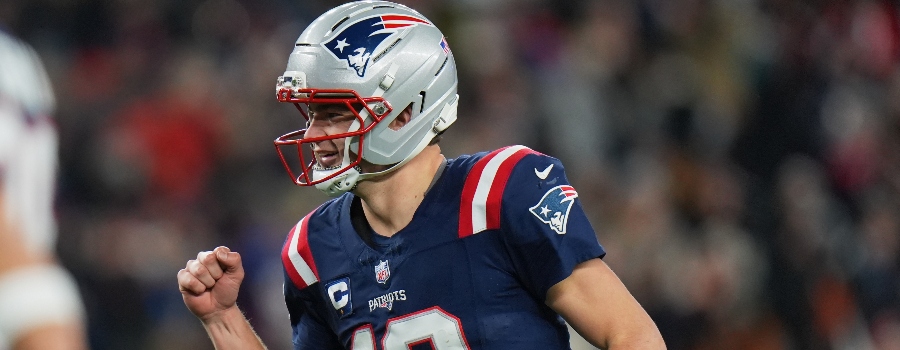
Drake Maye is the most expensive player in this contest, and he’s put together a marvelous second season. He led the league in a variety of efficiency metrics, including completion percentage, adjusted yards per attempt, QBR, and Quarterback Rating. He was just named a second-team All-Pro, making him a slight underdog to Matthew Stafford in the MVP market.

Maye was also excellent for fantasy purposes. Only Josh Allen averaged more fantasy points per game at the position, and Maye provided a rock-solid floor for most of the year. He posted a negative Plus/Minus in just four of his 17 outings, and he had less than 15.44 DraftKings points just once all season.

Maye combines his efficient passing with solid rushing upside. He’s not truly elite in that department, but he averaged 26.5 rushing yards per game with four total touchdowns during the regular season. Now that we’ve reached the postseason, it’s possible that Maye leans a little more on his legs moving forward.

Unfortunately, the matchup vs. the Chargers is not ideal. They were strong against the pass this season, ranking ninth in pass defense EPA. They allowed the second-fewest fantasy points per game to opposing quarterbacks, giving Maye an Opponent Plus/Minus of -4.0.

Still, he has the top median and ceiling projection in our NFL Models, and he also ranks first in projected Plus/Minus. He owns the top optimal lineup rate at both Captain and the Flex spots in Sim Labs, with a combined mark north of 80%. That makes him an extremely difficult fade.

Justin Herbert is the other quarterback in this contest, and he wasn’t quite as productive as Maye this season. He was 10th at the position in fantasy points per game, and his output was a lot more volatile. He was capable of putting together big games with five games of at least 26.28 DraftKings points, but he was also prone to plenty of clunkers.

Herbert enters the postseason on a bit of a downswing. He posted a negative Plus/Minus in six of his final seven starts, with 33.2 DraftKings points vs. the Cowboys’ lowly defense the lone exception. His string of poor performances coincides with Joe Alt landing on IR, and the Chargers’ offense line has struggled without him.

Herbert will have to navigate a tough set of circumstances this week vs. the Patriots. Not only is his team traveling to the East Coast, but the Patriots were a strong defensive team all season. They’re 11th in pass defense EPA, and they allowed the 11th-fewest fantasy points per game to the position.

The positive news for Herbert is that he has fared better than most QBs as a road underdog. He’s posted a positive Plus/Minus in that split for his career, averaging more than 21.4 DraftKings points per game (per the Trends tool). He posted a +2.24 Plus/Minus in two starts as a road underdog this season, so he’s still capable of providing production.

Herbert trails only Maye from a projection standpoint in our NFL Models, and he’s also No. 2 in optimal lineup rate in Sim Labs. Using both quarterbacks will be a popular approach, but it could certainly pay dividends.

NFL DFS Midrange Picks

Stefon Diggs is the most expensive skill position player in this contest. Diggs had a solid first year with the Patriots, despite being used as a part-time player. His route participation was limited to just 65%, with the Patriots taking it easy on him after he tore his ACL last season.

When Diggs was on the field, he was the clear focal point of the team’s passing attack. He was targeted on 24% of his routes run, and he put together a few big games. That includes 25.1 and 25.8 DraftKings points in two of his final three regular-season outings.

There’s a chance that Diggs takes on a larger role in the postseason. If he can see a few more snaps, he could definitely improve upon his fantasy production from the regular season. The current state of the Patriots’ receiving corps only increases that likelihood. The team will be without Mack Hollins, while Kayshon Boutte is listed as questionable. It leaves Diggs as one of just four truly healthy receivers on the roster, and he’s clearly the best of the bunch.

Omarion Hampton was a first-round pick for the Chargers in 2025, but his season has been marred by injuries. He was limited to just nine games played, though he did return for four of the team’s final five contests.

Hampton operated as the Chargers’ clear bell-cow back in his final game of the regular season, albeit with fellow running back Kimani Vidal, who isn’t on this week’s injury report, missing the game. He played on 83% of the team’s offensive snaps, and he handled 82% of their carries. Most importantly, he racked up a 26% target share. He finished with 20.0 DraftKings points in that contest, despite averaging a paltry 2.1 yards per carry vs. an excellent Texans defense.

If Hampton can maintain that workload vs. the Patriots with Vidal back in the mix, he has the potential to be one of the top fantasy producers in this game. Unfortunately, Hampton is officially listed as questionable with an ankle injury. He says he plans to play vs. the Patriots, but his workload remains to be seen.

It makes Hampton a high-risk, high-reward option. With that in mind, using him in the Captain spot makes plenty of sense. No one has a larger gap between optimal Captain rate and projected ownership in Sim Labs.

The Patriots’ backfield is also a bit muddled. They employed a committee between TreVeyon Henderson and Rhamondre Stevenson for most of the year, and both guys provided some fantasy value down the stretch.

Henderson is the more explosive player, and he had the edge in carries toward the end of the year. He’s capable of turning any touch into a long score, and there’s a chance that the Patriots expand his workload in the playoffs.

However, Stevenson had the more desirable workload for fantasy purposes during the regular season. He had the clear edge on passing downs and in short-yardage situations, which are the most high-value snaps for running backs.

Stevenson rode that workload to three straight big games to close out the regular season. He finished with 17.8, 27.2, and 38.3 DraftKings points, and he was the No. 1 scorer at the position in Week 18. Henderson had just 2.2, 8.2, and 17.3 DraftKings points over the same time frame.

It makes Stevenson arguably the superior option, especially when you factor in his cheaper price tag. If the utilization remains unchanged compared to the regular season, it should surprise no one if Stevenson outscores his more-heralded teammate.

While Diggs is the clear leader of the Patriots’ receiving corps, the Chargers have a trio of options that split the workload pretty evenly. Ladd McConkey, Quentin Johnston, and Keenan Allen all looked like the top option in the passing attack at various points this season.

McConkey is the most expensive of the trio, and he posted a 21% target share for the year. He took a clear step back after an impressive rookie season, and his role seemingly diminished down the stretch. He posted target shares of 12% and 6% in two of his final three games, and he posted a negative Plus/Minus in five of his final six games. The lone exception was 14.3 DraftKings points vs. the Cowboys, so he just narrowly managed to provide value in that elite matchup.

Still, McConkey profiles as the team’s No. 1 option. He owns the top raw projections among the trio, though he’s far from a must-play at $7,600. He also has a mediocre +0.09 correlation with his quarterback, so he’s not even required in Chargers’ stacks.

Johnston has a +0.48 correlation with Herbert, and he’s the clear big-play threat of the group. His 13.0 Average Depth of Target (aDOT) is easily the best mark of the trio, and when he and Herbert connect for a big play, it has the potential to propel them both to big fantasy performances.

Unlike McConkey, Johnston ended the year on a high note. He finished with 98 and 104 receiving yards in his final two games, and he also scored a touchdown. He has arguably the best ceiling of the group.

Allen led this trio in target share this season, though his production waned as the year progressed. He did see 13 targets in his last game of the season, but that was with Trey Lance at quarterback. McConkey and Johnston sat out that contest, while Allen did not get the same treatment.

Before that game, Allen had posted single-digit DraftKings points in nine straight outings. It’s hard to imagine much change heading into the playoffs.

The good news is that Allen has been priced down across the industry. He’s down to $5,200 on DraftKings, so he doesn’t necessarily need double-digit fantasy points to provide value. He has the best projected Plus/Minus of the group, so he’s arguably the most appealing option.

Boutte and Hunter Henry round out the Patriots’ pass-catching corps. Boutte has been an inconsistent option when available this season. He has just a 12% target share, but six of his 33 catches went for touchdowns. He also averaged 16.7 yards per catch, so he has some big play appeal if he’s active.

Henry is the more consistent producer. He ranked second on the squad with a 17% target share, and he posted double-digit fantasy points in five of his final six regular-season outings. The Chargers stand out as a tough matchup for tight ends, as they allowed the fifth-fewest fantasy points per game to the position, but Henry still grades out as an excellent value at $6,400 on DraftKings. He has the best projected Plus/Minus in the midrange.

NFL DFS Value & Punt Picks

  • Defenses & Kickers – These options are always in play in the single-game format. The kickers stand out as better values in our NFL Models, and Cameron Dicker is the most undervalued of the bunch in Sim Labs. His projected ownership is 6.3% lower than his optimal line rate in the Flex, which is the top differential on the slate.
  • Oronde Gadsden ($4,400 DraftKings, $5,400 FanDuel) – Gadsden broke out earlier this season, and he appeared on his way to becoming one of the best tight ends in fantasy. Unfortunately, the Chargers’ poor offensive line play has resulted in Gadsden staying in to block more as the year has progressed. His target share slipped to just 12% over his final six regular-season games, though he still managed double-digit DraftKings points in two of them.
  • Kyle Williams ($3,800 DraftKings, $4,800 FanDuel) – Williams’ best chance for relevance on this slate is if Boutte is ruled out. He saw an 86% route participation in Week 17 without Boutte, and he posted a 21% target share in that contest. With Boutte back in the fold in Week 18, his target share dipped to 32%, and he failed to earn a single target.
  • Kimani Vidal ($3,600 DraftKings, $7,000 FanDuel) – Vidal would become a smash play if Hampton is surprisingly ruled out, but he has some merit even if Hampton is active. The two players split touches for the first few games after Hampton returned from injury. If he’s not at 100%, it’s possible that Vidal carves out a solid role vs. the Patriots.
  • DeMario Douglas ($3,000 DraftKings, $5,800 FanDuel) – Douglas hasn’t been nearly as involved this season as in previous years for the Patriots, but he should still see a handful of opportunities vs. the Chargers. When he’s on the field, there’s a good chance the ball is headed in his direction: he was targeted on 19% of his routes run this season.
  • Austin Hooper ($2,400 DraftKings, $2,600 FanDuel) – With the Patriots a bit banged up at receiver, they could use a few more two-TE sets. Hooper hasn’t been a huge factor for the Patriots this season, but he did score a touchdown in Week 17 and had four targets the week prior.
  • Tre’ Harris ($2,000 DraftKings, $4,200 FanDuel) – Harris was a second-round pick for the Chargers in 2025, and he earned a few more opportunities as the year progressed. His route participation has been around 50% over the second half of the year, so he has the potential to pay off his minimal salary.
  • Will Dissly ($1,600 DraftKings, $1,600 FanDuel) – Dissly isn’t on the field very often for the Chargers, but tight ends are always a threat for a cheap score around the goal line.

Pictured: Drake Maye
Photo Credit: David Butler II, Imagn

What a start to the NFL playoffs! We had two fantastic games Saturday, and there are three more to choose from Sunday. That includes a Sunday Night Football contest between the New England Patriots and the Los Angeles Chargers. The Patriots are listed as 3.5-point home favorites, while the total sits at 45.5 points.

The Patriots were one of the biggest surprises in football this season. They were expected to be significantly improved compared to last year, but they ended up finishing with 14 wins and the No. 2 seed in the AFC. Their second-year quarterback blossomed into an MVP contender, and their offense finished in the top three in both yards and points per game. However, they had most of their success against an extremely easy schedule, with just two of their wins coming against playoff teams. It leaves the Patriots a bit unproven heading into the playoffs.

The Chargers finished with 11 wins during the regular season, but they enter the postseason on a two-game losing streak. One of those losses was irrelevant, as the team sat most of their starters in Week 18, but their offense has struggled to find a consistent rhythm down the stretch. Their quarterback is playing through an injury, while their offensive line has dealt with multiple key absences. That said, this team does have the experience edge, and that can play a difference in the playoffs.

Let’s dive into all the DFS options for Sunday Night Football.

NFL DFS Stud Picks

Drake Maye is the most expensive player in this contest, and he’s put together a marvelous second season. He led the league in a variety of efficiency metrics, including completion percentage, adjusted yards per attempt, QBR, and Quarterback Rating. He was just named a second-team All-Pro, making him a slight underdog to Matthew Stafford in the MVP market.

Maye was also excellent for fantasy purposes. Only Josh Allen averaged more fantasy points per game at the position, and Maye provided a rock-solid floor for most of the year. He posted a negative Plus/Minus in just four of his 17 outings, and he had less than 15.44 DraftKings points just once all season.

Maye combines his efficient passing with solid rushing upside. He’s not truly elite in that department, but he averaged 26.5 rushing yards per game with four total touchdowns during the regular season. Now that we’ve reached the postseason, it’s possible that Maye leans a little more on his legs moving forward.

Unfortunately, the matchup vs. the Chargers is not ideal. They were strong against the pass this season, ranking ninth in pass defense EPA. They allowed the second-fewest fantasy points per game to opposing quarterbacks, giving Maye an Opponent Plus/Minus of -4.0.

Still, he has the top median and ceiling projection in our NFL Models, and he also ranks first in projected Plus/Minus. He owns the top optimal lineup rate at both Captain and the Flex spots in Sim Labs, with a combined mark north of 80%. That makes him an extremely difficult fade.

Justin Herbert is the other quarterback in this contest, and he wasn’t quite as productive as Maye this season. He was 10th at the position in fantasy points per game, and his output was a lot more volatile. He was capable of putting together big games with five games of at least 26.28 DraftKings points, but he was also prone to plenty of clunkers.

Herbert enters the postseason on a bit of a downswing. He posted a negative Plus/Minus in six of his final seven starts, with 33.2 DraftKings points vs. the Cowboys’ lowly defense the lone exception. His string of poor performances coincides with Joe Alt landing on IR, and the Chargers’ offense line has struggled without him.

Herbert will have to navigate a tough set of circumstances this week vs. the Patriots. Not only is his team traveling to the East Coast, but the Patriots were a strong defensive team all season. They’re 11th in pass defense EPA, and they allowed the 11th-fewest fantasy points per game to the position.

The positive news for Herbert is that he has fared better than most QBs as a road underdog. He’s posted a positive Plus/Minus in that split for his career, averaging more than 21.4 DraftKings points per game (per the Trends tool). He posted a +2.24 Plus/Minus in two starts as a road underdog this season, so he’s still capable of providing production.

Herbert trails only Maye from a projection standpoint in our NFL Models, and he’s also No. 2 in optimal lineup rate in Sim Labs. Using both quarterbacks will be a popular approach, but it could certainly pay dividends.

NFL DFS Midrange Picks

Stefon Diggs is the most expensive skill position player in this contest. Diggs had a solid first year with the Patriots, despite being used as a part-time player. His route participation was limited to just 65%, with the Patriots taking it easy on him after he tore his ACL last season.

When Diggs was on the field, he was the clear focal point of the team’s passing attack. He was targeted on 24% of his routes run, and he put together a few big games. That includes 25.1 and 25.8 DraftKings points in two of his final three regular-season outings.

There’s a chance that Diggs takes on a larger role in the postseason. If he can see a few more snaps, he could definitely improve upon his fantasy production from the regular season. The current state of the Patriots’ receiving corps only increases that likelihood. The team will be without Mack Hollins, while Kayshon Boutte is listed as questionable. It leaves Diggs as one of just four truly healthy receivers on the roster, and he’s clearly the best of the bunch.

Omarion Hampton was a first-round pick for the Chargers in 2025, but his season has been marred by injuries. He was limited to just nine games played, though he did return for four of the team’s final five contests.

Hampton operated as the Chargers’ clear bell-cow back in his final game of the regular season, albeit with fellow running back Kimani Vidal, who isn’t on this week’s injury report, missing the game. He played on 83% of the team’s offensive snaps, and he handled 82% of their carries. Most importantly, he racked up a 26% target share. He finished with 20.0 DraftKings points in that contest, despite averaging a paltry 2.1 yards per carry vs. an excellent Texans defense.

If Hampton can maintain that workload vs. the Patriots with Vidal back in the mix, he has the potential to be one of the top fantasy producers in this game. Unfortunately, Hampton is officially listed as questionable with an ankle injury. He says he plans to play vs. the Patriots, but his workload remains to be seen.

It makes Hampton a high-risk, high-reward option. With that in mind, using him in the Captain spot makes plenty of sense. No one has a larger gap between optimal Captain rate and projected ownership in Sim Labs.

The Patriots’ backfield is also a bit muddled. They employed a committee between TreVeyon Henderson and Rhamondre Stevenson for most of the year, and both guys provided some fantasy value down the stretch.

Henderson is the more explosive player, and he had the edge in carries toward the end of the year. He’s capable of turning any touch into a long score, and there’s a chance that the Patriots expand his workload in the playoffs.

However, Stevenson had the more desirable workload for fantasy purposes during the regular season. He had the clear edge on passing downs and in short-yardage situations, which are the most high-value snaps for running backs.

Stevenson rode that workload to three straight big games to close out the regular season. He finished with 17.8, 27.2, and 38.3 DraftKings points, and he was the No. 1 scorer at the position in Week 18. Henderson had just 2.2, 8.2, and 17.3 DraftKings points over the same time frame.

It makes Stevenson arguably the superior option, especially when you factor in his cheaper price tag. If the utilization remains unchanged compared to the regular season, it should surprise no one if Stevenson outscores his more-heralded teammate.

While Diggs is the clear leader of the Patriots’ receiving corps, the Chargers have a trio of options that split the workload pretty evenly. Ladd McConkey, Quentin Johnston, and Keenan Allen all looked like the top option in the passing attack at various points this season.

McConkey is the most expensive of the trio, and he posted a 21% target share for the year. He took a clear step back after an impressive rookie season, and his role seemingly diminished down the stretch. He posted target shares of 12% and 6% in two of his final three games, and he posted a negative Plus/Minus in five of his final six games. The lone exception was 14.3 DraftKings points vs. the Cowboys, so he just narrowly managed to provide value in that elite matchup.

Still, McConkey profiles as the team’s No. 1 option. He owns the top raw projections among the trio, though he’s far from a must-play at $7,600. He also has a mediocre +0.09 correlation with his quarterback, so he’s not even required in Chargers’ stacks.

Johnston has a +0.48 correlation with Herbert, and he’s the clear big-play threat of the group. His 13.0 Average Depth of Target (aDOT) is easily the best mark of the trio, and when he and Herbert connect for a big play, it has the potential to propel them both to big fantasy performances.

Unlike McConkey, Johnston ended the year on a high note. He finished with 98 and 104 receiving yards in his final two games, and he also scored a touchdown. He has arguably the best ceiling of the group.

Allen led this trio in target share this season, though his production waned as the year progressed. He did see 13 targets in his last game of the season, but that was with Trey Lance at quarterback. McConkey and Johnston sat out that contest, while Allen did not get the same treatment.

Before that game, Allen had posted single-digit DraftKings points in nine straight outings. It’s hard to imagine much change heading into the playoffs.

The good news is that Allen has been priced down across the industry. He’s down to $5,200 on DraftKings, so he doesn’t necessarily need double-digit fantasy points to provide value. He has the best projected Plus/Minus of the group, so he’s arguably the most appealing option.

Boutte and Hunter Henry round out the Patriots’ pass-catching corps. Boutte has been an inconsistent option when available this season. He has just a 12% target share, but six of his 33 catches went for touchdowns. He also averaged 16.7 yards per catch, so he has some big play appeal if he’s active.

Henry is the more consistent producer. He ranked second on the squad with a 17% target share, and he posted double-digit fantasy points in five of his final six regular-season outings. The Chargers stand out as a tough matchup for tight ends, as they allowed the fifth-fewest fantasy points per game to the position, but Henry still grades out as an excellent value at $6,400 on DraftKings. He has the best projected Plus/Minus in the midrange.

NFL DFS Value & Punt Picks

  • Defenses & Kickers – These options are always in play in the single-game format. The kickers stand out as better values in our NFL Models, and Cameron Dicker is the most undervalued of the bunch in Sim Labs. His projected ownership is 6.3% lower than his optimal line rate in the Flex, which is the top differential on the slate.
  • Oronde Gadsden ($4,400 DraftKings, $5,400 FanDuel) – Gadsden broke out earlier this season, and he appeared on his way to becoming one of the best tight ends in fantasy. Unfortunately, the Chargers’ poor offensive line play has resulted in Gadsden staying in to block more as the year has progressed. His target share slipped to just 12% over his final six regular-season games, though he still managed double-digit DraftKings points in two of them.
  • Kyle Williams ($3,800 DraftKings, $4,800 FanDuel) – Williams’ best chance for relevance on this slate is if Boutte is ruled out. He saw an 86% route participation in Week 17 without Boutte, and he posted a 21% target share in that contest. With Boutte back in the fold in Week 18, his target share dipped to 32%, and he failed to earn a single target.
  • Kimani Vidal ($3,600 DraftKings, $7,000 FanDuel) – Vidal would become a smash play if Hampton is surprisingly ruled out, but he has some merit even if Hampton is active. The two players split touches for the first few games after Hampton returned from injury. If he’s not at 100%, it’s possible that Vidal carves out a solid role vs. the Patriots.
  • DeMario Douglas ($3,000 DraftKings, $5,800 FanDuel) – Douglas hasn’t been nearly as involved this season as in previous years for the Patriots, but he should still see a handful of opportunities vs. the Chargers. When he’s on the field, there’s a good chance the ball is headed in his direction: he was targeted on 19% of his routes run this season.
  • Austin Hooper ($2,400 DraftKings, $2,600 FanDuel) – With the Patriots a bit banged up at receiver, they could use a few more two-TE sets. Hooper hasn’t been a huge factor for the Patriots this season, but he did score a touchdown in Week 17 and had four targets the week prior.
  • Tre’ Harris ($2,000 DraftKings, $4,200 FanDuel) – Harris was a second-round pick for the Chargers in 2025, and he earned a few more opportunities as the year progressed. His route participation has been around 50% over the second half of the year, so he has the potential to pay off his minimal salary.
  • Will Dissly ($1,600 DraftKings, $1,600 FanDuel) – Dissly isn’t on the field very often for the Chargers, but tight ends are always a threat for a cheap score around the goal line.

Pictured: Drake Maye
Photo Credit: David Butler II, Imagn