DraftKings NFL Best Ball Roster Construction Insights

Recently, DraftKings released pick-by-pick data for their Millionaire Maker NFL Best Ball contest. Naturally, this provides a robust data set for research purposes.

In this series, I’ll be using this data to highlight some potential strategies for Best Ball drafts this summer. It should be noted that DraftKings updates their data on a regular basis, so the exact numbers mentioned here won’t always be 100% accurate.

However, we can get a general sense of what players are drafted when — and in what combinations—which should allow for some insight into draft strategies.

While this data is specific to DraftKings’ Milly Maker contest, player behavior is broadly similar across other Best Ball operators as well as other contest types. A notable exception is that DraftKings uses a 20-round draft, while some other operators use less.

This time, we’ll be taking a look at some common roster constructions on DraftKings while we brainstorm ways to get unique—without reaching for bad picks.

Dominate your Best Ball and season-long fantasy football leagues with our brand-new app that’s available in the Apple App Store and on Android!

The Concept

In massive-field Best Ball tournaments like the DK Millionaire Maker, one of the most important goals should be to draft as unique a team as possible.

Due to the nature of the format, in which the winners of 12 team leagues are rolled into one massive field at the end of the “regular season,” there are tons of repeat lineups in the fantasy playoffs. That makes it hard to separate from the pack, since players that help your team also likely boost the competition.

For example, Ja’Marr Chase is drafted first in the majority of Best Ball drafts. If he exceeds expectations, lineups with him will form a disproportionate sample of the playoff field—which also means players drafted around the 2/3 turn will be overrepresented.

The point of this article is to find ways to differentiate from common builds like that without sacrificing value relative to our Best Ball Rankings. While uniqueness is a necessary condition for a huge score in Best Ball, it’s not a sufficient one. A unique build that doesn’t score enough points to advance is worth it.

Let’s take a look at a few common constructions and see what we can do to avoid them.

Starting Your Draft

Our friends at RotoGrinders—namely Chris Gimino analyzed the pick-by-pick data from DraftKings from a number of different angles.

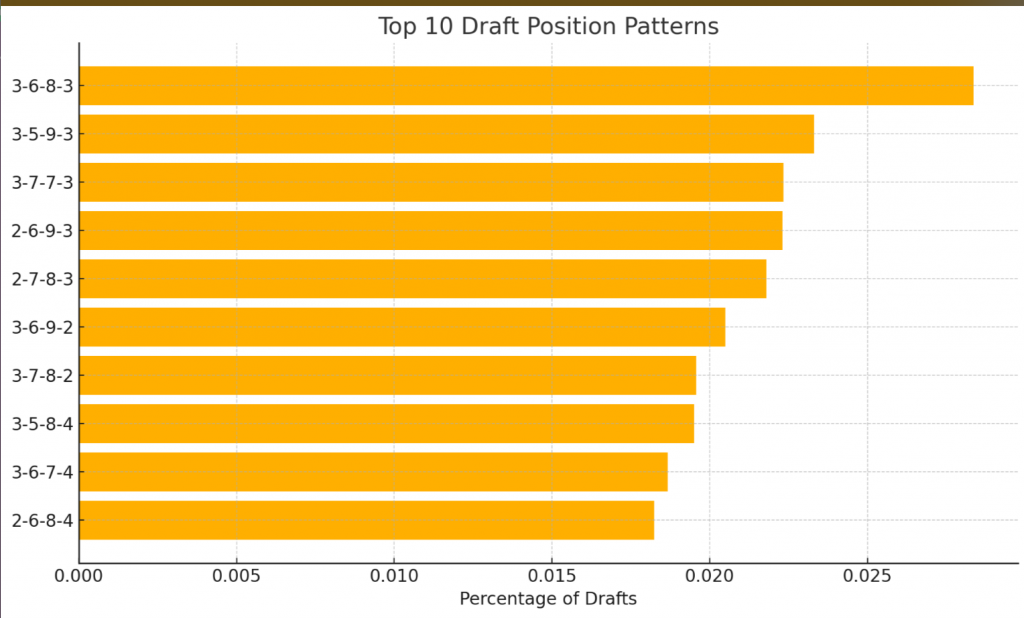
One of the more interesting insights is in how teams are usually drafted through the first three rounds (the format is QB-RB-WR-TE):
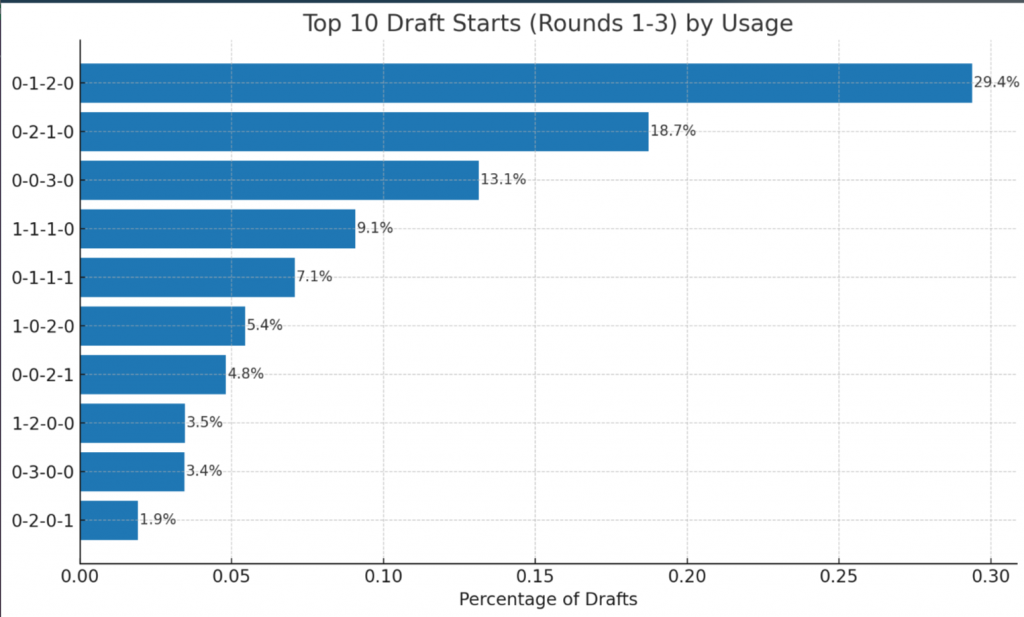
Almost 50% of drafts start with either two wide receivers and a running back or vice versa. Not coincidentally, that’s also probably the best way to draft from a point maximization standpoint.

However, going a different route could lead to some huge edges in the playoffs. Especially if drafting inside the first three or so picks. Since the same players are typically drafted in those spots, there will be plenty of teams with similar builds.

A highly contrarian way to get around that would be by drafting both a quarterback and a tight end inside of your first three picks. Spending that much draft capital early on those positions is a gamble, but if you get both right, you’d be in a small group of teams who have an elite player at both spots.

Josh Allen is ranked well above his ADP in our rankings, with his ADP putting him as an early Round 3 option. Somebody drafting from the first few spots could pair him with Brock Bowers or Trey McBride with a slight reach on the tight end, then load up on WR and RB for the next handful of rounds.

Three running backs (3.4%) is also a unique start I’m interested in. Given the high variance of receiver scoring, an elite RB room paired with a “WR by committee” approach is both unique and high-upside. Getting the right players takes some luck—but winning a tournament with nearly a million entrants always does.

Stacking

At this point, there’s nothing contrarian about stacking. The field is well-attuned to the idea that pairing quarterbacks with their pass catchers is an excellent way to increase correlation and reduces the number of things you have to get right in your draft.

Since that’s old news, we’ll be looking at how teams are stacked this season, with some potential options that are both unique and solid values based on our rankings.
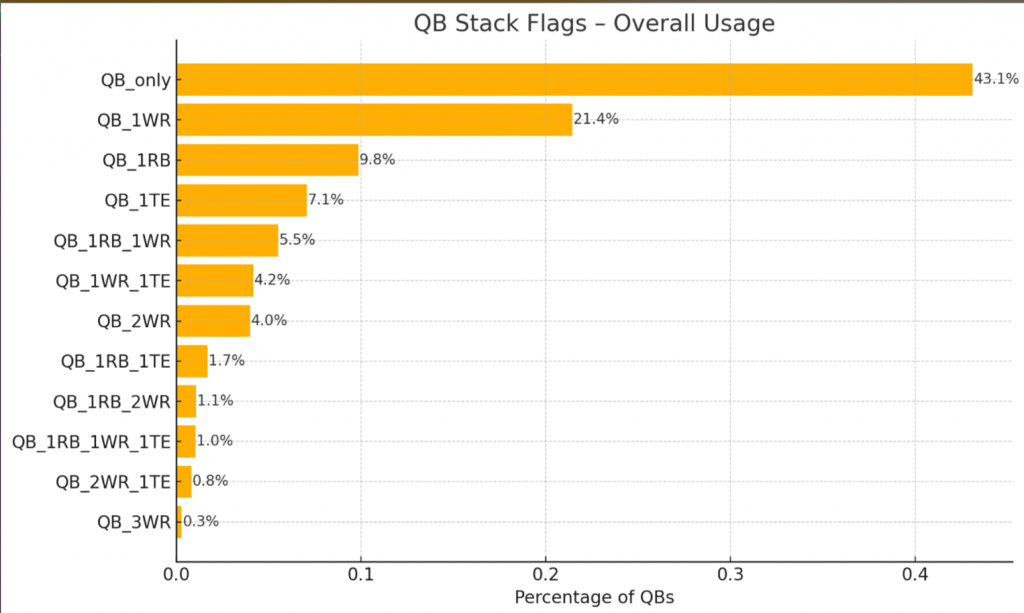
It stands out that despite the obvious nature of stacking, only 57% of QBs are paired with a teammate, and only just over a quarter are paired with more than one teammate.

Of course, stacking is easier said than done. Often you’re forced to either reach for one part of the stack or hope that player falls past their ADP. This data suggests reaching is probably a sharp move, especially on a QB when you already have two of his teammates.

Returning to Josh Allen, he’s paired with more than one teammate in just 22% of teams he’s drafted on:
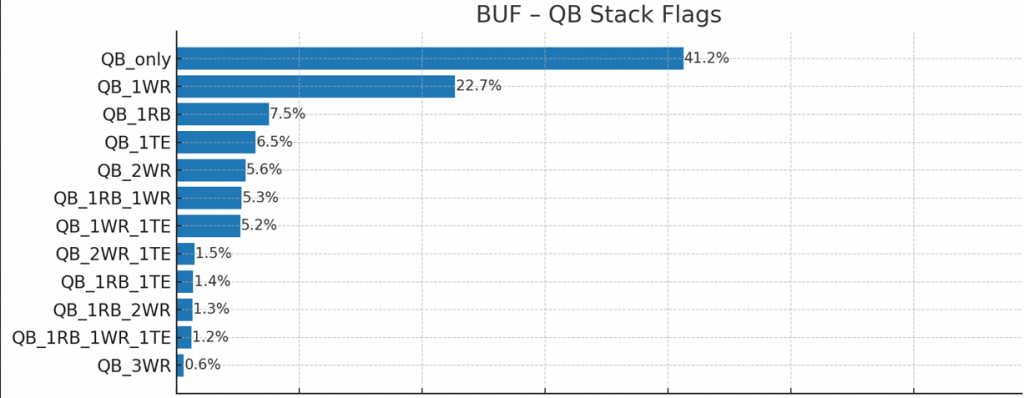
Since we’re showing ADP value on not only Allen, but also James Cook, Keon Coleman and Dalton Kincaid, reaching a bit on two or three of those players could be wise. Keep in mind, since only 8.33% of teams have Allen to begin with, that means less than 2% of teams overall have him paired with multiple teammates. That’s a great way to separate from the field.

Another team worth noting is the Bengals—less than 4% of Joe Burrow lineups include two WRs. If drafting from the first pick, starting with Chase and Tee Higgins (ADP of 25.63) and then reaching a bit for Burrow should be fairly unique.

On the flip side, Jared Goff is stacked at a considerably higher rate than most QBs. With Amon-Ra St. Brown, Jameson Williams, and Sam LaPorta all fighting for targets, there’s a chance Goff has a big year without producing any big scores from his primary pass catchers. We have Goff as the best value relative to ADP on the team. Consider him for a later round second QB option.

Overall Draft Structure

The final piece here is the total number of players drafted at each position. This one is harder to get an edge on — drafting more wide receivers than anyone else doesn’t mean any of those players are particularly contrarian, for example.

Still, it’s interesting data to have:
My biggest takeaway is that running backs are still probably being overdrafted, especially on full-PPR DraftKings. None of the 10 most common builds feature four or fewer backs, and the most common is to have six.

I’ll be making a point to look into some “Hero RB” style builds, where I draft one or two anchor backs at the top of the draft, then two or three handcuff-style players at the end.

This allows for more capital to be allocated elsewhere, while still providing a high ceiling if your early picks perform as expected.

Remember, it’s more valuable to draft handcuffs to other backs than the one you drafted. If you draft a first-round RB and they miss significant time, you’re unlikely to advance with their backup. However, if you take Saquon Barkley early and David Montgomery later, you now have two starters in the event Jahmyr Gibbs gets hurt.

To put it another way, the ceiling for two backs from the same team is one workhorse running back. The ceiling for drafting somebody else’s handcuff is two workhorses for the same draft capital.

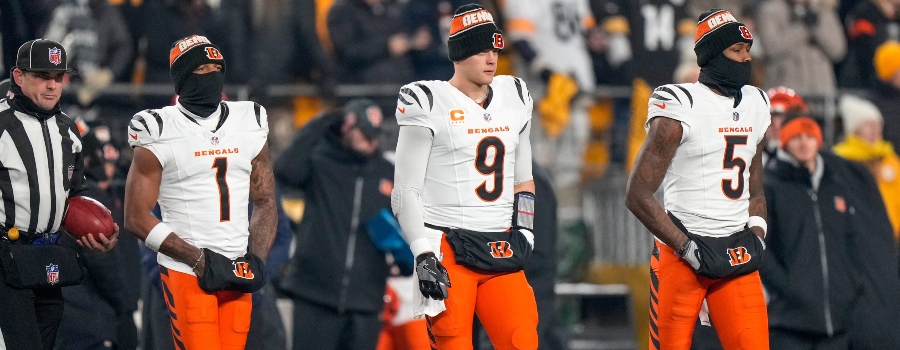
Pictured: Ja’Marr Chase, Joe Burrow, Tee Higgins

Photo credit: Imagn

Recently, DraftKings released pick-by-pick data for their Millionaire Maker NFL Best Ball contest. Naturally, this provides a robust data set for research purposes.

In this series, I’ll be using this data to highlight some potential strategies for Best Ball drafts this summer. It should be noted that DraftKings updates their data on a regular basis, so the exact numbers mentioned here won’t always be 100% accurate.

However, we can get a general sense of what players are drafted when — and in what combinations—which should allow for some insight into draft strategies.

While this data is specific to DraftKings’ Milly Maker contest, player behavior is broadly similar across other Best Ball operators as well as other contest types. A notable exception is that DraftKings uses a 20-round draft, while some other operators use less.

This time, we’ll be taking a look at some common roster constructions on DraftKings while we brainstorm ways to get unique—without reaching for bad picks.

Dominate your Best Ball and season-long fantasy football leagues with our brand-new app that’s available in the Apple App Store and on Android!

The Concept

In massive-field Best Ball tournaments like the DK Millionaire Maker, one of the most important goals should be to draft as unique a team as possible.

Due to the nature of the format, in which the winners of 12 team leagues are rolled into one massive field at the end of the “regular season,” there are tons of repeat lineups in the fantasy playoffs. That makes it hard to separate from the pack, since players that help your team also likely boost the competition.

For example, Ja’Marr Chase is drafted first in the majority of Best Ball drafts. If he exceeds expectations, lineups with him will form a disproportionate sample of the playoff field—which also means players drafted around the 2/3 turn will be overrepresented.

The point of this article is to find ways to differentiate from common builds like that without sacrificing value relative to our Best Ball Rankings. While uniqueness is a necessary condition for a huge score in Best Ball, it’s not a sufficient one. A unique build that doesn’t score enough points to advance is worth it.

Let’s take a look at a few common constructions and see what we can do to avoid them.

Starting Your Draft

Our friends at RotoGrinders—namely Chris Gimino analyzed the pick-by-pick data from DraftKings from a number of different angles.

One of the more interesting insights is in how teams are usually drafted through the first three rounds (the format is QB-RB-WR-TE):

Almost 50% of drafts start with either two wide receivers and a running back or vice versa. Not coincidentally, that’s also probably the best way to draft from a point maximization standpoint.

However, going a different route could lead to some huge edges in the playoffs. Especially if drafting inside the first three or so picks. Since the same players are typically drafted in those spots, there will be plenty of teams with similar builds.

A highly contrarian way to get around that would be by drafting both a quarterback and a tight end inside of your first three picks. Spending that much draft capital early on those positions is a gamble, but if you get both right, you’d be in a small group of teams who have an elite player at both spots.

Josh Allen is ranked well above his ADP in our rankings, with his ADP putting him as an early Round 3 option. Somebody drafting from the first few spots could pair him with Brock Bowers or Trey McBride with a slight reach on the tight end, then load up on WR and RB for the next handful of rounds.

Three running backs (3.4%) is also a unique start I’m interested in. Given the high variance of receiver scoring, an elite RB room paired with a “WR by committee” approach is both unique and high-upside. Getting the right players takes some luck—but winning a tournament with nearly a million entrants always does.

Stacking

At this point, there’s nothing contrarian about stacking. The field is well-attuned to the idea that pairing quarterbacks with their pass catchers is an excellent way to increase correlation and reduces the number of things you have to get right in your draft.

Since that’s old news, we’ll be looking at how teams are stacked this season, with some potential options that are both unique and solid values based on our rankings.

It stands out that despite the obvious nature of stacking, only 57% of QBs are paired with a teammate, and only just over a quarter are paired with more than one teammate.

Of course, stacking is easier said than done. Often you’re forced to either reach for one part of the stack or hope that player falls past their ADP. This data suggests reaching is probably a sharp move, especially on a QB when you already have two of his teammates.

Returning to Josh Allen, he’s paired with more than one teammate in just 22% of teams he’s drafted on:

Since we’re showing ADP value on not only Allen, but also James Cook, Keon Coleman and Dalton Kincaid, reaching a bit on two or three of those players could be wise. Keep in mind, since only 8.33% of teams have Allen to begin with, that means less than 2% of teams overall have him paired with multiple teammates. That’s a great way to separate from the field.

Another team worth noting is the Bengals—less than 4% of Joe Burrow lineups include two WRs. If drafting from the first pick, starting with Chase and Tee Higgins (ADP of 25.63) and then reaching a bit for Burrow should be fairly unique.

On the flip side, Jared Goff is stacked at a considerably higher rate than most QBs. With Amon-Ra St. Brown, Jameson Williams, and Sam LaPorta all fighting for targets, there’s a chance Goff has a big year without producing any big scores from his primary pass catchers. We have Goff as the best value relative to ADP on the team. Consider him for a later round second QB option.

Overall Draft Structure

The final piece here is the total number of players drafted at each position. This one is harder to get an edge on — drafting more wide receivers than anyone else doesn’t mean any of those players are particularly contrarian, for example.

Still, it’s interesting data to have:

My biggest takeaway is that running backs are still probably being overdrafted, especially on full-PPR DraftKings. None of the 10 most common builds feature four or fewer backs, and the most common is to have six.

I’ll be making a point to look into some “Hero RB” style builds, where I draft one or two anchor backs at the top of the draft, then two or three handcuff-style players at the end.

This allows for more capital to be allocated elsewhere, while still providing a high ceiling if your early picks perform as expected.

Remember, it’s more valuable to draft handcuffs to other backs than the one you drafted. If you draft a first-round RB and they miss significant time, you’re unlikely to advance with their backup. However, if you take Saquon Barkley early and David Montgomery later, you now have two starters in the event Jahmyr Gibbs gets hurt.

To put it another way, the ceiling for two backs from the same team is one workhorse running back. The ceiling for drafting somebody else’s handcuff is two workhorses for the same draft capital.

Pictured: Ja’Marr Chase, Joe Burrow, Tee Higgins

Photo credit: Imagn

About the Author

Billy Ward writes NFL, MLB, and UFC DFS content for FantasyLabs. He has a degree in mathematical economics and a statistics minor. Ward's data-focused education allows him to take an analytical approach to betting and fantasy sports. Prior to joining Action and FantasyLabs in 2021, he contributed as a freelancer starting in 2018. He is also a former Professional MMA fighter.