The first edition of this article covered how to build the best draft with a late pick. This time around, we’re going to switch things up and look at the best way to approach things when you have an early pick.
For the sake of this article, I’m mostly referring to a top three or so selection. One of the benefits there is it’s much easier to plan the early stage of your draft with one of the first picks, since there are fewer variables (in the form of your leaguemates’ selections) to account for.
That can be a big advantage, since you can then look further out to your next selection(s) based on your likely first pick. An even bigger advantage would be to use our rankings to identify the best available options with each of your picks — but I’ll be highlighting some potential options that stand out in those rankings here.
Don’t forget to sign up for your fantasy football league on Yahoo Sports!
Round 1
This is both the easiest pick to plan for and the one most dependent on your league’s scoring setting. For that reason, I’m splitting this into three sections, for full, half, and non-PPR leagues.
Full PPR: Best Available WR
Our three best projected Flex (WR, RB, or TE) players in full-PPR scoring are all wide receivers. That’s the biggest reason to simply take the best available of Ja’Marr Chase, Justin Jefferson, or CeeDee Lamb if you have a top-three pick.
It goes a bit deeper than that, though. One of the downsides to having an early pick is you don’t get another selection until late in the second round. That leads to your team being heavily dependent on that first pick to have any shot at competing.
With so many proverbial eggs in one basket, an injury to that player can be catastrophic — just ask people who drafted Christian McCaffrey first overall last season. With WR injury rates being so much lower than RBs, I feel much more confident with an early WR than RB — while that’s less of a concern with a later first-round pick, since pick #2 comes sooner.
Half PPR: Ja’Marr Chase or Best RB Available
Half-PPR leagues are probably the trickiest at the top. The best running backs, especially those that catch passes, tend to outperform the best wide receivers in half-PPR scoring settings. However, you still run into the risk mentioned above, where their injury rates are considerably higher.
Our projections have a fairly wide gap between Chase and the next best wide receivers, but a much tighter group of running backs. Effectively, Chase is in a tier of his own, while the three best backs are separated by less than ten points in our full-season marks.
For that reason, Chase is still my top priority if I have the #1 overall pick (or I’m drafting behind somebody who makes a mistake), but after that I’m looking at one of Saquon Barkley, Bijan Robinson, or Jahmyr Gibbs with that selection.
Standard Scoring: Best RB Available
However, in fully non-PPR leagues, the value of having one of the top running backs is too high to ignore. Our projections list the aforementioned three backs along with Derrick Henry in the top tier, with a relatively narrow gap between them.
While Barkley actually has the best projections, I’d prefer Robinson if drafting first overall in a non-PPR league. Barkley has higher upside, but Robinson is five years younger with more than 1,000 fewer NFL carries on his odometer.
That makes the injury risk somewhat lower on Robinson (or Gibbs) than veterans like Barkley or Henry, and I’d rather miss out on the top back by a point or two per game than lose my #1 pick for an extended period due to injury.
Dominate your Best Ball and season-long fantasy football leagues with our brand-new app that’s available in the Apple App Store and on Android!

Rounds 2 and 3
By definition, these two picks will be either very close together or back-to-back (if you draft #1 overall), so it’s important to have a few players in mind as your spot approaches.
The nice part is you’re much less likely to be sniped between picks by somebody drafting between your selections than with a mid-round pick, so you can plan appropriately for multiple picks to help fill out your roster.
I’m breaking this down by how I want my roster to look following my third pick in different league formats, since your first selection could be different based on those settings.

Full PPR: At Least Two Wide Receivers
In full PPR leagues, this is where you get to decide if you want to try a “zero RB” style draft. I’m a fan of that style of roster construction, but it relies on hitting on some late-round running backs that give at least moderate production.
The advantage to that system is it’s entirely possible to come away with the best WR and the best player at one of the “onesie” positions (QB and TE), which could give you enough total production that limited RB scoring doesn’t matter as much.
Late second and early third round picks are the perfect time to take a shot on Josh Allen or Lamar Jackson at QB and Brock Bowers, Trey McBride, or even George Kittle at tight end. Our projections show a nearly 20-point drop-off from Jackson and Allen to the next best QB and almost 30 points from Kittle to the TE4.
Comparatively, the running backs going in this range (Kyren Williams and Chase Brown) only project 5-7 points better than some you could likely get in the late fourth round, like Alvin Kamara, so it makes sense to wait.
Of course, with full PPR scoring, you certainly need two wide receivers through the first three rounds, so take the best available based on our projections there as well.
Half PPR or Standard: At Least One Running Back
If you missed out on a running back with your first pick in half PPR, be sure to come away with at least one at the 2/3 turn. While the projection drop-off isn’t as strong for backs as other positions, with the rest of your league drafting running backs higher, there’s a good chance that all of the viable starters will be gone by your pick in late Round 4.
From there, you’ve got plenty of flexibility. I still like the idea of grabbing a TE or QB if one of the top options is available (especially in the early third round), but two WRs and one RB or vice versa also make plenty of sense.
It’s also important to think about which backs and receivers you’re drafting, especially this high, based on your scoring system. As an example, both AJ Brown and Ladd McConkey have late second-round ADPs on Yahoo.
Brown is a stronger value in non-PPR leagues, since he typically puts up more yardage and touchdowns on a per-game basis, while McConkey should see more passing volume. We can apply the same exercise to running backs — Kyren Williams is our PPR RB11 but moves up two spots to RB9 in standard leagues.
This is why our customizable projections are so valuable. They’re based on simulating out every statistical category for each player, so you can get an accurate picture of their scoring in any format.
Middle Rounds: Draft For Value
The later we get into the draft, the less your draft slot matters. Enough players will have gone ahead of or behind their ADP that your educated guesses for who to draft aren’t especially applicable. For that reason, my analysis is mostly unchanged from the late-round draft slot article, but I’ve updated it where appropriate below:
If you were able to land two running backs you feel confident about in the first three rounds, this is where I’d load up on wide receivers. Especially in PPR leagues, their upside is much higher than running backs with a similar ADP, making them a better value.
In half or non-PPR leagues I do want to make sure I have my second back somewhere within the first five or so rounds, though. There’s a fairly significant drop-off after RB22 (David Montgomery) or thereabouts in our projections, and his tier is typically drafted by the middle of the fifth round. Since you have an early fifth-round selection, this is your last shot at a reasonably solid second RB starter.
I’m probably waiting on whichever “onesie” position I didn’t draft earlier, as the difference between the mid-tier QBs and TEs and the last players drafted is fairly insignificant. However, there are a few mid-range options with the potential to exceed that, especially at tight end.
Sam LaPorta was the overall fantasy TE1 as a rookie but had a down sophomore season. That was mostly due to a decreased passing rate from the 15-2 Lions, as well as some nagging injuries. With the Lions likely to take a step back and be forced to pass more and LaPorta healthy, he could be the top tight end again but is being drafted as TE4.
The case is similar for former Lion TJ Hockenson. He missed the first half of 2024 recovering from a torn ACL while playing for the 14-3 Vikings. Improved health and fewer team wins should both help him this year. He’s also due for some touchdown regression after being held scoreless on 41 catches last year.

Later Rounds: Draft For Ceiling
The double-digit rounds are the time in the draft where I tend to pivot more to drafting high-upside RBs.
Wide receivers need to be good in order to earn volume. Even if they’re thrust into a starting role, if they can’t get open, their QB won’t throw them the ball. Running back touches are given, though, and even less talented players can put up big fantasy scores.
You likely have at least 2-3 backs on your team at this point, who are all ideally starters for their real-life team. Now we’re looking for players who are one injury away from a starting role, with bonus points if they’re attached to a good offense.
I personally prefer drafting these “handcuff” backs that play on different teams than my starter, since that gives your roster way more upside.
Let’s say you started your draft with McCaffrey. By drafting his backup, Isaac Guerendo, if CMC goes down, you’ve now used a first and tenth round pick collectively to get somewhere around 80% of CMC’s healthy production.
If, instead, you draft Guerendo on a lineup that started with De’Von Achane, McCaffrey missing time means you have two high-end starters with similar draft capital invested. It’s a riskier strategy, since an Achane injury in this scenario leaves you with no backup plan.
We’re not playing to finish in the top half of our leagues though; we’re playing to win. With that in mind, it’s a far better strategy to shoot for the moon, especially since you can use a few picks in this range to select different backups.
Final Two Rounds: Team Defense and Kicker
Assuming your league uses either of these positions, there’s going to be a team or two in your draft that reaches for a top defense and maybe even a kicker. Don’t be that guy.
Both positions have extremely hard-to-predict scoring, as well as a small difference between the best and worst starting players. Our projections show just a 15-point difference between the top defense and the 12th best, so you’re losing out on less than a point per week by being the last person to draft one. The gap is even less at kicker (around 10 points), so that holds doubly true.
If your league doesn’t force you to draft a valid starting roster, I’d also consider stashing a few more backup RBs at this point. If no injuries occur in front of them by Week 1, you can simply drop them and grab the best available DST/kicker right before the season starts.
Plus, these are ideal positions to stream from. Kicker scoring heavily correlates with their team’s implied point total, while defensive scoring is correlated to the point spread (the more heavily favored a team, the better).
By keeping an eye on the Vegas lines, it’s usually fairly straightforward to get a starting-level player at this position on the weekly waiver wire.
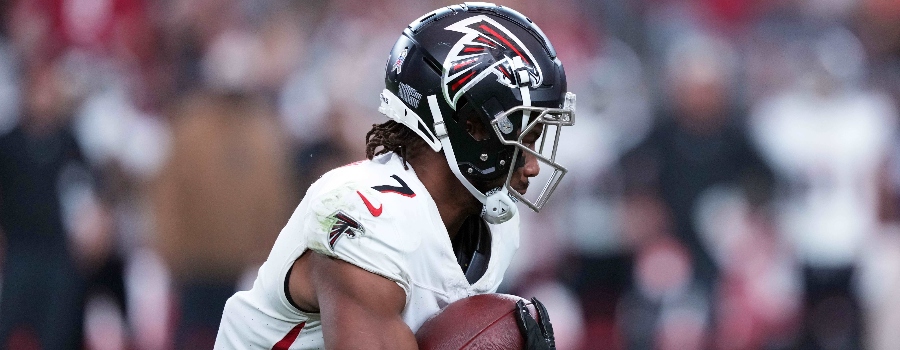
Pictured: Bijan Robinson
Photo Credit: Imagn