NFL DFS Super Bowl 60: Top Seahawks vs. Patriots Takeaways Using Our SimLabs Simulations

We’ve had NFL sims for a few years at this point, and it remains an invaluable tool, particularly for smaller slates. That’s especially true for Showdown contests, where balancing building unique lineups with strong projections is even more important than on main slates. From a pure Expected Value (EV) standpoint, a smaller chance of taking down first place solo is better than a larger chance of sharing 1st place with many other lineups.

Sure, we can look at ownership projections without a simulator. However, that’s only part of the story. Traditional ownership projections don’t factor in correlation. Not just in terms of player performance — which is relatively easy to sort out — but more importantly in terms of ownership within individual lineups. Some players may be popular individually but unlikely to appear together for a variety of reasons.

SimLabs solves that by simulating out thousands of potential opponent lineups to see where edges may lie. After experimenting with the tool for the Super Bowl Showdown slate on DraftKings, here are some of the lessons I’ve learned.

Become an All-Access Member Today

Lineup builder and optimizer

Real-time DFS models & projections

Data-driven analysis & tutorials
 

Defenses are Underrated

Probably my favorite feature of the SimLabs tool is the “Optimal vs. Projected Ownership” feature. Even if you prefer to build lineups by hand, it’s an excellent way to get an at-a-glance view of the best GPP plays on the slate.

What immediately stood out to me was the fact that the two top plays in that metric for the Super Bowl are the two team defenses. Perhaps surprisingly, the underdog Patriots are projecting just ahead of the favored Seahawks. They’re projecting for slightly fewer points overall but are both cheaper and expected to be less popular, which evidently makes up for the difference.

With that said, I wouldn’t recommend playing both defenses together. Opposing defenses have a slight negative correlation, but playing them both also limits you in terms of the other spots on your roster. Since defenses correlate negatively with offensive players on the other team, it’s hard to build viable lineups with two team defenses.

In extremely large-field contests like the $20 Super Bowl Million contest, one or two “double defense” rosters might make sense, but pair them mainly with wide receivers and tight ends. With full-PPR scoring, we want players who can catch passes, since PPR points don’t take much away from the opposing defense.

Leave Some Salary On the TableEspecially in Single Entry

This is more evergreen advice than specific to Super Bowl 60, but one of the simplest ways to build unique lineups is to leave an uncomfortable amount of salary unused in your lineups.

I tinkered with tons of lineups in SimLabs, and broadly speaking, the sims were more likely to leave salary on the table in single-entry or small-field contests than large-field ones. While this feels slightly backwards — the premium on unique lineups decreases with the size of the contest — it actually makes some sense.

Broadly speaking, the majority of the lineups entered in single-entry contests are hand-built, while in 15-max contests, the bulk of the lineups were constructed with some kind of optimizer or simulation. Those computer-generated lineups are more likely to leave salary on the table, which means there’s more of an edge doing so when your opponents aren’t.

Plus, there are a couple dozen single-entry contests on DraftKings for the game, so you could simulate 20+ single-entry lineups and spread them across various contests. With much of the field playing more conservatively with their one entry, this is an easy way to get some cheap upside.


Don’t Be Afraid to Get Weird

This primarily applies to the massive, top-heavy flagship contests where the majority of the money goes to first place. For example, the $20 Millionaire Maker awards more than 20% of the total prize pool to the first-place finisher, and second place is worth less than one-fifth of that. With that kind of structure, building a non-duplicated lineup is extremely valuable, even if it means taking some long shots.

Three of the top seven players in Optimal-Projected Ownership have sub-2% ownership projections, and that doesn’t even account for the team defenses, which are both in the mid-single-digit range. With six available roster spots, I want at least one sub-2% owned player in most of my lineups, including players with higher overall ownership but lower Captain utilization.

On top of that, unique pairings are also important. For example, you could play the Patriots defense with Sam Darnold (or the Seahawks defense and Drake Maye). The hope there is for a defensive touchdown, which only costs the offending QB a single point but gets the ball right back to them in a worse game script.

Another potential oddball combination is the Seattle defense with kick returner Rashid Shaheed, with the latter in the captain spot. A return touchdown from Shaheed would count for both him individually and the Seattle defense, plus he could rack up further points on offense. He’s projecting for less than 1% Captain Ownership, and probably shows up more in lineups with Darnold than his defense.

Those are just potential examples of underutilized groupings that you could lock in SimLabs, especially if you have a strong conviction about any of them. Of course, SimLabs takes aggregate ownership into account as well, so you could also trust the sims to handle it for you.

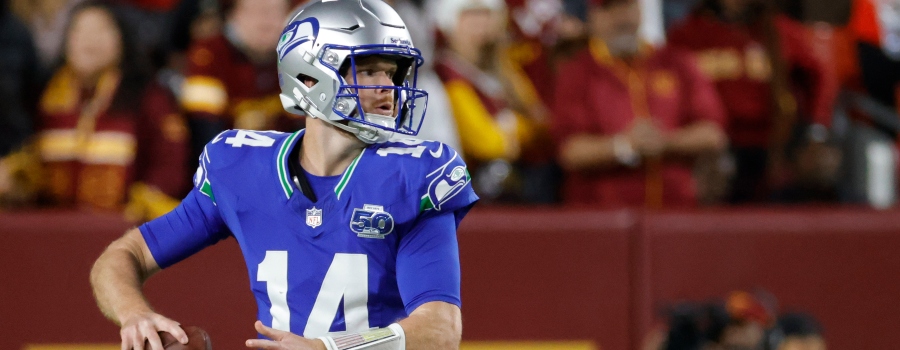
Pictured: Sam Darnold
Photo credit: Imagn

We’ve had NFL sims for a few years at this point, and it remains an invaluable tool, particularly for smaller slates. That’s especially true for Showdown contests, where balancing building unique lineups with strong projections is even more important than on main slates. From a pure Expected Value (EV) standpoint, a smaller chance of taking down first place solo is better than a larger chance of sharing 1st place with many other lineups.

Sure, we can look at ownership projections without a simulator. However, that’s only part of the story. Traditional ownership projections don’t factor in correlation. Not just in terms of player performance — which is relatively easy to sort out — but more importantly in terms of ownership within individual lineups. Some players may be popular individually but unlikely to appear together for a variety of reasons.

SimLabs solves that by simulating out thousands of potential opponent lineups to see where edges may lie. After experimenting with the tool for the Super Bowl Showdown slate on DraftKings, here are some of the lessons I’ve learned.

Become an All-Access Member Today

Lineup builder and optimizer

Real-time DFS models & projections

Data-driven analysis & tutorials
 

Defenses are Underrated

Probably my favorite feature of the SimLabs tool is the “Optimal vs. Projected Ownership” feature. Even if you prefer to build lineups by hand, it’s an excellent way to get an at-a-glance view of the best GPP plays on the slate.

What immediately stood out to me was the fact that the two top plays in that metric for the Super Bowl are the two team defenses. Perhaps surprisingly, the underdog Patriots are projecting just ahead of the favored Seahawks. They’re projecting for slightly fewer points overall but are both cheaper and expected to be less popular, which evidently makes up for the difference.

With that said, I wouldn’t recommend playing both defenses together. Opposing defenses have a slight negative correlation, but playing them both also limits you in terms of the other spots on your roster. Since defenses correlate negatively with offensive players on the other team, it’s hard to build viable lineups with two team defenses.

In extremely large-field contests like the $20 Super Bowl Million contest, one or two “double defense” rosters might make sense, but pair them mainly with wide receivers and tight ends. With full-PPR scoring, we want players who can catch passes, since PPR points don’t take much away from the opposing defense.

Leave Some Salary On the TableEspecially in Single Entry

This is more evergreen advice than specific to Super Bowl 60, but one of the simplest ways to build unique lineups is to leave an uncomfortable amount of salary unused in your lineups.

I tinkered with tons of lineups in SimLabs, and broadly speaking, the sims were more likely to leave salary on the table in single-entry or small-field contests than large-field ones. While this feels slightly backwards — the premium on unique lineups decreases with the size of the contest — it actually makes some sense.

Broadly speaking, the majority of the lineups entered in single-entry contests are hand-built, while in 15-max contests, the bulk of the lineups were constructed with some kind of optimizer or simulation. Those computer-generated lineups are more likely to leave salary on the table, which means there’s more of an edge doing so when your opponents aren’t.

Plus, there are a couple dozen single-entry contests on DraftKings for the game, so you could simulate 20+ single-entry lineups and spread them across various contests. With much of the field playing more conservatively with their one entry, this is an easy way to get some cheap upside.


Don’t Be Afraid to Get Weird

This primarily applies to the massive, top-heavy flagship contests where the majority of the money goes to first place. For example, the $20 Millionaire Maker awards more than 20% of the total prize pool to the first-place finisher, and second place is worth less than one-fifth of that. With that kind of structure, building a non-duplicated lineup is extremely valuable, even if it means taking some long shots.

Three of the top seven players in Optimal-Projected Ownership have sub-2% ownership projections, and that doesn’t even account for the team defenses, which are both in the mid-single-digit range. With six available roster spots, I want at least one sub-2% owned player in most of my lineups, including players with higher overall ownership but lower Captain utilization.

On top of that, unique pairings are also important. For example, you could play the Patriots defense with Sam Darnold (or the Seahawks defense and Drake Maye). The hope there is for a defensive touchdown, which only costs the offending QB a single point but gets the ball right back to them in a worse game script.

Another potential oddball combination is the Seattle defense with kick returner Rashid Shaheed, with the latter in the captain spot. A return touchdown from Shaheed would count for both him individually and the Seattle defense, plus he could rack up further points on offense. He’s projecting for less than 1% Captain Ownership, and probably shows up more in lineups with Darnold than his defense.

Those are just potential examples of underutilized groupings that you could lock in SimLabs, especially if you have a strong conviction about any of them. Of course, SimLabs takes aggregate ownership into account as well, so you could also trust the sims to handle it for you.

Pictured: Sam Darnold
Photo credit: Imagn
About the Author

Billy Ward writes NFL, MLB, and UFC DFS content for FantasyLabs. He has a degree in mathematical economics and a statistics minor. Ward's data-focused education allows him to take an analytical approach to betting and fantasy sports. Prior to joining Action and FantasyLabs in 2021, he contributed as a freelancer starting in 2018. He is also a former Professional MMA fighter.