One of my favorite pieces of content to make is my weekly review of the winning Millionaire Maker — or occasionally other large prize pool — lineup. While we (rightfully) spend most of our time looking forward to the next slate, reverse-engineering what works in GPPs is a valuable exercise to make us better DFS players.
Week 5 featured a smaller 10-game slate that still produced some massive scores in the standard $20 buy-in Millionaire Maker contest.
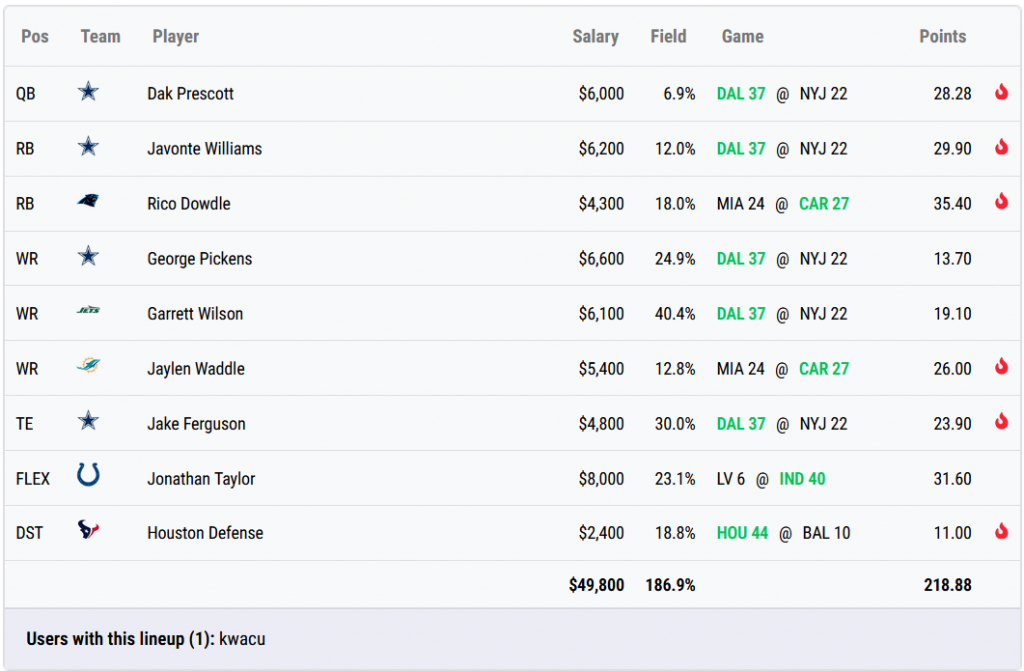
We finally had a small-portfolio player take down the Milly Maker this week, with user kwacu winning the grand prize on one of their three lineups. Their best lineup squeaked by with just a three-point margin of victory; let’s take a look.
The Lineup
The Stack
The most interesting thing about this lineup is how heavily stacked it is. Five of the eight offensive players all came from the Cowboys-Jets game, with four of them on the Dallas side. Stacking the game was a fairly common build in Week 5, but the way kwacu went about it probably led to much lower effective ownership than the individual ownerships imply.
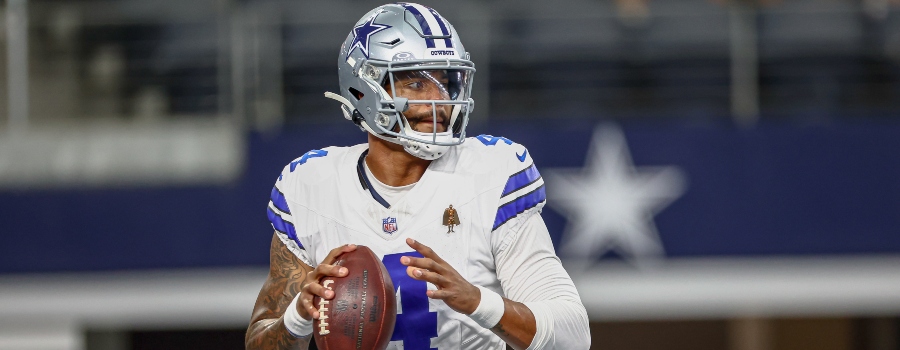
The most important pivot was going from the chalky Justin Fields to Dak Prescott at QB. Fields finished north of 30% ownership and was projecting as one of the obvious best plays on the slate against a bad Cowboys defense. For what it’s worth, this lineup still would’ve won (while saving $400 in salary) with Fields, so it was ultimately inconsequential — but Prescott scored higher at roughly one-fifth the ownership.
Ewacu then paired Prescott with his two top receiving targets, George Pickens and Jake Ferguson, who collectively have dominated the passing attack with CeeDee Lamb injured. I like double-stacking QBs like Prescott, who don’t offer much with their legs, since they probably will produce at least two GPP-winning scores if they’re able to throw for enough volume to get their own.
The bring back was the very obvious Garrett Wilson, who is the only bright spot of the Jets passing attack and came in at 40% owned. Of course, most of that 40% probably paired him with Fields, so the pool of people kwacu was competing against who used this pairing was much smaller.
The real unique piece, though, was Cowboys running back Javonte Williams. Typically we don’t see RBs included in game stacks like this unless they’re big pass catchers, which Williams certainly isn’t. However, this build worked in the scenario where Dallas built a lead through the air and then maintained it on the ground — which is exactly what happened.
It wouldn’t shock me if kwacu is just a big Cowboys fan who ranted to root for their team, but either way, this was a very unique roster to build. Still, I wouldn’t suggest loading up this heavily on one team in massive GPPs moving forward, as typically it’s hard to produce that many slate-winning scores with just one football to go around.


Other Correlations
The other correlated piece in this lineup was the opposing RB/WR stack of Rico Dowdle and Jaylen Waddle. Both Dowdle and Waddle were expected to see expanded roles due to injury coming into the game. Dowdle was too cheap for his starting role with Chuba Hubbard injured, and Waddle became the Dolphins’ de facto WR1 when Tyreek Hill went down.
Both of those predictions came true, with Waddle seeing a season-high nine targets and Dowdle turning 23 carries into more than 200 yards.
It was also convenient that both players benefited from the same gamescript — a Panthers lead meant more Carolina rushing and more Miami passing. While Carolina was technically a slight underdog coming in, the game was close to a coinflip, so it wasn’t a huge stretch to work out that way.
Plus, the Panthers and Dolphins are two of the league’s worst defenses, so banking on this game producing big scores was fairly reasonable, especially when we could be pretty confident where they’d come from.

The Chalk
The only “player” not yet mentioned here was Houston, who I pegged early as pretty obviously the best D/ST play. They were priced for a matchup with Lamar Jackson but instead faced Cooper Rush while simultaneously coming in as one of the league’s best defenses.
While they weren’t able to produce a touchdown on a slate where multiple other units did, their 11-point game was enough to see this lineup across the finish line. They didn’t finish as the best play — New Orleans outscored them for $200 less — but they certainly didn’t harm any lineups they were in.
Be sure to check out all the pick’ems Sleeper has to offer with our Sleeper Fantasy promo code.
The Sleepers
The only piece of this lineup with single-digit ownership was Prescott, whom we already discussed in the stack section. However, this lineup did a great job of being unique without forcing any bad plays. By overstacking one game, with a clear scenario where that would work out, they cut their effective ownership massively.
Plus, by using the less popular QB from that game, they moved past the majority of rosters stacking it if Prescott outscored Fields — which he did. That wasn’t a big reach, either, with the Cowboys coming in as favorites.
The most impressive thing about this build, though, is how few things it had to get right to win the GPP. Picking the nine best uncorrelated plays is like a nine-team parlay. This got that number down to three.
We could be reasonably certain ahead of time that the Cowboys pass offense would flow through Ferguson and Pickens, and the Jets through Wilson. Including Prescott and Williams was effectively just a bet that the Cowboys would get a lead through the air and hold it on the ground.
Waddle and Dowdle were also both obviously strong plays — if the Panthers got out to a lead and forced Miami to the air. That’s the second correct guess made by kwacu.
The third was then that the Texans would be (one of) the best D/ST plays, which, again, wasn’t all that bold of a call. Combining those three ideas turned $20 into a million — which is pretty great odds on a three-leg parlay of sorts.
Pictured: Dak Prescott
Photo Credit: Imagn
YOU MAY ALSO LIKE
 Week 2 NFL DFS QB Picks Breakdown: Derek Carr Week?
 Week 2 NFL DFS Cheat Sheet: Top Picks, Stacks, Lineup Optimizer Settings, Leverage Plays, More
 NFL DFS Picks: DraftKings Showdown Breakdown (Thursday, Nov. 16) for Bengals-Ravens on Thursday Night Football
 NFL DFS Leverage Picks on DraftKings for Week 10